
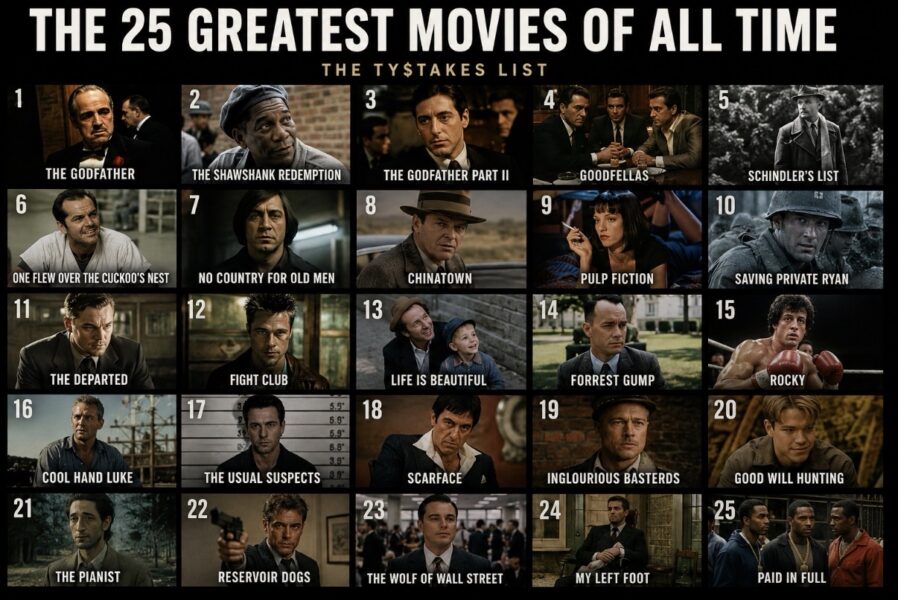
This is not a film-school checklist. This is a list built on story, emotion, acting, rewatchability, cultural impact, and the movies that still feel alive long after the credits roll.
Everybody has a movie list.
Some are built for awards.
Some are built for critics.
Some are built for film schools.
Some are built to look smart.
This one is different.
This is not about pretending every old classic automatically belongs near the top just because people have been saying it for 70 years. This is not about ranking movies only by Oscars, Rotten Tomatoes scores, box office totals, or what a professor would put on a syllabus.
This list is about what actually lasts.
The greatest movies should do something to you. They should make you feel like you stepped into a world. They should give you characters that feel real enough to argue about. They should have scenes you remember years later, lines you can still hear, performances that feel impossible to replace, and endings that make the whole story land.
A great movie does not have to be perfect. It has to be alive.
That is why this list leans into movies about power, loyalty, corruption, hope, survival, identity, family, betrayal, friendship, and downfall. It has gangster epics, prison dramas, war films, character studies, street stories, dark comedies, revenge fantasies, and movies that hit straight in the heart.
Some of these films are obvious all-time greats. Some are personal picks. Some are respected by everyone. Some are here because they mean something culturally, not just critically.
That is what makes the list honest.
This is the TysTakes Top 25 Movies of All Time.
25. Paid in Full
Putting Paid in Full at No. 25 is not about saying it is better made than every classic ever left off this list. It is about recognizing the kind of movie that lives with people.
Some movies have awards. Some movies have reputation. Paid in Full has culture.
It captures a world where money, loyalty, pride, and survival all collide. Ace, Mitch, and Rico are not just characters in a crime story. They represent different ways people respond to power. Ace wants control. Mitch wants status. Rico wants respect so badly that it becomes dangerous.
That is why the movie works. It is not only about drug money or street life. It is about how fast success can turn into pressure, how friendship can turn into jealousy, and how ambition can destroy people who thought they were finally winning.
It belongs on this list because it has something real. It has energy. It has quotability. It has warning signs. It has betrayal. It has that rise-and-fall feeling that connects it to bigger crime classics like Goodfellas, Scarface, and The Godfather.
No. 25 on a list like this is still a major honor. Paid in Full earns it because it is a movie people do not just watch — they remember.
24. My Left Foot
My Left Foot deserves a spot because of Daniel Day-Lewis.
That simple.
There are great performances, and then there are performances that become the entire reason a movie cannot be ignored. Day-Lewis as Christy Brown is one of those performances. He does not play him like an inspirational symbol. He plays him like a full person — angry, funny, difficult, brilliant, stubborn, vulnerable, and alive.
That matters.
A weaker movie would have turned Christy into a lesson. This one lets him be human. It shows his struggle without making him feel like a clean, easy hero. It shows dignity, but also frustration. Talent, but also pain. Love, but also conflict.
That is why the movie belongs here. It is not the flashiest film on the list. It is not the most rewatchable. But it has one of the strongest acting showcases ever, and sometimes one performance is powerful enough to carry a movie into history.
23. The Wolf of Wall Street
The Wolf of Wall Street is one of the wildest movies ever made about greed.
The genius of the film is that it does not make corruption look boring. It makes it look fun, hilarious, insane, and addictive — because that is how excess sells itself.
Martin Scorsese knows exactly what he is doing. He lets you feel the rush of Jordan Belfort’s world before showing how empty it is. The parties, the money, the speeches, the drugs, the sales floor, the yachts, the ridiculous confidence — it is all entertaining until you realize the whole thing is built on fraud, ego, and moral emptiness.
Leonardo DiCaprio gives one of his most fearless performances. He is not trying to make Jordan likable. He is making him magnetic, pathetic, funny, disgusting, and impossible to stop watching.
That is why the movie is important. It captures a modern kind of corruption — not dark rooms and quiet threats, but bright lights, salesmanship, status, and people cheering for the guy robbing them.
It is one of the best movies ever made about how greed becomes entertainment.
22. Reservoir Dogs
Reservoir Dogs is the movie that announced Quentin Tarantino had arrived.
It does not have a giant budget. It does not need one. The movie is mostly men in suits, a warehouse, a robbery we barely see, and dialogue sharp enough to cut glass.
That is the power of it.
Tarantino takes the heist movie and flips it inside out. Instead of showing the robbery, he shows the aftermath. The panic. The suspicion. The blood. The ego. The lies. The fear that somebody in the room is not who he says he is.
That makes the movie feel tight and dangerous. Every conversation has pressure under it. Every joke could turn into violence. Every character is performing toughness while the whole situation falls apart.
It belongs here because it changed independent crime films. It proved that style, voice, structure, and confidence could make a small movie feel massive.
21. The Pianist
The Pianist is one of the most haunting survival films ever made.
It is not loud about its greatness. It does not turn survival into a heroic speech. It shows survival as silence, hunger, fear, luck, loss, and the instinct to keep breathing when the world has collapsed.
Adrien Brody’s performance is devastating because it feels stripped down to the bone. He does not overplay the pain. He lets the emptiness show. His character survives, but the movie never lets survival feel simple.
That is what makes it so powerful.
The film belongs on this list because it understands that history is not only made of battles and speeches. Sometimes history is one person hiding, starving, listening, waiting, and trying to make it through one more day.
It is difficult to watch, but it has weight. And weight matters.
20. Good Will Hunting
Good Will Hunting is not great because Will Hunting is smart.
It is great because he is hurt.
The genius part gets people into the movie, but the pain is what makes it last. Will can solve impossible problems, but he cannot solve himself. He can outtalk people, embarrass people, push people away, and act like he does not care. But underneath all of that is fear — fear of love, fear of leaving, fear of becoming more than the life he knows.
Matt Damon gives Will anger and intelligence. Ben Affleck gives the movie friendship and loyalty. But Robin Williams gives it its soul.
His performance as Sean Maguire is one of the warmest and most human in modern film. He feels like a man who has suffered, not a character written to give advice. When he tells Will, “It’s not your fault,” the scene hits because the whole movie has been building to that moment.
This is a movie about talent, trauma, friendship, and finally letting somebody care about you.
That is why it belongs.
19. Inglourious Basterds
Inglourious Basterds is Quentin Tarantino at one of his boldest, strangest, and most entertaining levels.
It is a war movie, but not in the traditional sense. It is a revenge fantasy. A suspense thriller. A dark comedy. A movie about movies. And somehow, all of it works.
The opening scene alone is enough to earn the film serious respect. It is mostly a conversation at a table, yet it has more tension than most action scenes. Christoph Waltz as Hans Landa is charming, funny, polite, and terrifying. That mix makes him unforgettable.
Brad Pitt brings the movie its comic swagger, but Mélanie Laurent gives it its heart. Her story gives the film emotional purpose. She is not just part of Tarantino’s fantasy. She is the pain and revenge that drive it.
The movie belongs here because it understands cinema as power. In this world, movies do not just show history. They burn it down and rewrite it.
That is bold. That is memorable. That is why it lasts.
18. Scarface
Scarface is excessive, loud, violent, messy, stylish, and impossible to forget.
That is exactly the point.
Tony Montana is not a quiet character, and Scarface is not a quiet movie. It is a rise-and-fall story turned all the way up. Al Pacino plays Tony like ambition with no brakes. He wants money, power, respect, women, status, and control. But nothing is ever enough.
That is what makes the movie more than just a crime film.
It is about hunger turning into emptiness. Tony gets the mansion, the money, the name, and the fear of everyone around him. But the more he gains, the less human he becomes. His success isolates him. His pride destroys him. His dream becomes a cage.
The reason Scarface belongs is not because people quote it or put posters on walls, even though they do. It belongs because beneath all the style is a warning: if your whole life is about getting more, you may not recognize yourself when you finally have it.
17. The Usual Suspects
The Usual Suspects is built around one of the greatest endings in movie history.
But the ending only works because the whole movie is about storytelling.
Who is telling the truth? Who is lying? Who controls the version of events we believe? Those questions are what make the movie so compelling. It is not just a crime mystery. It is a magic trick about narrative itself.
The legend of Keyser Söze gives the movie its myth. Kevin Spacey’s Verbal Kint gives it its center. The film keeps pulling the audience along until the final reveal changes everything that came before it.
That is rare.
A great twist is not just shocking. It makes you want to replay the entire movie in your head. The Usual Suspects does exactly that.
It deserves this spot because it understands that sometimes the most dangerous weapon in a movie is not a gun.
It is a story well told.
16. Cool Hand Luke
Cool Hand Luke belongs because Paul Newman gives one of the coolest and saddest performances ever.
Luke is not a traditional hero. He is stubborn, reckless, funny, wounded, and impossible to fully control. He becomes a symbol because he refuses to let the system take his spirit.
That is the heart of the movie.
It is about rebellion, punishment, masculinity, loneliness, faith, and freedom. Luke keeps smiling, keeps pushing, keeps testing the limits. But underneath the charm is pain. He does not really have a plan. He just cannot surrender.
That makes the movie powerful.
The famous line — “What we’ve got here is failure to communicate” — became iconic, but the film is bigger than one quote. It is about what happens when a person refuses to be broken, even when breaking him becomes the whole point of the system.
It fits perfectly beside The Shawshank Redemption and One Flew Over the Cuckoo’s Nest. Different stories, same core idea: dignity matters, even when the world tries to crush it.
15. Rocky
Rocky is one of the greatest underdog stories ever because it is not really about winning.
It is about being seen.
Rocky Balboa is not chasing greatness at first. He is surviving. He is lonely. He is awkward. He is kind. He is a fighter, but he does not feel like a champion. He feels like a man life has almost passed by.
That is why the movie hits.
When Rocky gets his shot against Apollo Creed, the point is not that he has to win. The point is that he has to last. He has to prove to himself that he is not just some nobody from the neighborhood.
Sylvester Stallone wrote and played Rocky with real hunger. You can feel it. The movie has heart because it understands what it means to be counted out. It understands the dream of one chance.
The ending is perfect because Rocky does not care about the judges. He calls for Adrian. That tells you everything. The fight mattered, but love mattered more.
That is why Rocky still stands.
14. Forrest Gump
Forrest Gump is sentimental, but sentiment is not automatically a weakness.
Sometimes a movie lasts because it is open-hearted enough to reach people who do not usually talk about movies like critics.
Tom Hanks gives Forrest sincerity, innocence, and emotional clarity. The film moves through decades of American history, but its real subject is life itself — how random it can be, how painful it can be, how people come and go, and how love can stay with you even when it hurts.
Forrest does not fully understand the historical moments around him, but the audience does. That contrast gives the movie a strange kind of sadness. He moves through war, fame, loss, friendship, family, and grief while trying to hold onto the people he loves.
Is it perfect? No.
But greatness is not always about perfection. Sometimes it is about reach. And Forrest Gump reached millions because it made complicated things feel emotionally simple without making them meaningless.
That is why it belongs.
13. Life Is Beautiful
Life Is Beautiful should not work as well as it does.
A film that begins with comedy and romance before moving into the horror of the Holocaust sounds almost impossible to balance. But Roberto Benigni finds a way, because the movie’s heart is clear.
It is about a father trying to protect his son’s innocence in a world that has become evil.
That is what makes it devastating. The humor is not there to minimize tragedy. It is there to show love under impossible circumstances. Guido uses imagination as a shield. He cannot stop the cruelty around them, but he can try to keep his child from fully understanding it.
That idea is heartbreaking.
The movie earns this spot because it shows that hope can sometimes be an act of love. Not fake hope. Not easy hope. A desperate, beautiful, painful kind of hope.
It is one of the most emotional films on this list.
12. Fight Club
Fight Club is one of those movies that still feels dangerous because people keep arguing about what it means.
That is usually the sign of a film that hit something real.
David Fincher made a dark, stylish, angry movie about identity, consumer culture, masculinity, emptiness, and the desire to feel alive in a world that feels fake. It is not just about men fighting in basements. That is the surface. Underneath, it is about people who feel spiritually numb and mistake destruction for freedom.
Edward Norton is perfect as the exhausted narrator. Brad Pitt’s Tyler Durden is charismatic, funny, cool, and poisonous. That is the whole point. He is appealing because bad ideas often arrive with confidence.
The movie belongs here because it captured a very specific kind of modern frustration. It is messy, aggressive, quotable, and uncomfortable.
It does not ask to be liked.
It asks to be dealt with.
11. The Departed
The Departed is one of the most entertaining crime thrillers of the 2000s.
It moves fast, talks sharp, hits hard, and never lets the pressure drop.
At its core, the movie is about identity. Almost everyone is pretending to be someone else. Leonardo DiCaprio plays Billy Costigan like a man being eaten alive by his own undercover life. Matt Damon’s Colin Sullivan is the opposite — smooth, protected, and rotten underneath. Jack Nicholson turns Frank Costello into chaos in human form. Mark Wahlberg comes in with pure venom and steals every scene he touches.
What makes the movie work is the constant feeling that exposure is coming. Every phone call matters. Every conversation has danger underneath. Every character is trapped by the lie that keeps them alive.
It belongs this high because it is Scorsese doing what he does best: crime, guilt, loyalty, betrayal, violence, and people trying to survive worlds they helped create.
10. Saving Private Ryan
Saving Private Ryan deserves a top-ten spot because it is one of the most powerful war films ever made.
The opening D-Day sequence is unforgettable, but the movie is not great only because of its realism. It is great because of the question underneath it: what is one life worth?
Tom Hanks gives the film its moral center. Captain Miller is not a superhero. He is tired, scared, decent, and trying to do his duty in a world where duty can feel impossible. That is what gives the movie its power.
Spielberg does not make war look clean. He shows fear, confusion, courage, sacrifice, and cost. The movie honors soldiers without turning combat into fantasy.
It belongs here because it understands that heroism is not about being fearless.
It is about being afraid and moving anyway.
9. Pulp Fiction
Pulp Fiction changed the rhythm of modern movies.
It does not move like a normal crime film. It loops, pauses, wanders, explodes, jokes, and doubles back on itself. It is violent, funny, cool, strange, and completely confident.
Quentin Tarantino made dialogue feel like action. Characters talk about burgers, foot massages, miracles, loyalty, and nonsense — and somehow every conversation feels charged. John Travolta, Samuel L. Jackson, Uma Thurman, and Bruce Willis all become iconic inside a world that feels both artificial and alive.
The movie belongs in the top ten because its influence is impossible to ignore. After Pulp Fiction, everyone wanted sharper dialogue, nonlinear structure, better needle drops, and criminals who sounded like philosophers and comedians at the same time.
It is not just style.
It is style so strong it became its own language.
8. Chinatown
Chinatown is one of the greatest stories ever written for the screen because it understands corruption in a brutally honest way.
Jack Nicholson’s Jake Gittes thinks he is uncovering a mystery. He thinks if he can find the truth, the truth will matter. But the deeper he goes, the more he realizes that some systems are too powerful to be fixed by one man asking questions.
That is the darkness of the movie.
It is not just a detective story. It is about power protecting itself. It is about wealth, violence, family secrets, and the awful realization that justice is not guaranteed just because the truth comes out.
The ending is famous because it refuses comfort. It leaves a bruise.
Chinatown belongs this high because it is controlled, elegant, disturbing, and honest about the world in a way most movies are afraid to be.
7. No Country for Old Men
No Country for Old Men is one of the coldest and most perfectly controlled modern American films.
The Coen brothers strip the crime thriller down until it feels almost mythic. A man finds money. Another man comes for it. An old sheriff watches the violence unfold and realizes the world may have moved beyond his understanding.
Javier Bardem’s Anton Chigurh is one of the most unsettling villains ever because he does not feel like a regular criminal. He feels like fate. He has rules, but they are horrifying rules. He is calm, strange, and almost impossible to reason with.
Josh Brolin gives the movie tension. Tommy Lee Jones gives it sadness.
That sadness is what makes the film great. It is not only about murder or money. It is about aging, morality, evil, and the fear that the world has become too cruel and random to explain.
It earns this spot because it leaves silence where most movies would force answers.
6. One Flew Over the Cuckoo’s Nest
One Flew Over the Cuckoo’s Nest is funny, rebellious, heartbreaking, and painful.
Jack Nicholson gives one of the great screen performances as Randle McMurphy, a man who walks into an institution and brings life into a place designed to drain it out of people. He is not perfect. He is reckless, selfish at times, and wild. But he has spirit. And in that ward, spirit becomes dangerous.
Nurse Ratched is one of the greatest villains in film because she does not act like a villain. She is calm, controlled, polite, and terrifying. Her power comes from rules, pressure, and the ability to make people feel small.
The movie is about freedom, control, rebellion, masculinity, mental health, and the cost of refusing to disappear.
It belongs this high because the ending still hurts. It is not just sad. It is unforgettable.
5. Schindler’s List
Schindler’s List is not the kind of movie people casually throw on for entertainment.
That does not make it less great. It may make it more important.
Steven Spielberg made a Holocaust film with seriousness, restraint, and moral weight. It is devastating without feeling exploitative. It is beautifully made, but never in a way that makes horror look decorative. Every choice feels tied to memory.
Liam Neeson gives Oskar Schindler complexity. Ben Kingsley gives the film quiet dignity. Ralph Fiennes gives it one of the most chilling portraits of cruelty ever put on screen.
The movie belongs in the top five because it shows what cinema can do at its most responsible. It can remember. It can teach. It can force people to sit with history instead of looking away.
Some films entertain. Some films endure. Some films carry a responsibility.
Schindler’s List is one of them.
4. Goodfellas
Goodfellas is the gangster movie that makes the life look irresistible before showing how poisonous it really is.
That is what makes it brilliant.
Martin Scorsese does not open the movie by lecturing the audience about crime. He lets you feel why Henry Hill wanted in. The money. The clothes. The respect. The restaurants. The power. The thrill of being somebody. Then slowly, the dream turns into paranoia, violence, betrayal, and fear.
Ray Liotta gives Henry charm and weakness. Robert De Niro gives Jimmy quiet menace. Joe Pesci’s Tommy is funny until he is terrifying. Lorraine Bracco’s Karen is crucial because she shows how the life seduces people from the inside and outside.
If The Godfather is about power and family, Goodfellas is about addiction.
The addiction to status.
The addiction to danger.
The addiction to being untouchable.
It belongs at No. 4 because few movies have ever had this much speed, voice, energy, and truth about self-destruction.
3. The Godfather Part II
The Godfather Part II is one of the only sequels ever made that can stand next to the original without shrinking.
It is colder than the first film. Darker. More lonely. And that is exactly why it works.
The movie tells two stories at once. Young Vito Corleone rises from nothing and builds power through survival, patience, and intelligence. Michael Corleone, already powerful, loses more of himself trying to protect the empire he inherited.
That contrast is devastating.
Vito’s story has warmth. Michael’s story has ice.
Robert De Niro gives young Vito quiet dignity. Al Pacino gives Michael a terrifying stillness. He does not need to explode. He shuts down. His face becomes harder. His voice becomes colder. Every decision moves him further from the man he once was.
The movie is about family, betrayal, immigration, capitalism, loyalty, and loneliness. It shows the American dream from both sides — the rise and the cost.
It deserves No. 3 because it does something almost impossible. It expands a masterpiece and makes the tragedy even deeper.
2. The Shawshank Redemption
Some people may expect a darker or more “serious critic” pick at No. 2.
But movies are not only about technical greatness. They are about what they do to people. And few movies have reached people like The Shawshank Redemption.
It is a prison movie, but only on the surface. Deep down, it is about hope.
Andy Dufresne survives because he refuses to let Shawshank own his mind. Red survives because friendship teaches him how to believe again. The movie takes its time. It lets years pass. It lets pain settle. It lets hope feel earned.
That is why people love it.
Morgan Freeman’s narration gives the film warmth, wisdom, and sadness. Tim Robbins makes Andy calm, mysterious, and quietly unbreakable. Their friendship becomes the heartbeat of the entire story.
The reason this movie belongs at No. 2 is simple: everybody understands feeling trapped by something.
A place.
A mistake.
A fear.
A past.
A life that does not feel free.
The Shawshank Redemption tells people that hope is not foolish. Hope is survival.
That message is why it still hits. That message is why people keep watching.
1. The Godfather
The Godfather is the greatest movie of all time because it does everything a movie can do — and it does it with control, emotion, atmosphere, performance, tragedy, and truth.
This is not just about critics saying it is great.
You can feel why it is great.
From the opening wedding scene, the movie pulls you into a world that feels completely alive. Outside, there is music, dancing, food, family, celebration. Inside, there are whispers, favors, threats, and power. That contrast tells you everything.
This is a family celebration and a criminal headquarters at the same time.
That is the genius of The Godfather. It never separates love from power. It shows how close they can sit next to each other.
The movie is about crime, but it is not only a crime movie. It is about fathers and sons. Immigrants and America. Loyalty and corruption. Family and business. Protection and control. Love and fear.
At the center is Michael Corleone.
That is why the movie is No. 1.
Michael begins as the son who seems different. He is a war hero. He sits apart from the family business. He tells Kay, “That’s my family, Kay. That’s not me.” And at first, you believe him.
But the tragedy of The Godfather is watching that sentence slowly die.
Michael does not become the head of the family in one sudden leap. He changes step by step. First out of loyalty. Then revenge. Then strategy. Then power. Then control. By the time he becomes Don Corleone, he has convinced himself that every choice was necessary.
That is what makes it realistic.
Most people do not lose themselves all at once. They compromise piece by piece.
Marlon Brando’s Don Vito Corleone is one of the most iconic characters in movie history because he is not played as a simple villain. He is warm, dangerous, tired, wise, loving, and ruthless. He believes in family, but his version of family is tied to power.
Al Pacino’s performance is one of the greatest ever because so much of it happens quietly. His eyes change. His voice lowers. His face hardens. The warmth leaves him slowly. He does not just become powerful. He becomes unreachable.
And then comes the ending.
Kay asks him about Carlo. Michael lies. She wants to believe him. Maybe for a second, she does. Then she watches the men enter the room and kiss his hand. The door closes between them.
That door is everything.
It is the door closing on Kay.
The door closing on Michael’s old life.
The door closing on the man who said, “That’s not me.”
That is why The Godfather deserves No. 1.
It has the performances. The writing. The music. The cinematography. The atmosphere. The iconic scenes. The quotes. The legacy.
But more than anything, it has emotional truth.
It understands that power does not always arrive looking evil. Sometimes it arrives looking like duty. Like loyalty. Like family. Like protection.
And by the time you realize what it has cost, the door is already closed.
Key Takeaways
This list is not just built on critic reputation. It is built on story, emotion, acting, rewatchability, cultural power, and movies that still connect.
The Godfather earns No. 1 because it is the most complete film here — a crime story, family tragedy, American epic, and character transformation all in one.
The Shawshank Redemption ranks No. 2 because its message of hope connects with people across generations.
The Godfather Part II earns No. 3 because it expands the original masterpiece and shows the cold cost of power after the rise.
Goodfellas, Scarface, The Departed, Paid in Full, Reservoir Dogs, and The Wolf of Wall Street give the list a strong identity built around ambition, loyalty, betrayal, greed, and downfall.
The emotional balance comes from movies like Rocky, Good Will Hunting, Life Is Beautiful, Forrest Gump, Cool Hand Luke, My Left Foot, and The Shawshank Redemption.
The heavier historical weight comes from Schindler’s List, Saving Private Ryan, and The Pianist.
That mix is what makes the list feel personal and real.
Final TysTakes Thought
The greatest movies are not just the ones we respect.
They are the ones we feel.
They make us understand ambition, fear, hope, loyalty, corruption, grief, survival, friendship, love, and freedom. They give us characters who feel bigger than fiction because something about them feels true.
That is why this list matters.
Goodfellas shows the addiction of the life.
Scarface shows ambition eating itself alive.
No Country for Old Men shows evil moving through the world like fate.
Rocky shows what one chance can mean to a person nobody believes in.
The Shawshank Redemption shows hope surviving in a place built to kill it.
But The Godfather stands above them all because it takes the biggest themes — family, power, loyalty, America, love, betrayal, and corruption — and puts them inside one man’s transformation.
Michael Corleone does not start as the villain of his own life.
That is what makes it tragic.
He becomes that man one choice at a time.
And when that final door closes, the movie does not need to explain what happened.
You feel it.
Michael protected the family.
But he lost himself.
That is cinema.