
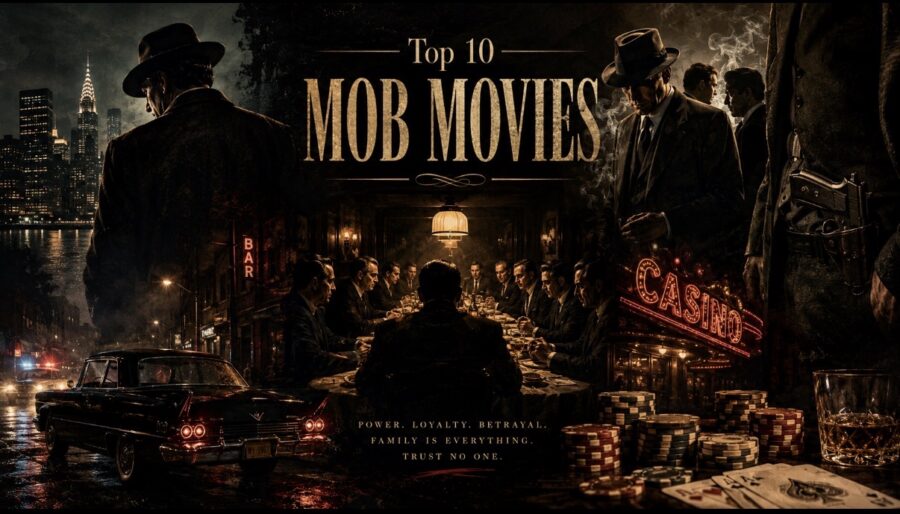
A TysTakes Ranking of Crime, Loyalty, Power, Betrayal, and the Films That Made the Mob Movie Legendary
Mob movies are not just about gangsters.
The best ones are about family, loyalty, ego, betrayal, fear, ambition, and the price of power. They show men trying to control the world around them while slowly losing control of themselves.
That is why the genre lasts.
A great mob movie is not just about who gets killed or who runs the streets. It is about what people are willing to become for money, respect, survival, or family. It is about the line between loyalty and blindness. It is about the way power can look beautiful from the outside and feel like a prison from the inside.
These ten films stand out because they do more than show crime. They show consequences.
10. Once Upon a Time in America
Directed by Sergio Leone
Once Upon a Time in America is not a fast mob movie. It is a haunting one.
This is a film about memory, regret, friendship, and the past that never really leaves. Sergio Leone takes the gangster genre and turns it into something almost dreamlike. The movie does not just follow crime. It follows time.
Robert De Niro plays Noodles, a gangster looking back on a life filled with ambition, betrayal, violence, and loss. What makes the film powerful is the way it feels like a man trying to understand his own memories. Some moments feel real. Some feel broken. Some feel like guilt rewriting the past.
This is not the clean rise-and-fall mob story. It is messier, sadder, and more reflective. It shows that the gangster life does not just destroy bodies. It destroys friendship, innocence, and the way people remember themselves.
Once Upon a Time in America belongs on this list because it is one of the most emotional gangster films ever made. It may not be the easiest watch, but it stays with you.
9. Carlito’s Way
Directed by Brian De Palma
Carlito’s Way is one of the great “trying to get out” crime movies.
Al Pacino plays Carlito Brigante, a former criminal who wants a second chance. He wants to leave the streets behind. He wants love. He wants peace. He wants to believe that the past does not have to own him forever.
But in mob movies, the past almost always finds a way back.
What makes Carlito’s Way so strong is that Carlito is not chasing more power. He is trying to escape the life that once defined him. That gives the film a different kind of tension. You are not watching a man rise. You are watching a man fight against being pulled back down.
Pacino gives Carlito a tired wisdom. He has been through enough to know the game, but he still believes he can beat it. Sean Penn’s performance as David Kleinfeld adds chaos around him, showing how one bad connection can drag a man back into danger.
Carlito’s Way is tragic because Carlito can see the ending coming before everyone else can. He knows the streets. He knows the people. He knows the mistakes. But knowing the trap does not always mean you can escape it.
8. The Departed
Directed by Martin Scorsese
The Departed is a mob movie built on lies.
Nobody is safe. Nobody is fully honest. Everybody is pretending to be something they are not.
Martin Scorsese takes the Boston crime world and turns it into a pressure cooker. This is not an old-school mob story about family tradition or honor. This is about paranoia, corruption, identity, and survival.
Leonardo DiCaprio plays Billy Costigan like a man whose nerves are being shredded scene by scene. He is undercover inside the mob, trying to survive without losing himself. Matt Damon’s Colin Sullivan is the opposite, a mob mole inside the police department, hiding behind confidence, charm, and a clean public image.
Then there is Jack Nicholson as Frank Costello, a gangster who treats fear like a business strategy.
What makes The Departed great is how modern it feels. There is no romantic code here. Loyalty is temporary. Trust is dangerous. Everyone is being used by somebody.
By the end, the movie feels like a warning: when everyone is living a lie, the truth usually arrives too late.
7. Casino
Directed by Martin Scorsese
Casino is about what happens when crime becomes corporate.
The suits are sharper. The money is bigger. The lights are brighter. But underneath the glamour of Las Vegas, the same old mob rules are still there.
Robert De Niro plays Sam “Ace” Rothstein, a gambling expert sent to run a casino with precision and control. Joe Pesci plays Nicky Santoro, the muscle who brings violence and ego into every room he enters. Sharon Stone gives one of the best performances in any mob movie as Ginger, a woman trapped between survival, addiction, love, and destruction.
What makes Casino so interesting is that it shows the mob at its most polished and its most unstable. Everyone wants control, but nobody can fully control greed, jealousy, or pride.
The casino is supposed to be a machine. Money goes in. Power comes out. But people are not machines. They get reckless. They fall in love. They get paranoid. They take things personally.
That is where everything falls apart.
Casino is not as tight as Goodfellas, but it is bigger, colder, and more brutal in its view of power. It shows that even when the mob goes legitimate on the surface, the violence underneath never really disappears.
6. American Gangster
Directed by Ridley Scott
American Gangster works because it is not just about crime. It is about business.
Denzel Washington’s Frank Lucas is calm, smart, disciplined, and terrifying because he does not need to act loud to be powerful. He builds an empire with strategy. He understands supply, demand, branding, loyalty, and fear. He carries himself like a CEO, but the company is built on drugs and death.
That contrast is what makes the movie so compelling.
Frank Lucas is not presented as some reckless street criminal. He is careful. He is patient. He knows how to move in rooms where people underestimate him. But the film also shows the cost of that empire. His success poisons communities, damages families, and proves that intelligence without morality can become dangerous.
Russell Crowe’s Richie Roberts gives the movie its other side. He is not perfect, but he represents a kind of stubborn honesty in a world full of corruption.
American Gangster belongs here because it expands the mob movie beyond the usual Italian-American crime world. It is still about power, loyalty, and empire, but from a different angle. It shows that the gangster story is also an American business story, just with blood on the money.
5. Scarface
Directed by Brian De Palma
Scarface is loud, wild, excessive, and unforgettable.
Tony Montana is not a quiet climber. He is a storm. He arrives with nothing and wants everything. Money. Respect. Power. Status. The world.
Al Pacino plays Tony like a man who is always fighting, even when no one is touching him. Every room feels too small for him. Every insult feels personal. Every success only makes him hungrier.
That is the tragedy of Scarface. Tony gets everything he thought would make him untouchable, and it only makes him more alone, more paranoid, and more dangerous.
The famous line, “The world is yours,” becomes the entire point of the movie. Tony believes that if he owns enough, wins enough, and scares enough people, he will finally feel complete.
But he never does.
Scarface is the American dream turned into a nightmare. It is not subtle, but it does not need to be. It is about ambition without peace, power without wisdom, and success without a soul.
That is why it remains iconic.
4. A Bronx Tale
Directed by Robert De Niro
A Bronx Tale is one of the most meaningful mob movies because it is not really about becoming a gangster.
It is about choosing what kind of man you want to be.
The story follows Calogero, a young kid growing up in the Bronx who is pulled between two father figures. His real father, Lorenzo, is a hardworking bus driver who believes in honesty, discipline, and doing things the right way. Sonny, the neighborhood mob boss, offers power, respect, confidence, and protection.
That is what makes the movie special. It is not just good versus evil. Sonny is not written like a cartoon villain. He has wisdom. He has charm. He teaches Calogero lessons about life, fear, and respect. But Lorenzo teaches him something deeper, that real strength comes from character, not intimidation.
The heart of the movie is that tension.
The street looks attractive. The mob looks powerful. Sonny looks untouchable. But Lorenzo understands something the street never fully admits: the working man has honor too.
A Bronx Tale deserves its place because it brings humanity to the genre. It shows how the mob can influence a neighborhood, a kid, a family, and a future. More than anything, it shows that the saddest thing in life is wasted talent.
3. Goodfellas
Directed by Martin Scorsese
Goodfellas might be the most electric mob movie ever made.
From the opening line, “As far back as I can remember, I always wanted to be a gangster,” the movie pulls you right into the life. The suits. The cars. The food. The clubs. The respect. The feeling that normal rules do not apply.
At first, it feels exciting.
Then it starts to rot.
That is the brilliance of Goodfellas. Martin Scorsese lets you feel the attraction before showing you the sickness. You understand why Henry Hill wants in. You understand why the life feels bigger than anything else. But slowly, the glamour turns into paranoia, addiction, betrayal, and fear.
Ray Liotta gives the movie its heartbeat as Henry Hill. Robert De Niro brings quiet calculation as Jimmy Conway. Joe Pesci’s Tommy DeVito is terrifying because he can go from funny to deadly in a second.
Unlike The Godfather, this is not about kings. This is about soldiers, hustlers, thieves, and climbers. It feels fast, funny, violent, and alive. It shows the daily rhythm of the mob, the jokes, the meals, the schemes, the money, and the sudden explosions of violence.
Goodfellas is entertaining until it becomes horrifying.
That is why it is a masterpiece.
2. The Godfather Part II
Directed by Francis Ford Coppola
The Godfather Part II is one of the greatest sequels ever made because it does not just continue the story. It makes the story deeper.
The film follows two timelines. One shows young Vito Corleone building power from nothing. The other shows Michael Corleone ruling the empire and becoming more isolated with every decision.
That contrast is what makes the movie unforgettable.
Vito’s story feels like survival. He comes from tragedy, poverty, and loss. He builds his power slowly, quietly, and intelligently. Michael’s story feels like a man freezing from the inside. He already has the empire, but the more he protects it, the more alone he becomes.
Al Pacino’s performance is terrifying because of how controlled it is. Michael barely has to raise his voice. His silence does the damage. His eyes tell you everything. He becomes colder, sharper, and more distant as the movie goes on.
This is a mob movie, but it is also a tragedy about legacy. One generation builds something to protect the family. The next generation protects it so ruthlessly that the family breaks apart.
That is the genius of The Godfather Part II.
It asks a brutal question: what is the point of winning the empire if you lose everyone inside the house?
1. The Godfather
Directed by Francis Ford Coppola
The Godfather is the greatest mob movie ever made because it is not just about the Mafia.
It is about America. Family. Loyalty. Power. Tradition. Business. Violence. And the quiet ways people justify becoming what they once said they were not.
At the center is Michael Corleone, one of the greatest character transformations in movie history. When the movie begins, he is the outsider. He is the war hero. He tells Kay, “That’s my family, Kay. That’s not me.”
By the end, that line feels almost tragic.
Michael does not become the head of the family all at once. That is what makes the movie so brilliant. His transformation happens step by step. He protects his father. He takes revenge. He enters the business. He makes cold decisions that sound practical, even necessary. Then, before you fully realize it, the man who wanted distance from the family has become the most ruthless Corleone of them all.
Marlon Brando’s Vito Corleone gives the movie its soul. He is powerful, but tired. Gentle with his family, but dangerous in business. He believes in loyalty, but his world is built on violence. That contradiction is what gives the movie its weight.
Everything about The Godfather feels controlled, the pacing, the shadows, the music, the performances, the writing. But what makes it number one is the way it understands the cost of power.
Every favor has a price.
Every family empire has blood in the foundation.
Every act of loyalty can become a step toward destruction.
That is why The Godfather still stands above the rest.
Key Takeaways
The Godfather is the greatest because it is the complete mob tragedy, a story about family, power, loyalty, and moral collapse.
The Godfather Part II is the deepest, showing how one generation builds an empire and the next generation becomes trapped inside it.
Goodfellas is the most electric, capturing the thrill, humor, violence, and sickness of mob life from the inside.
A Bronx Tale is the most personal, showing how the mob can shape a young man’s choices without making the story only about crime.
Scarface is the most iconic rise-and-fall story, a brutal warning about ambition without peace.
American Gangster brings a different kind of empire story, showing the gangster as businessman and the cost of success built on destruction.
Casino shows the mob at its most corporate, where money, control, ego, and violence all collide under the lights of Las Vegas.
The Departed modernizes the mob movie through paranoia, corruption, identity, and betrayal.
Carlito’s Way is one of the great tragic escape stories, about a man trying to leave the life before it pulls him back.
Once Upon a Time in America is the most haunting, turning the gangster film into a story about memory, regret, friendship, and time.
Final Thought
The best mob movies last because they are never only about crime.
They are about men who want respect and mistake it for power. They are about families that become businesses and businesses that become prisons. They are about loyalty that turns into silence, ambition that turns into violence, and dreams that turn into consequences.
That is why these ten movies matter.
They do not just show the underworld.
They show what happens when people build their lives around power, then realize too late that power takes something back.