
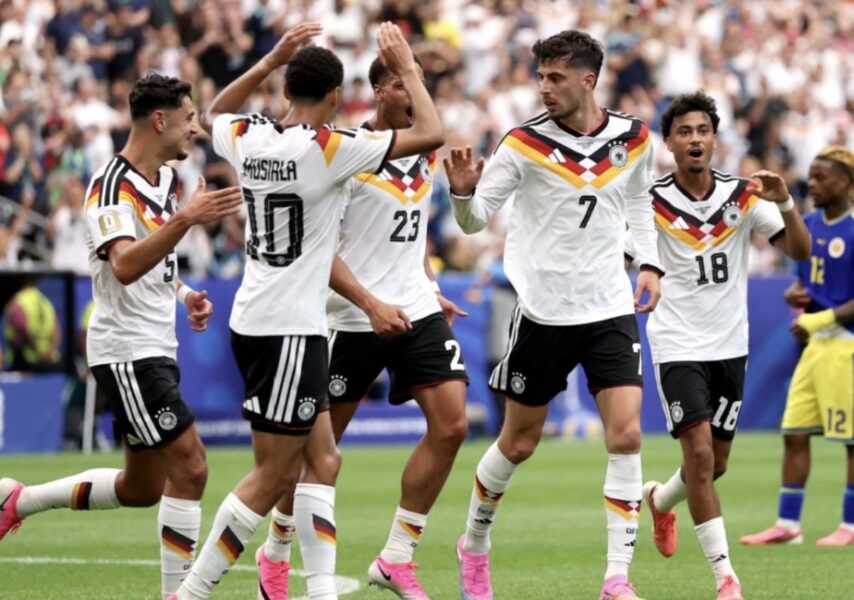
A 7-1 World Cup opener over Curaçao was more than a blowout. It was a reminder that when Germany finds rhythm, the entire tournament feels different.
Germany does not do quiet when it is serious.
It does not need drama.
It does not need noise.
It does not need to tell the world it has arrived.
It just puts seven goals on the board and lets everybody else figure out what it means.
That is what happened in Germany’s World Cup opener against Curaçao.
A 7-1 win.
A ruthless second-half performance.
A reminder that one of the most historic nations in the sport is not here to be part of the tournament.
Germany is here to threaten the whole thing.
For a moment, though, this match had a twist.
Curaçao did not come into this World Cup as just another team. They came in as a story. The smallest nation ever to appear at the tournament. A team carrying pride, history, and the kind of emotion that makes the World Cup different from every other sporting event on earth.
And when Livano Comenencia scored in the first half to make it 1-1, that was a genuine World Cup moment.
That goal mattered.
Not because it changed the final result.
Because it gave Curaçao something no scoreline can erase.
Their first World Cup goal.
Their first roar.
Their first moment where the whole world had to look at them and say, they belong here too.
But after that, Germany showed the other side of the World Cup.
The cruel side.
The side where a team can have its dream moment, and then a giant can wake up and bury it.
Germany did not panic after the equalizer. They did not get tight. They did not let the match become weird. They simply raised the level, moved the ball quicker, attacked with more purpose, and turned a beautiful underdog story into a reminder of how ruthless elite teams can be.
Kai Havertz was the face of that response.
Two goals.
Calm movement.
Smart positioning.
A performance that showed why he can be such an important piece for this German side. Havertz is not always the loudest player on the pitch, but when he is involved, Germany’s attack has a different shape. He can drop. He can link. He can arrive late. He can finish. Against Curaçao, he did exactly what Germany needed from him.
He made the game feel under control.
But the bigger story was the collection of talent around him.
Jamal Musiala.
Florian Wirtz.
Leroy Sané.
Joshua Kimmich.
A group with creativity, pace, control, and enough attacking options to overwhelm teams if the ball starts moving the way Julian Nagelsmann wants it to move.
Musiala and Wirtz are the two names that make Germany feel different now.
They are not just good players.
They are imagination.
They are the kind of players Germany has needed. The kind who can receive the ball in tight spaces, turn pressure into danger, and make a match feel unpredictable. For a national team that has sometimes looked too rigid in recent years, those two bring life.
Germany has always had structure.
Now it has flair.
That combination is dangerous.
And that is why this opener felt important.
Yes, Curaçao was overmatched. Nobody should pretend this was Germany beating France, Brazil, Argentina, or Spain. The opponent matters. The level of the test matters. There will be harder matches, tighter matches, more physical matches, and games where Germany will not get this much space.
But in a World Cup opener, you can only answer the question in front of you.
Germany answered loudly.
Seven goals loudly.
There is something psychological about a result like this. It settles nerves. It builds belief. It lets the attacking players feel the ball hit the net early in the tournament. It gives the coach options. It tells the rest of the group that Germany is not stumbling into this World Cup.
They are sprinting into it.
Group E already looks different now.
Ivory Coast is next for Germany, and that will be a more physical, more complicated test. Ecuador is waiting later in the group, too. Those matches will reveal more about Germany’s defensive discipline, their balance, and whether this attack can still function when the opponent has the athletes and organization to punch back.
But the first impression matters.
And Germany’s first impression was terrifying.
The most important thing was not just the score.
It was the mood.
Germany looked free. Germany looked aggressive. Germany looked like a team that wanted to punish every mistake. That is what great German teams have always done. They do not just beat you. They keep coming until the match feels completely out of reach.
That is what happened here.
At 2-1, Curaçao could still dream.
At 3-1, the match started slipping.
Then Germany turned the whole thing into an avalanche.
That is the word for it.
Avalanche.
Once the goals started coming, there was no pause, no mercy, no easing off. Just movement, pressure, finishing, and another reminder that Germany’s standard is different.
This is a four-time World Cup champion. A country built into the history of the tournament. When Germany is bad, it becomes a global story. When Germany is good, the whole bracket gets nervous.
After the last couple World Cups, Germany needed something like this.
They needed a performance that felt clean.
They needed a performance that felt powerful.
They needed a performance that made people stop talking about the past and start worrying about the present.
That is what 7-1 can do.
Still, the job is nowhere near finished.
A World Cup is not won in the first game. Germany knows that better than anyone. Big openers can fool teams. Easy wins can hide problems. A group-stage blowout can make everyone feel comfortable before the tournament punches back.
But this was not meaningless.
It was a statement.
Germany came into this World Cup needing to remind people who they are.
Against Curaçao, they did.
They reminded people that when the midfield starts controlling the tempo, when Musiala and Wirtz start creating, when Havertz starts finishing, and when the whole team starts moving together, Germany can still look like Germany.
And when Germany looks like Germany, the World Cup feels a little more dangerous.
For Curaçao, the night still gave them history.
For Germany, it gave them momentum.
And for everyone else watching, it gave them a warning.
The giant is awake.