
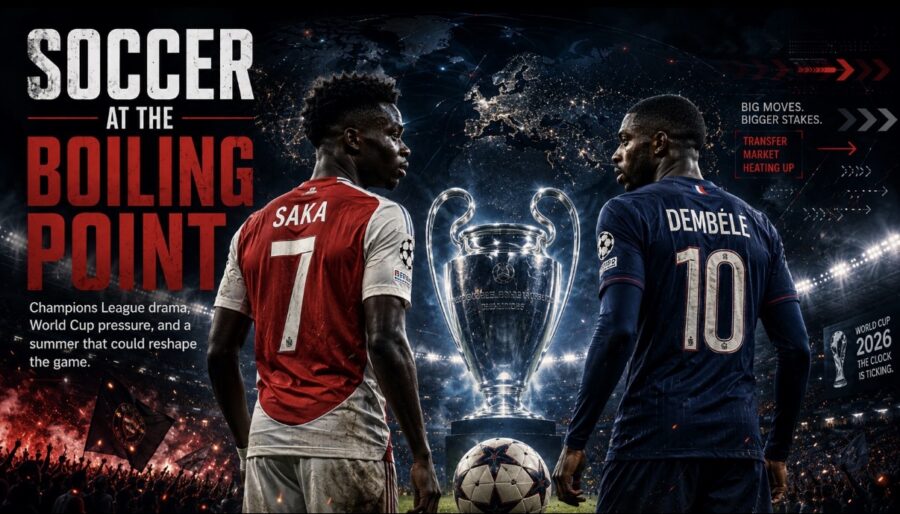
Soccer is entering one of those stretches where the sport feels bigger than the sport.
The Champions League final is here. The World Cup is close enough to feel real. Transfer rumors are already starting to shake Europe. And everywhere you look, the biggest clubs and biggest countries are either chasing history, protecting legacies, or trying to avoid being left behind.
Right now, the center of the soccer world is Budapest, where Arsenal and Paris Saint-Germain are set to meet in the 2026 UEFA Champions League final at the Puskás Aréna. For PSG, this is about defending their crown and proving last year was not just one perfect run. For Arsenal, this is about something deeper: validation. Mikel Arteta’s project has spent years building toward this kind of night, and now the Gunners are one win away from turning potential into European immortality. UEFA confirms the final is Arsenal vs. PSG at the Puskás Aréna, while Reuters reports Arsenal enter the match on a 14-game unbeaten run with David Raya recording nine clean sheets during that stretch. (UEFA.com) (Reuters)
That is what makes this final so interesting. PSG still has the flash, the pace, the attacking danger, and the confidence of a club that already knows what it feels like to climb the mountain. But Arsenal has the structure. They have the defensive backbone. They have William Saliba and Gabriel anchoring the back line, Declan Rice driving the midfield, and an identity that feels less like a hot streak and more like a machine built for pressure. Reuters also noted PSG coach Luis Enrique praised Arsenal’s high pressing, especially the work of Viktor Gyökeres up front. (Reuters)
This is not just a final. It is a collision between two versions of modern soccer.
PSG represents speed, danger, and star power. Arsenal represents control, discipline, and years of patient construction. One club is trying to stay on top. The other is trying to finally break through.
And while Europe is locked in on the Champions League, the rest of the soccer world is already staring at the next giant shadow: the 2026 FIFA World Cup.
This summer’s World Cup will be the biggest ever, with 48 teams, 104 matches, and three host nations: the United States, Mexico, and Canada. FIFA says it will be the first World Cup with 48 teams and the first hosted across three countries. That alone changes everything — more countries, more games, more chaos, more travel, more opportunity, and more pressure. (FIFA)
For American soccer fans, this is the moment the sport has been waiting for. The World Cup is not some faraway tournament happening across the ocean. It is coming to North America. The final will be at MetLife Stadium in New Jersey on July 19, 2026, putting the biggest match in the world right in the middle of the American sports landscape. (Fox Sports)
That matters.
Because soccer in the United States has always been waiting for the moment when casual fans stop treating it like a side event and start treating it like appointment viewing. A home World Cup has the power to do that. It can turn young players into household names. It can make new fans. It can turn one great U.S. run into a national sports moment.
But the World Cup is also putting pressure on the legends.
Argentina has already made headlines, with Lionel Messi leading the defending champions into another World Cup campaign. Reports say Lionel Scaloni named his final 26-man squad, with Paulo Dybala left out. That creates a brutal but fascinating storyline: Argentina is not just trying to celebrate the past. It is trying to defend it. (The Times of India)
That is the hard part about winning a World Cup. The first title makes you immortal. The next tournament asks if you can survive everyone chasing you.
Brazil has its own drama too. Neymar’s fitness is already being watched closely because of a calf issue, according to live soccer updates from The Guardian and Sky Sports. When Brazil enters a World Cup, the pressure is never normal. It is cultural. It is emotional. It is the weight of yellow shirts, old ghosts, and impossible expectations. (The Guardian) (Sky Sports)
Then there is the transfer market, which is already starting to rumble before the summer truly begins.
Barcelona has been linked with a major move for Newcastle winger Anthony Gordon, while Liverpool could be facing defensive changes with reports around Ibrahima Konaté’s future. ESPN also reported Bayern Munich are exploring a move for Juventus striker Dušan Vlahović, while Manchester United are tracking Botafogo’s Danilo. (The Guardian) (ESPN)
That is the other side of soccer right now. Even before the trophies are handed out and before the World Cup kicks off, clubs are already planning the next version of themselves.
Because modern soccer never really stops.
The Champions League final tells us who rules Europe right now. The World Cup will tell us who rules the world. The transfer window will tell us who is brave enough to change before they are forced to.
Key Takeaways
Arsenal vs. PSG is the biggest club match of the moment.
PSG is trying to defend its European crown, while Arsenal is trying to turn years of progress into the biggest trophy in club soccer.
The 2026 World Cup is already changing the sport’s energy.
With 48 teams, 104 matches, and North America hosting, this could be the biggest global soccer event ever.
The legends are under pressure.
Messi and Argentina are trying to defend their title. Neymar’s fitness is already a major storyline for Brazil.
The transfer market is about to explode.
Big clubs like Barcelona, Bayern Munich, Liverpool, Manchester United, and Juventus are already tied to major moves and rumors.
Final Take
Soccer right now feels like it is standing at the edge of something massive.
The Champions League final gives fans the drama of the present. The World Cup gives the sport the pressure of history. And the transfer market gives every big club a warning: stay sharp, or get passed.
That is what makes this moment so exciting. It is not just about one match, one country, or one superstar.
It is about soccer entering a summer where everything feels connected — legacy, pressure, money, ambition, and the chase to be remembered.
For fans, this is the good stuff.
The games are getting bigger. The stakes are getting louder. And the soccer world is about to remind everyone why no sport does drama quite like this one.