
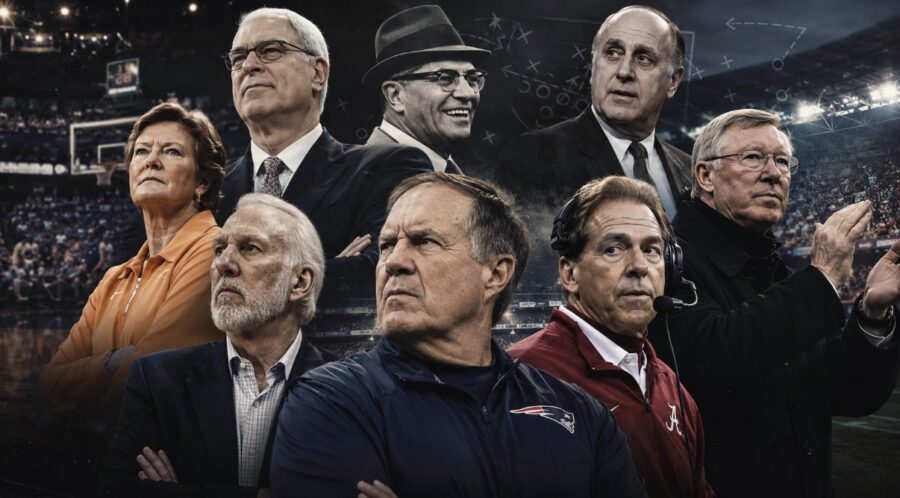
They did not just win games — they built worlds, shaped legends, and changed the way sports are played forever.
Great players can win a game.
Great coaches can change an entire era.
That is the difference.
The story of the greatest coaches ever is not just about rings, trophies, banners, or records. It is about the people who walked into a locker room and made everyone inside believe there was a higher standard waiting for them. They took talent and turned it into structure. They took pressure and turned it into fuel. They took chaos and made it look like destiny.
Every sport has its giants. The names are almost mythological now.
Phil Jackson sitting calmly while Michael Jordan, Scottie Pippen, Kobe Bryant, and Shaquille O’Neal turned basketball into theater. Bill Belichick standing on an NFL sideline in a gray hoodie, emotionless while the Patriots ripped apart another opponent’s weakness. Nick Saban stalking the Alabama sideline like every missed assignment was a personal insult. Vince Lombardi making football sound like a test of character. Gregg Popovich building a basketball culture in San Antonio that lasted longer than most dynasties even dream of.
They all looked different. They all coached differently. But they shared one thing.
They understood that winning starts before the game ever begins.
Phil Jackson: The Master of Managing Greatness
Phil Jackson may have had more talent than any coach in basketball history, but that is also what made his job so complicated.
Coaching Michael Jordan is not easy. Coaching Kobe Bryant is not easy. Coaching Shaq is not easy. Coaching all-time greats with massive egos, impossible standards, and championship expectations is not just about drawing up plays. It is about managing personalities that could swallow a normal locker room whole.
Jackson won 11 NBA championships as a head coach, the most in league history. But the number only tells part of the story.
His real genius was not just the triangle offense. It was emotional control. He understood rhythm, silence, pressure, ego, sacrifice, and trust. He knew when to speak and when to let the room breathe. He had a rare ability to make superstars feel both powerful and accountable.
With the Bulls, he helped turn Jordan from the greatest individual force in basketball into the centerpiece of a dynasty. With the Lakers, he took the tension between Kobe and Shaq and still turned it into three straight championships.
That is the mark of a legendary coach.
A good coach can teach a system.
A great coach can make legends buy into it.
Bill Belichick: The Coldest Football Mind Ever Built
Bill Belichick did not sell romance. He sold preparation.
No coach in modern football history became more connected to cold, ruthless, weekly adjustment than Belichick. His Patriots were not always the flashiest team. They were not always the most talented. But they were usually the most prepared.
That was the nightmare.
He could beat you in different ways. One week New England would throw 45 times. The next week they would run the ball into the ground. One Super Bowl would be about Tom Brady. Another would be about defense. Another would be about special teams, field position, and forcing the opponent to slowly lose patience.
Belichick’s genius was adaptability. He did not care about style points. He cared about finding the one thing you could not handle, then attacking it until the game cracked open.
Six Super Bowl wins as a head coach made him the defining NFL coach of the 21st century. But the real story is how long the machine lasted. The Patriots were not a one-year miracle. They were a two-decade standard.
In a league designed for parity, Belichick created repetition.
That might be his greatest achievement.
Nick Saban: The Emperor of College Football
Nick Saban did not just build great teams.
He built a factory.
At Alabama, Saban turned college football into a weekly inspection of excellence. Recruiting, practice habits, strength training, film study, discipline, depth charts, assistant coaches, player development — everything mattered. Nothing was too small. Nothing was allowed to slip.
His famous “process” became more than a phrase. It became the identity of a dynasty.
Saban understood something most people only say they understand: championships are not won on the final play. They are won in the boring, repetitive, exhausting work that nobody sees. The film session. The winter workout. The special teams drill. The freshman learning how to practice like a professional before he ever becomes a star.
That is why Alabama kept reloading. One Heisman winner would leave, another would arrive. One first-round pick would go to the NFL, another would take his place. The names changed, but the machine kept moving.
Saban’s greatness was not just winning titles. It was creating a program where winning felt like the expectation, not the surprise.
That is almost impossible to sustain.
He sustained it anyway.
Vince Lombardi: The Standard That Never Died
Vince Lombardi coached in a different era, but his name still feels larger than the sport.
That tells you everything.
Lombardi turned the Green Bay Packers into a symbol of toughness, discipline, and belief. His teams were physical, organized, and relentless. But his legacy became bigger than strategy. Lombardi became the voice of football’s old-school soul.
He represented the idea that winning required sacrifice. That preparation mattered. That accountability mattered. That a team could become more than a collection of players if it believed deeply enough in one standard.
The Super Bowl trophy is named after him for a reason.
Lombardi is not remembered only because he won. He is remembered because he made winning sound like a moral code.
His influence still echoes in every locker room speech, every training camp slogan, every coach who tells a team that details separate champions from everyone else.
Some coaches build teams.
Lombardi built an idea.
Gregg Popovich: The Culture King
Gregg Popovich never needed noise.
That was part of his power.
The San Antonio Spurs were not built on flash. They were built on trust, passing, patience, player development, international scouting, and a culture that made stars comfortable sacrificing for the group.
Tim Duncan was the perfect superstar for Popovich: quiet, brilliant, consistent, and completely committed to winning the right way. But Popovich’s greatness went beyond Duncan. He adapted across eras. He won with twin towers. He won with defense. He won with ball movement. He helped turn Tony Parker and Manu Ginóbili into Hall of Fame-level winners. He later created one of the most beautiful basketball teams ever with the 2014 Spurs.
That team did not just win. It flowed.
Popovich’s legacy is about culture. Players were coached hard, but they were also treated like full people. He built relationships. He challenged stars. He developed unknown players into important pieces. He made San Antonio one of the most respected organizations in all of sports.
Some coaches dominate through fear.
Popovich did it through trust, honesty, and standards.
Pat Summitt: The Giant Who Built More Than a Program
Any story about the greatest coaches ever is incomplete without Pat Summitt.
At Tennessee, Summitt became one of the most important figures in basketball history. Her impact went far beyond women’s college basketball. She built champions, but she also built confidence, discipline, and opportunity for generations of athletes.
She coached with intensity, but also with purpose. Her players did not just leave Tennessee with wins. They left prepared for life.
That is the rarest kind of coaching legacy.
Summitt proved that greatness is not limited to the size of the stage. Sometimes the coach makes the stage bigger.
She helped grow the women’s game. She demanded respect before it was always freely given. She carried herself with a force that made people pay attention.
The wins mattered.
The impact mattered more.
Red Auerbach: The Original Dynasty Builder
Before modern NBA dynasties, there was Red Auerbach.
The Boston Celtics became the league’s first true empire under his leadership. Auerbach understood talent, roles, toughness, and team chemistry before those ideas became sports clichés. He helped create the blueprint for championship basketball.
His Celtics were not just great because they had great players. They were great because everyone understood the mission. Bill Russell became the defensive soul of the dynasty. The team played with intelligence, sacrifice, and an edge that defined an entire era.
Auerbach was also ahead of his time in important ways, including his willingness to trust Black players and later Black leadership in a league and country still fighting through deep racial barriers.
His legacy is not just basketball success.
It is basketball architecture.
Sir Alex Ferguson: The Soccer Empire Builder
In global sports, few coaches ever controlled a kingdom like Sir Alex Ferguson controlled Manchester United.
For more than two decades, Ferguson built, rebuilt, and rebuilt again. That is what separated him from almost everyone else. Winning once is hard. Winning with one generation is harder. Winning across multiple generations is legendary.
He managed stars, developed young players, handled pressure from the English media, and kept Manchester United operating with the expectation that every season had to matter.
His teams had flair, toughness, late-game magic, and a terrifying belief that no match was over until the final whistle.
That became part of the club’s identity.
Ferguson’s greatness was not just tactical. It was psychological. His teams believed they were supposed to win. Opponents often felt it too.
That is when a coach becomes more than a coach.
That is when he becomes part of the opponent’s fear.
What All the Greatest Coaches Have in Common
The greatest coaches ever do not all share the same personality.
Some are calm. Some are fiery. Some are cold. Some are emotional. Some are teachers. Some are generals. Some are artists. Some are obsessed with control.
But they all share a few traits.
They see the game before everyone else does.
They get players to accept uncomfortable truths.
They turn talent into habits.
They make stars sacrifice without making them smaller.
They build cultures that survive bad nights, injuries, pressure, and doubt.
Most importantly, they understand that greatness is not just about the best player. It is about the best environment.
A great coach creates a place where winning behavior becomes normal.
That is the secret.
Key Takeaways
Phil Jackson was the greatest manager of superstar personalities basketball has ever seen.
Bill Belichick was the NFL’s master of preparation, adaptability, and weekly problem-solving.
Nick Saban built the most powerful modern college football machine by turning discipline into a dynasty.
Vince Lombardi became more than a coach — he became the symbol of football excellence.
Gregg Popovich proved culture, trust, and player development can build a dynasty without constant chaos.
Pat Summitt’s legacy reached beyond wins because she helped shape the future of women’s basketball and the lives of her players.
Sir Alex Ferguson showed that the hardest thing in sports is not reaching the top — it is staying there for decades.
Final Take
The greatest coaches ever were not great simply because they had great players.
They were great because they knew what to do with greatness once it walked into the room.
That is the difference between talent and dynasty. Talent gives you a chance. Coaching gives that chance direction.
Phil Jackson gave superstars peace. Bill Belichick gave football a machine. Nick Saban gave college football a standard. Lombardi gave the sport a soul. Popovich gave basketball a culture. Pat Summitt gave generations of players a path. Ferguson gave Manchester United an identity that felt bigger than any one season.
The best coaches do not just win trophies.
They leave fingerprints on the sport forever.
And years later, when the banners are dusty and the highlights turn old, that is what remains: the system, the standard, the belief, and the players who still carry their coach’s voice with them long after the final whistle.