
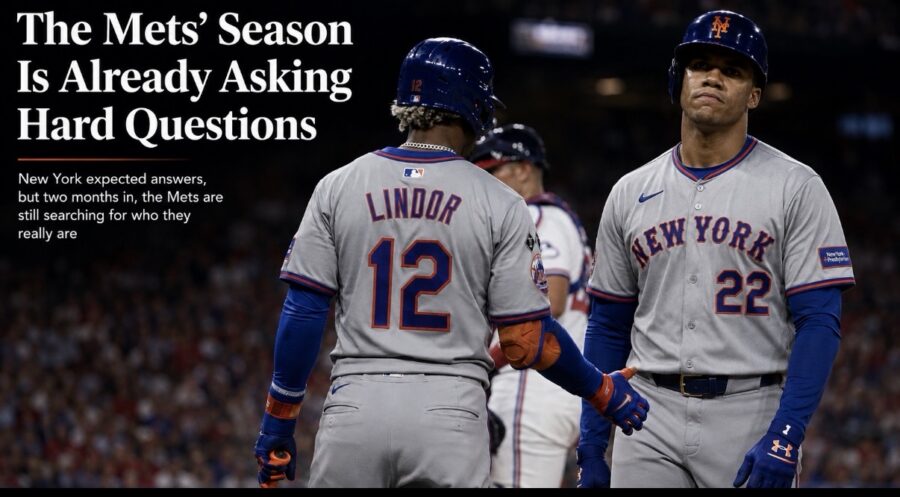
New York expected answers, but two months in, the Mets are still searching for who they really are
The Mets did not enter this season looking for more confusion.
They entered it looking for direction.
After another offseason filled with big decisions, bold moves, and familiar promises, New York was supposed to feel sharper. Cleaner. More complete. The kind of team that finally looked like it had a plan, not just a payroll.
Instead, two months into the season, the Mets are once again living in that uncomfortable place between hope and frustration.
They are 25-33, sitting last in the NL East. That record alone is enough to raise eyebrows. But the bigger problem is where it puts them. The Braves are 40-19, already creating real separation at the top of the division.
That means the Mets are not just having a slow start.
They are already chasing.
And in New York, chasing this early never feels quiet.
Baseball is long. A few good weeks can change the standings. A hot lineup can calm down the noise. A strong series can make everything feel possible again.
The Mets just showed that with a 6-1 win over the Marlins, their third straight victory. Christian Scott gave them five strong innings, struck out eight, allowed one run, and finally earned the first win of his big league career. That matters. So does getting contributions from different parts of the lineup. Mark Vientos had a two-run double. Marcus Semien added an RBI single. Jared Young and Hayden Senger both homered.
Those are the nights that make you pause before writing this team off.
But one good weekend does not erase the bigger question.
Who are the Mets supposed to be?
This was supposed to be a team with more balance. More stability. More answers in the everyday lineup. Instead, the season has already become a test of patience, identity, and front-office trust.
And nothing represents that pressure more than the Brandon Nimmo trade.
Nimmo was not just another player. He was homegrown. He was connected to the fan base. He represented years of Mets baseball through rebuilds, resets, collapses, comebacks, and everything in between.
Trading him for Marcus Semien was a statement.
The Mets were saying they were ready to move differently. They wanted a veteran presence. They wanted a different defensive structure. They wanted a shorter financial commitment and a new lineup fit.
But when a move like that does not work right away, it does not stay quiet in New York.
It gets louder every week.
The numbers are hard to ignore. Nimmo is hitting .270 with a .348 on-base percentage, a .434 slugging percentage, a .782 OPS, six home runs, and 18 RBIs with Texas. Semien is hitting .214 with a .263 on-base percentage, a .297 slugging percentage, a .560 OPS, three home runs, and 18 RBIs with the Mets.
That is not just a small difference.
That is the kind of gap that follows a team around.
Nimmo’s OPS is more than 220 points higher than Semien’s. Every quiet night from the Mets offense makes that comparison feel heavier. Every time Nimmo produces somewhere else, the question comes back.
Did the Mets make the right call?
That is what makes this season feel bigger than a normal slow start.
It is not just about losing games. It is about the decisions behind the losses. It is about whether the Mets have built something that can actually last, or whether they are still stuck chasing fixes that create new problems.
There are positives.
Christian Scott’s first career win gives the Mets something real to build on. He struck out eight Marlins over five innings and gave New York exactly the kind of start it needed. For a rotation searching for stability, that kind of outing matters.
A.J. Minter has also been one of the better signs for the bullpen. His 1.38 ERA with 18 strikeouts in 13 innings gives the Mets a reliable arm in a season where reliable has not always been easy to find.
But good moments are not the same as a clear identity.
That is where the Mets are stuck.
One night, they look like a team that can still make noise. The next, they look like a team trying to convince itself that the bigger issues are not really there.
The Braves look like the class of the division. The Phillies are still dangerous. The Nationals have been more competitive than expected. Even the Marlins have made the Mets earn everything.
That leaves New York in a difficult spot.
They are not just chasing wins.
They are chasing trust.
For Mets fans, that might be the biggest part of the story. This fan base has been through enough strange seasons, enough false starts, enough summer collapses, and enough “just wait until it clicks” talk to know that talent on paper does not always become winning baseball.
At some point, a team has to stop being interesting and start being dangerous.
The Mets are not there yet.
They have names. They have resources. They have flashes. They have enough pieces to make you pause before writing them off completely.
But they also have questions everywhere.
Can the offense become consistent?
Can Semien find himself before the trade becomes a season-long punchline?
Can the rotation give them enough innings?
Can the bullpen hold up?
Can this front office prove that its vision is more than just another version of the same Mets cycle?
That is the pressure of playing baseball in New York.
A bad week becomes a debate. A bad month becomes a referendum. A struggling veteran becomes a symbol. A trade becomes a verdict before the season even reaches summer.
Fair or not, that is the city. That is the market. That is the job.
The Mets still have time to change the story. That is the beauty of baseball. It gives you more chances than almost any sport. It gives you tomorrow after a bad night. It gives you another series after a rough one. It gives you six months to figure yourself out.
But time only matters if a team uses it.
Right now, the Mets are not just trying to fix their record.
They are trying to prove they have a real direction.
Key Statistics
The Mets are 25-33, last in the NL East.
The Braves are 40-19, giving Atlanta a major early lead in the division.
Brandon Nimmo is hitting .270 with a .782 OPS, six home runs, and 18 RBIs for Texas.
Marcus Semien is hitting .214 with a .560 OPS, three home runs, and 18 RBIs for New York.
Nimmo’s OPS is more than 220 points higher than Semien’s.
Christian Scott earned his first career win against Miami, striking out eight over five innings.
The Mets beat the Marlins 6-1 for their third straight victory.
A.J. Minter has posted a 1.38 ERA with 18 strikeouts in 13 innings.
Key Takeaways
The Mets’ biggest issue is not just their record. It is the feeling that the team still does not have a clear identity.
The Marcus Semien trade is becoming one of the main pressure points of the season, especially because Brandon Nimmo has been the better offensive player in Texas.
Christian Scott’s first career win gives the Mets something positive to build on, but one strong start does not erase the bigger questions.
The NL East is not waiting for New York. Atlanta has already created separation, and the Mets are playing from behind.
The season is not over, but the Mets need answers soon before “slow start” turns into another wasted year.
Final Thought
The Mets do not need to win the World Series in May.
They do not even need to have everything figured out by June.
But they do need to start showing people what this team is supposed to be.
Because right now, Mets fans are not just watching losses pile up. They are watching another season begin to ask the same uncomfortable question.
Is this team actually close?
Or are the Mets once again selling hope before proving they have a real plan?