
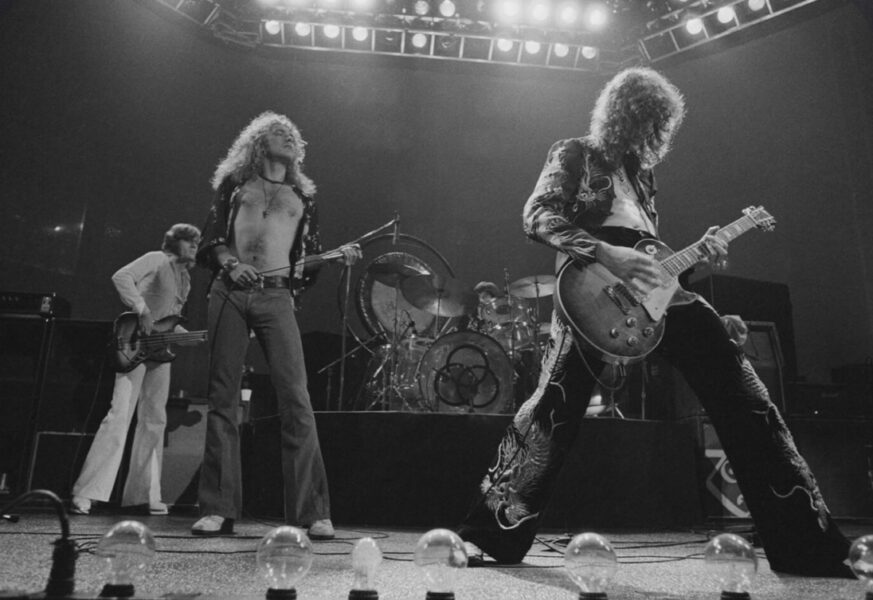
Some bands write songs.
Led Zeppelin built worlds.
They did not just play loud. Plenty of bands were loud. Zeppelin sounded enormous — like blues dragged through a storm, like folk music played on a mountain cliff, like rock and roll suddenly discovered it could be dangerous, mystical, beautiful, and completely untouchable all at once.
When Jimmy Page, Robert Plant, John Paul Jones, and John Bonham came together in 1968, rock music was already changing fast. The Beatles had opened the studio door. Hendrix had set the guitar on fire. Cream had stretched the blues into something heavier. The Rolling Stones had given rock its swagger.
Then Led Zeppelin arrived and made everything feel bigger.
Heavier.
Darker.
More powerful.
They were not just a band.
They were an event.
The Beginning: From the Yardbirds to Something Louder
Led Zeppelin did not start with a grand introduction.
It started with Jimmy Page trying to keep something alive.
Page had been part of The Yardbirds, one of the great British blues-rock bands of the 1960s. When that group fell apart, Page still had concert dates to play. So he began building a new lineup. He brought in bassist and keyboardist John Paul Jones, a brilliant musician with a sharp ear for arrangement. Then came singer Robert Plant, a young vocalist with wild curls, a huge voice, and the presence of someone born to stand in front of amplifiers. Plant recommended drummer John Bonham, a powerhouse from the Midlands whose playing could shake the floorboards loose.
At first, they were called the New Yardbirds.
That name did not last.
Soon, they became Led Zeppelin — a name that sounded strange, heavy, and impossible to ignore.
Perfect.
Because once they started playing, they did not sound like a normal rock band. They sounded like something taking off.
The Sound: Blues, Fire, and Myth
Led Zeppelin’s sound came from the blues, but it did not stay there.
Jimmy Page understood blues guitar, but he also understood drama. He knew how to build tension. He knew when to whisper and when to explode. His riffs did not just support songs — they became monuments.
Robert Plant sang like a man standing at the edge of some ancient battlefield. His voice could be seductive, wounded, wild, and almost supernatural. He did not just sing lyrics. He cast spells with them.
John Paul Jones was the secret weapon. While Page and Plant got the spotlight, Jones gave Zeppelin shape. Bass lines, keyboards, arrangements, texture — he was the steady mind inside the madness.
And then there was John Bonham.
Bonham did not play drums like he was keeping time.
He played like time was trying to keep up with him.
His kick drum hit like a cannon. His fills felt physical. He had power, but he also had groove. That is what made him special. He could crush a song without making it stiff. He swung. He stomped. He made Led Zeppelin feel like it had an engine made of thunder.
Together, they made music that could be heavy one second and delicate the next.
That was the trick.
Led Zeppelin could give you “Whole Lotta Love,” a riff so massive it feels carved out of stone.
Then they could turn around and give you “Going to California,” soft, searching, and almost fragile.
They could play the brutal stomp of “Immigrant Song,” then the haunted beauty of “The Rain Song.”
They were not one thing.
That is why they lasted.
The Riff That Changed the Room
When Zeppelin released their early albums, rock music got heavier almost overnight.
The first album introduced the blueprint: blues roots, massive riffs, explosive vocals, and a sense that the band was playing with no ceiling above them. Then Led Zeppelin II pushed it even harder. “Whole Lotta Love” became more than a hit. It became a warning shot.
The guitar riff alone sounds like trouble walking into a room.
It is simple, nasty, and unforgettable.
That was Zeppelin’s gift. They could make something feel ancient and futuristic at the same time. The blues had been around for decades, but in their hands, it sounded like it was being blasted through a machine built for the 1970s.
Critics did not always understand them at first.
Fans did.
That is usually how revolutions start.
Stairway to Heaven and the Burden of a Masterpiece
Then came “Stairway to Heaven.”
There are famous songs, and then there are songs that become part of the furniture of music history. “Stairway” became one of those.
It starts quietly, almost like a folk tale being told by candlelight. Then it grows. The drums enter. The guitar rises. Plant’s voice lifts the whole thing into the clouds. By the end, the song is no longer walking up a stairway.
It is flying.
“Stairway to Heaven” became Zeppelin’s most legendary song, but also the one that sometimes overshadows how deep the band really was. They were not just the band that made one epic classic-rock anthem. They were the band that made Physical Graffiti, Houses of the Holy, Led Zeppelin IV, and songs that still sound larger than most bands’ entire careers.
“Stairway” was not the whole story.
It was just the mountain peak everybody could see from miles away.
The Myth Around the Band
Part of Led Zeppelin’s power came from the mystery.
They were not over-explained. They did not feel like a band begging to be understood. They felt distant, almost untouchable. The album covers helped. The symbols helped. The fantasy imagery helped. The lack of singles in the early years helped. The massive concerts helped.
Zeppelin felt less like a pop act and more like a legend forming in real time.
And then there were the stories.
Hotels. Private jets. Wild nights. Excess. Rumors. Chaos. Some of it became rock mythology. Some of it became darker with time. Zeppelin represented the peak of 1970s rock-star power — the good, the bad, and the reckless.
That is part of telling the story honestly.
Their music was towering, but the world around them could be messy. The Zeppelin myth was full of brilliance and danger. That tension is part of why their story still fascinates people.
They sounded like gods.
They lived like men who sometimes forgot they were mortal.
The Live Force
To understand Led Zeppelin, you have to understand that their songs were never frozen.
Live, they stretched everything.
A song could become a journey. Solos expanded. Sections changed. The band followed each other through instinct and power. Page would bend a riff into a new shape. Plant would push his voice toward the edge. Jones would hold the architecture together. Bonham would drive the whole thing like a storm coming over the hills.
That is why Zeppelin concerts became legendary.
They did not just reproduce records.
They chased something.
Sometimes it was messy. Sometimes it was magical. Sometimes it was both.
But at their best, they made the stage feel too small for the sound coming out of it.
The Tragedy of John Bonham
Every great band has a center of gravity.
For Led Zeppelin, John Bonham was a huge part of that center.
On September 25, 1980, Bonham died at only 32 years old. His death ended Led Zeppelin. The surviving members could have tried to continue under the same name, but they knew the truth.
Without Bonham, it was not Led Zeppelin.
That decision matters.
A lot of bands replace members and move on. Zeppelin did not. They understood that the chemistry was the band. The four pieces together made the sound. Remove one, and the whole thing changes.
Bonham’s death turned Zeppelin’s story into something frozen in time.
There would be reunions and one-off performances, but the true Zeppelin era was over.
The thunder had stopped.
Why Led Zeppelin Still Matters
Led Zeppelin still matters because they changed the size of rock music.
They made hard rock heavier. They helped lay the foundation for heavy metal. They proved that albums could feel like worlds, not just collections of songs. They blended blues, folk, rock, funk, Eastern sounds, fantasy, and pure volume into something nobody else could fully copy.
That is the key.
Many bands tried to sound like Led Zeppelin.
Nobody really did.
Because Zeppelin was not just riffs. It was chemistry.
Page’s guitar needed Plant’s voice. Plant’s wildness needed Jones’ control. Jones’ structure needed Bonham’s force. Bonham’s thunder needed Page’s vision.
Four musicians. One storm.
That is why the music still hits.
Put on “Kashmir” and it does not feel old. It feels massive. It feels like a desert caravan crossing through a dream. Put on “When the Levee Breaks” and the drums still sound like the end of the world. Put on “Black Dog” and the groove still twists and punches like it was recorded yesterday.
Led Zeppelin did not age like a normal band.
They became part of rock’s foundation.
Final Thought
Led Zeppelin was not perfect.
No great rock story ever is.
But they were powerful in a way few bands have ever been. They took the blues, turned it up until the walls shook, wrapped it in myth, and made rock music feel larger than life.
They could be heavy, beautiful, reckless, mysterious, and unforgettable — sometimes all in the same song.
That is why Led Zeppelin still matters.
Because when their music hits, it does not feel like history.
It feels like thunder coming back.