
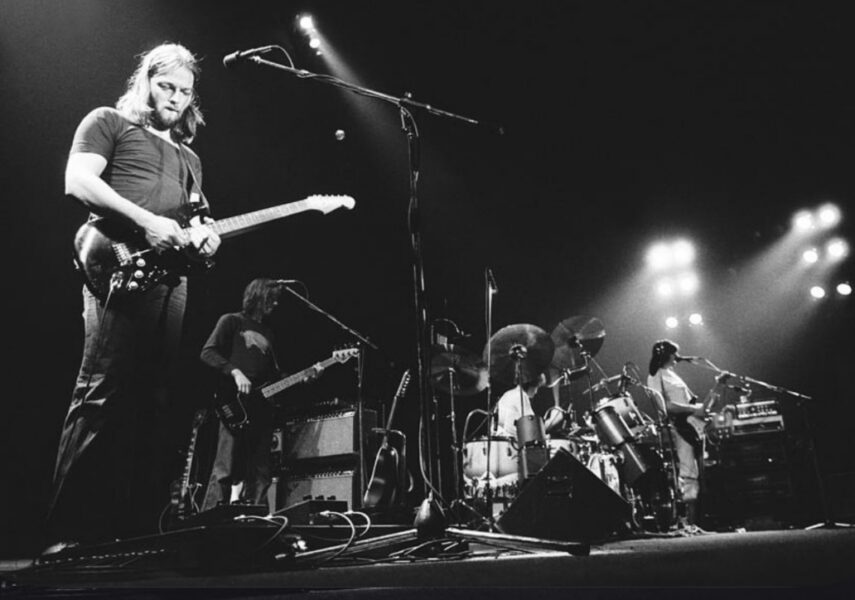
Some bands make songs you sing along to. Pink Floyd made songs you disappeared into!
They were not just a rock band. They were a mood, a world, a strange late-night feeling you could not fully explain. Their music sounded like loneliness in a stadium, like a heartbeat under a city, like someone staring at the ceiling at 2 a.m. wondering where their life went.
That was Pink Floyd’s power.
They did not always hit you with speed or swagger. They surrounded you. The clocks, the voices, the cash registers, the helicopters, the breathing, the long guitar solos, the slow-building tension — it all felt like more than music.
It felt like entering somebody’s mind.
And sometimes, that mind was breaking apart.
The Beginning: Psychedelic London and Syd Barrett’s Strange Spark
Pink Floyd began in London in the mid-1960s, when rock music was stretching into strange new shapes. The Beatles were experimenting. Dylan had gone electric. Hendrix was rewriting the guitar. Psychedelia was turning clubs into light shows and songs into hallucinations.
At the center of early Pink Floyd was Syd Barrett.
Barrett was the band’s first true visionary — brilliant, playful, mysterious, and fragile. He wrote songs that felt like nursery rhymes from another planet. Early Floyd was colorful, weird, and full of childlike imagination, with tracks like “See Emily Play” and the album The Piper at the Gates of Dawn giving the band its first identity.
But Syd’s story quickly became one of rock’s saddest.
As the band grew, Barrett’s mental health declined. His behavior became unpredictable. He would stare blankly onstage. He would struggle to perform. The person who helped invent Pink Floyd’s first sound was slowly slipping away from the band he helped create.
Eventually, David Gilmour joined, and Barrett was left behind.
That loss never really left Pink Floyd.
In a strange way, Syd Barrett became the ghost inside the machine.
David Gilmour Arrives and the Band Finds Its Sound
After Barrett’s departure, Pink Floyd had to figure out what they were without him.
That is where the band slowly became something bigger.
David Gilmour brought one of the most emotional guitar voices in rock history. He did not need to play a million notes. He could hold one note and make it feel like the sky was opening. His guitar did not just solo — it cried, floated, burned, and drifted.
Roger Waters became the band’s main conceptual force. He was sharp, intense, political, emotional, and unafraid to write about fear, greed, war, madness, death, and alienation.
Richard Wright gave Pink Floyd its atmosphere. His keyboards were the mist around the songs, the space between the stars, the soft colors that made the music feel endless.
Nick Mason held it all together with patient, steady drumming that gave the band room to breathe.
That was the magic.
Pink Floyd understood space.
A lot of bands tried to fill every second.
Pink Floyd knew the silence could be just as powerful as the sound.
The Dark Side of the Moon: When Anxiety Became a Masterpiece
Then came The Dark Side of the Moon.
Released in 1973, it became one of the defining albums in rock history. But what makes it incredible is not just its popularity. It is how human it feels.
The album is about pressure. Time. Money. Death. Madness. The things people chase. The things that break people down. The feeling of being alive in a world that keeps moving too fast.
And somehow, Pink Floyd turned all of that into music you could feel in your bones.
The ticking clocks of “Time” sound like life itself waking you up too late.
“Money” turns greed into a groove.
“Us and Them” feels like war, class, and human distance melting into one sad, beautiful song.
“Brain Damage” brings the madness close.
The album does not just ask what life means.
It asks what life costs.
That is why people still listen to it front to back. It does not feel like a collection of singles. It feels like a complete journey — one long thought that keeps circling back to the same fear:
What if the world is making us lose ourselves?
Wish You Were Here: A Goodbye to a Lost Friend
After Dark Side, Pink Floyd could have tried to make another giant commercial machine.
Instead, they made something lonelier.
Wish You Were Here came out in 1975, and it carried the shadow of Syd Barrett more directly than almost anything they ever made. The album is about absence — the people who disappear, the music business that eats artists alive, and the emptiness that success cannot fix.
At its heart is “Shine On You Crazy Diamond,” a long, haunting tribute to Barrett.
The song does not sound like a normal goodbye.
It sounds like someone trying to reach a friend through fog.
Gilmour’s guitar opens the track with a few notes that feel instantly recognizable — sad, distant, and almost glowing. The band takes its time. Nothing is rushed. The music feels like memory slowly forming in the dark.
Then there is the famous story: during the recording sessions, Syd Barrett unexpectedly appeared at Abbey Road Studios. He had changed so much that the band barely recognized him at first.
That moment feels almost too cinematic to be real.
The man who had once been Pink Floyd’s bright, strange spark walked into the room while they were making music haunted by his absence.
That is Pink Floyd in one scene.
Success, sadness, memory, and ghosts all standing in the same studio.
Animals: The Band Gets Darker
By 1977, Pink Floyd’s music had grown colder and angrier.
Animals was not cosmic like Dark Side or mournful like Wish You Were Here. It was sharp, bitter, and political. Loosely inspired by George Orwell’s Animal Farm, the album divided people into dogs, pigs, and sheep — predators, rulers, and followers.
It is one of their most underrated records.
The music is heavier. The lyrics are harsher. Waters’ anger is more obvious. The band sounds less like it is floating through space and more like it is staring down at society and not liking what it sees.
This was not peace-and-love psychedelic rock anymore.
This was Pink Floyd with its teeth showing.
The Wall: Fame Becomes a Prison
Then came The Wall.
Released in 1979, it became one of the most ambitious rock albums ever made — part album, part psychological breakdown, part anti-war statement, part rock opera.
Roger Waters built the story around Pink, a rock star who slowly isolates himself from the world brick by brick. Childhood trauma, school cruelty, fame, war, grief, and emotional numbness all become part of the wall he builds around himself.
It was personal, theatrical, and massive.
“Another Brick in the Wall, Part 2” became the anthem everyone knew, but the album is much deeper than that. “Comfortably Numb” became one of the band’s greatest achievements — Waters’ cold, detached lyrics meeting Gilmour’s soaring guitar solo, creating one of the most unforgettable emotional contrasts in rock.
That song is Pink Floyd at their best.
The words feel trapped.
The guitar feels like escape.
And that is the whole story of The Wall.
A man is sealed inside himself, but the music keeps trying to break out.
The Conflict Inside the Machine
Pink Floyd’s greatness came with tension.
Roger Waters and David Gilmour became two major creative forces pulling in different directions. Waters brought the concepts, the anger, the storylines, the sharp political edge. Gilmour brought the voice, the guitar, the melodic beauty, the emotional lift.
Together, they made magic.
But that magic became harder to hold.
By the 1980s, the band was fractured. Waters eventually left, leading to years of bitterness and legal battles over the Pink Floyd name. Gilmour, Mason, and Wright continued without him, and the band entered a new era.
Fans still debate the divide.
Was Pink Floyd more Waters’ vision or Gilmour’s sound?
The truth is probably what makes the band so great:
It needed both.
Waters gave Pink Floyd its brain.
Gilmour gave it its soul.
Wright gave it its atmosphere.
Mason gave it its pulse.
Take one part away, and the machine still runs — but it does not feel exactly the same.
Why Pink Floyd Still Matters
Pink Floyd still matters because they made music for people who feel too much and do not always know how to say it.
They wrote about anxiety before everyone talked openly about anxiety. They wrote about isolation, greed, time, madness, war, fame, and emotional distance without making it sound like a lecture.
They made those feelings into sound.
That is why their music keeps finding new generations.
A teenager can hear “Time” and suddenly understand the fear of wasting life.
Someone grieving can hear “Wish You Were Here” and feel less alone.
Someone angry at the world can hear Animals and feel the bitterness sharpen.
Someone emotionally numb can hear “Comfortably Numb” and realize the song is not just about a character.
It is about them.
Pink Floyd did not just make albums.
They made mirrors.
Final Thought
Pink Floyd was never just background music.
It was the sound of drifting too far into your own head and finding something beautiful there.
They took rock music and turned it into architecture — walls, moons, machines, dreams, echoes, and empty spaces big enough for millions of people to step inside. They proved that a song could be slow and still powerful, strange and still emotional, massive and still deeply personal.
That is why Pink Floyd still feels different.
Because when their music plays, it does not just fill the room.
It changes the room.
And for a little while, you are not just listening to Pink Floyd.
You are inside the dream.