
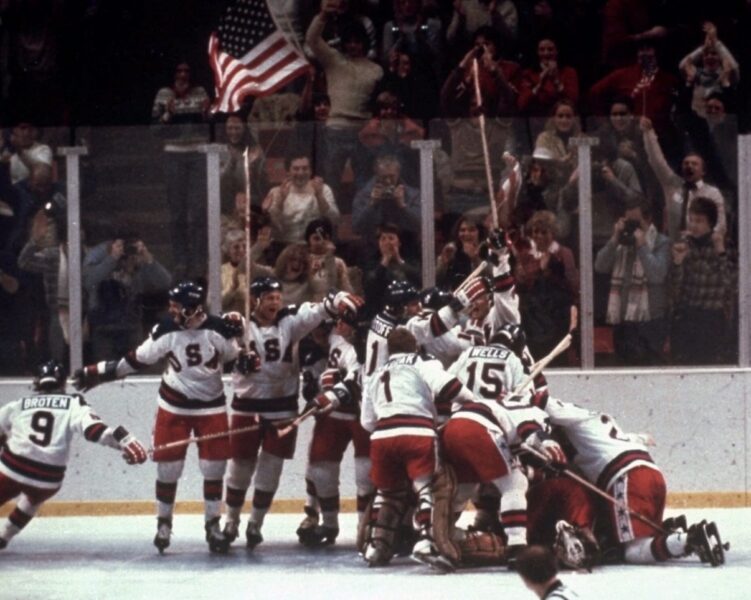
Before it became a movie, a slogan, and a piece of national memory, it was just a group of college kids staring down the greatest hockey machine in the world.
There are games that are remembered because of the score.
Then there are games that become part of a country’s memory.
The Miracle on Ice belongs in that second group.
On February 22, 1980, inside a packed arena in Lake Placid, New York, the United States men’s Olympic hockey team faced the Soviet Union in a game that felt bigger than sports before the puck even dropped. It was not just red, white, and blue against red. It was the Cold War on ice. It was amateur college players against a Soviet hockey empire. It was nervous American hope against one of the most dominant teams the sport had ever seen.
And somehow, impossibly, beautifully, the kids won.
The final score was 4-3.
But the meaning was much larger than that.
The Machine They Were Facing
To understand why this game still matters, you have to understand who the Soviet Union was in hockey.
They were not just good.
They were terrifying.
The Soviet team was experienced, disciplined, skilled, and built like a machine. They played with precision and speed. Their passing was sharp. Their positioning was clinical. Their confidence was earned. This was a group that had dominated international hockey for years, beating opponents not just with talent, but with a system that made them feel inevitable.
The Americans, by comparison, were young and raw.
Most of them were college players. They were not NHL superstars. They were not supposed to stare down the most feared hockey team on earth and live to tell the story. They were supposed to compete hard, maybe keep it respectable, and eventually get swallowed by the machine.
That was the expectation.
But expectations are exactly what make underdog stories dangerous.
Herb Brooks Built a Team, Not a Collection of Names
The United States had one major advantage: Herb Brooks.
Brooks was demanding, intense, and almost impossible to satisfy. He understood that if the Americans were going to have any chance, they could not just play emotional hockey. Emotion alone would get them crushed.
They had to be conditioned.
They had to be disciplined.
They had to become one unit.
Brooks did not build the team around comfort. He built it around pressure. He pushed his players until they hated him, then pushed them more. He knew that if they could survive his practices, his mind games, and his standards, maybe they could survive the Soviets.
That was the genius.
Brooks was not trying to make them feel good.
He was trying to make them ready.
And by the time Lake Placid arrived, the Americans were not the most talented team in the tournament. But they were fast, tough, connected, and fearless enough to believe the impossible might have a small opening.
That is all a great underdog ever needs.
The Game That Refused to Follow the Script
The Soviets struck first.
That alone could have been enough to make the game feel normal. The powerhouse lands a punch, the underdog absorbs it, and eventually reality takes over.
But the Americans would not disappear.
Every time the Soviets seemed ready to take control, the U.S. answered. They played with speed. They clogged lanes. They fought for every inch. Goalie Jim Craig turned away chance after chance, keeping the Americans alive when the Soviet attack started coming in waves.
The game was tense because it never fully broke open.
The Soviets led.
The Americans hung around.
The Soviets pressed.
The Americans refused to panic.
Then came the moment that changed everything.
In the third period, with the U.S. trailing 3-2, Mark Johnson tied the game. Suddenly, the arena had a new sound. Not just excitement. Belief.
Then Mike Eruzione fired the shot that became history.
U.S. 4, Soviet Union 3.
There was still time left. That is what made it almost unbearable. The Americans were not celebrating yet. They were surviving. The Soviets attacked. The crowd screamed. The clock became the main character.
And then Al Michaels delivered the line that would live forever:
“Do you believe in miracles? Yes!”
It was not just a call.
It was the sound of a moment realizing what it had become.
Why It Hit America So Hard
The Miracle on Ice did not happen in a vacuum.
That is why it became so powerful.
In 1980, America was dealing with uncertainty, tension, and doubt. The Cold War hung over everything. The country was hungry for something that felt clean, hopeful, and unifying. Sports often gets exaggerated as a symbol of national identity, but that night, it truly became one.
The U.S. did not beat the Soviets because they were bigger stars.
They beat them because they were brave enough to stay in the fight.
That is why people connected to it. It looked like sports, but it felt like something deeper: a reminder that the favorite does not always own the ending.
For one night, a group of young American hockey players gave the country a story it needed.
Not a political speech.
Not a perfect solution.
Just a game.
Just a win.
Just proof that impossible things can bend.
The Part People Forget
One thing people sometimes forget is that the Miracle on Ice was not technically the gold medal game.
That almost makes it even better.
The U.S. still had to beat Finland afterward to actually win gold. That matters because it shows the difference between a great upset and a true championship story. The win over the Soviets became the emotional mountain. But the Americans still had to finish the job.
And they did.
That is what separates the Miracle on Ice from a one-night fairy tale.
It was not just an upset.
It was the defining moment of a gold medal run.
The Americans did not just shock the world and fade.
They turned the miracle into a championship.
The Legacy
Decades later, the Miracle on Ice still feels untouched.
Part of that is because it had everything: the underdog, the villainous dynasty, the political backdrop, the home crowd, the perfect broadcaster line, the late goal, the desperate final seconds, and the gold medal finish.
But the bigger reason it still matters is because sports fans never stop looking for that feeling.
Every time an underdog walks into a game with no chance, people reach for Lake Placid. Every time a powerhouse looks unbeatable, people remember that the Soviet team looked unbeatable too. Every time a young team plays with belief bigger than its résumé, the Miracle on Ice becomes the comparison.
That is the highest level of sports history.
Not just a moment people remember.
A moment people use to understand every upset that comes after it.
Key Takeaways
The Miracle on Ice remains one of the greatest upsets in sports history because the talent gap seemed enormous.
The Soviet Union was an international hockey powerhouse, while the United States roster was built mostly from young amateur and college players.
Herb Brooks’ coaching was central to the story because he prepared the team physically, mentally, and emotionally for a level of pressure most of them had never faced.
Jim Craig’s goaltending kept the U.S. alive against one of the most dangerous attacks in the world.
Mike Eruzione’s third-period goal gave the United States a 4-3 lead and created one of the most famous finishes in Olympic history.
Al Michaels’ “Do you believe in miracles?” call became one of the most iconic lines in sports broadcasting.
The U.S. still had to beat Finland afterward to win the gold medal, which made the story more than just one upset.
Final Take
The Miracle on Ice is the kind of sports story that never gets old because it is not really about hockey alone.
It is about belief.
It is about a team that had every reason to be afraid and chose to play anyway. It is about a coach who understood that preparation could give young players courage. It is about a goalie holding the line, a captain taking his shot, and a clock ticking down while an entire country held its breath.
That is why the game still lives.
Not because the United States won.
Because for one night, against the greatest hockey machine in the world, a group of kids made the impossible look real.
And that is what sports history is supposed to feel like.