
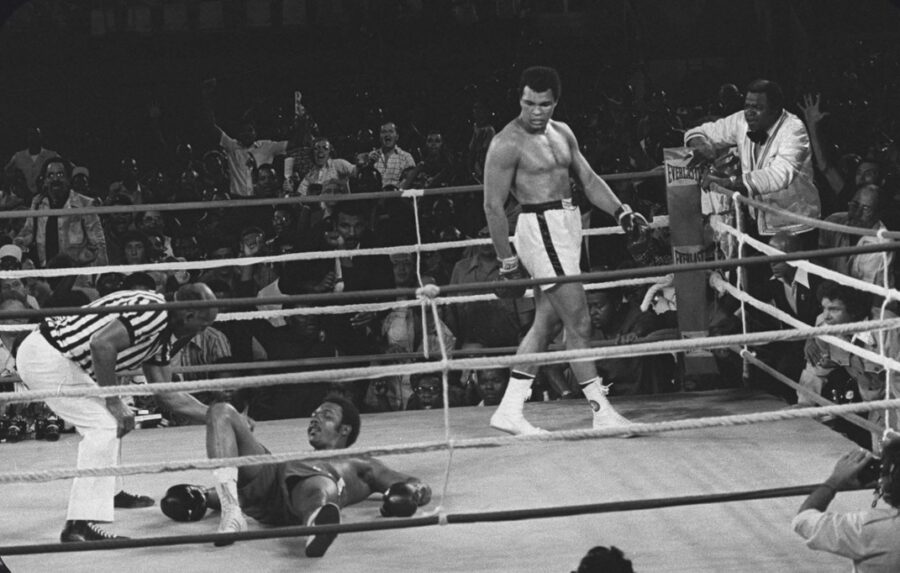
The Night Ali Shocked the World, Beat George Foreman, and Became Bigger Than Boxing
There are fights that decide championships.
Then there are fights that become history.
On October 30, 1974, in Kinshasa, Zaire, Muhammad Ali stepped into the ring against George Foreman in one of the most famous boxing matches ever held. It was called the Rumble in the Jungle, and at the time, most people thought Ali was walking into a beating.
Foreman was younger. Stronger. Undefeated. Terrifying.
He had destroyed Joe Frazier. He had crushed Ken Norton. Two men who had given Ali serious problems were wiped out by Foreman like they did not belong in the same ring.
Ali was 32 years old, which in boxing years felt older back then. People thought he was still great, but maybe past his prime. They wondered if the speed was gone. They wondered if the old magic had faded. They wondered if this was the night Ali’s courage would finally get him hurt.
But Ali knew something the world did not.
He did not need to fight Foreman’s fight.
He needed to make Foreman fight his.
The Stage Was Bigger Than Sports
The Rumble in the Jungle was not just a boxing match. It was an event.
It was held in Zaire, now the Democratic Republic of the Congo, and promoted by Don King. The fight became part of a larger cultural moment, with music, politics, race, fame, and global attention all surrounding the ring.
Ali understood the stage better than anyone.
He was not just showing up as a boxer. He was showing up as Muhammad Ali, the most charismatic athlete in the world, a man who could turn a press conference into theater and a fight into a movement.
The people in Zaire embraced him. The chant followed him everywhere:
“Ali, bomaye!”
It meant, “Ali, kill him.”
That chant became the soundtrack of the fight.
Foreman was the champion, but Ali became the people’s fighter. He smiled. He talked. He danced. He made the crowd believe. Before the first bell even rang, Ali had already started winning the mental battle.
George Foreman Was Supposed to Be Too Much
To understand how impossible Ali’s win felt, you have to understand George Foreman in 1974.
Foreman was not just a champion. He was destruction.
He was 40-0. He punched with the kind of power that changed fights instantly. He did not need twelve rounds. He did not need to outbox you. He could end the night with one clean shot.
His win over Joe Frazier in 1973 was frightening. Foreman knocked Frazier down six times in two rounds. This was the same Joe Frazier who had beaten Ali in the “Fight of the Century.”
Then Foreman beat Ken Norton, another fighter who had given Ali trouble, in two rounds too.
That is why so many people believed Ali had no chance. The logic seemed simple.
If Frazier and Norton struggled with Ali, but Foreman destroyed Frazier and Norton, then Foreman should destroy Ali.
But boxing is not math.
Ali knew that.
Ali’s Genius Was Not Just Speed
When people talk about Muhammad Ali, they usually talk about the speed, the footwork, the personality, and the poetry.
Float like a butterfly. Sting like a bee.
But the Rumble in the Jungle proved something else.
Ali was not just fast.
He was brilliant.
Early in the fight, Ali surprised Foreman by throwing quick right hands. He showed Foreman that he was not afraid. But then Ali did something almost nobody expected.
He went to the ropes.
At first, it looked dangerous. Maybe even reckless. Ali let Foreman come forward. He covered up. He leaned back. He took punches on his arms, shoulders, and body. Foreman kept swinging, trying to break him down.
But Ali was not trapped.
He was setting the trap.
This strategy became known as the rope-a-dope.
Ali used the looseness of the ropes to absorb some of Foreman’s power. He protected himself, tied Foreman up when he needed to, talked to him, frustrated him, and made him work harder than he wanted to.
Foreman was throwing heavy punches, but many of them were not landing clean.
Round by round, the unbeatable champion started to slow down.
The Fight Turned Into a Test of Mind
The most amazing part of the Rumble in the Jungle is that Ali won the fight before he finished it.
He made Foreman question himself.
That was Ali’s real greatness. He did not just fight the body. He fought the mind.
Foreman expected Ali to run. Ali did not run.
Foreman expected Ali to break. Ali did not break.
Foreman expected fear. Ali gave him confidence.
Ali talked to him during the fight. He leaned on the ropes and challenged him. He made the strongest man in boxing keep throwing until that strength became a weakness.
By the later rounds, Foreman looked tired. His punches were slower. His pressure was fading. The crowd could feel it. Ali could feel it.
The whole fight had changed.
What started as a question of whether Ali could survive became a question of when Ali would strike.
The Eighth Round Changed Everything
In the eighth round, Ali found his moment.
Foreman was exhausted. The punches did not have the same snap. His body language had changed. The monster was still dangerous, but he was no longer fresh.
Then Ali came off the ropes.
In one sudden burst, he fired a sharp combination. A right hand landed clean. Foreman stumbled. Ali followed with more punches, and Foreman went down.
The undefeated heavyweight champion was on the canvas.
The crowd exploded.
Foreman tried to get up, but he could not beat the count.
Muhammad Ali had done the impossible.
He had knocked out George Foreman.
He had regained the heavyweight championship of the world.
Why This Win Meant So Much
The Rumble in the Jungle was more than a comeback win.
It was a resurrection.
Ali had lost years of his prime after refusing induction into the U.S. military during the Vietnam War. He was stripped of his heavyweight title and banned from boxing during a time when he should have been at his athletic peak.
By 1974, many wondered if the best version of Ali was gone forever.
Then he beat Foreman.
Not by luck.
Not by running.
Not by surviving and hoping.
He beat him with courage, intelligence, strategy, and nerve.
That is why this fight became one of the defining moments of Ali’s career. It showed that greatness is not only about physical gifts. It is about adjustment. Belief. Timing. Mental strength. The ability to see a path when nobody else can.
Ali did not beat Foreman because he was younger.
He beat Foreman because he was smarter.
Key Takeaways
Muhammad Ali entered the fight as the underdog, with many believing George Foreman was too powerful and too dangerous.
Foreman was undefeated and had destroyed Joe Frazier and Ken Norton, two fighters who had given Ali major problems.
Ali used the rope-a-dope strategy to let Foreman tire himself out while protecting against the worst of his punches.
The fight became a battle of intelligence, patience, and mental toughness, not just strength.
Ali knocked Foreman out in the eighth round and reclaimed the heavyweight championship.
The Rumble in the Jungle remains one of the greatest examples of strategy, courage, and belief in sports history.
Final Thought
The Rumble in the Jungle is remembered because Muhammad Ali did more than win a fight.
He changed the story.
He walked into the ring against a younger, stronger, undefeated champion and made the impossible feel planned. He took fear and turned it into theater. He took danger and turned it into strategy. He took the world’s doubt and used it as fuel.
That night in Zaire, Ali proved that greatness is not just about power.
It is about vision.
It is about nerve.
It is about knowing who you are when everyone else thinks they already know how your story ends.
George Foreman entered as the destroyer.
Muhammad Ali left as the king again.