
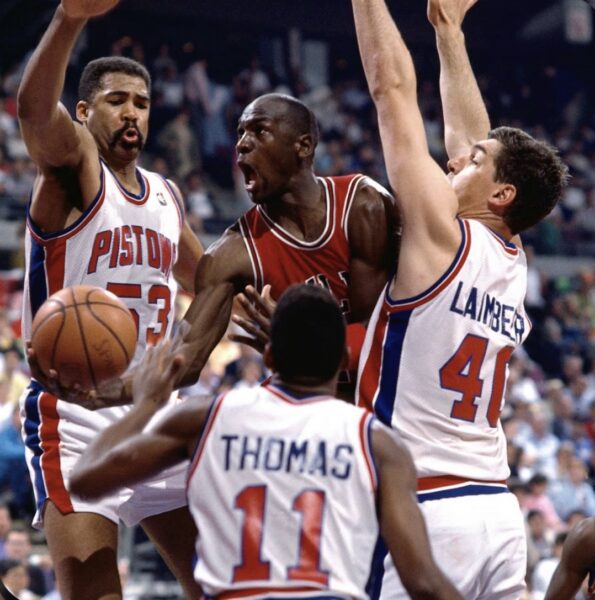
Before Michael Jordan became inevitable, he had to get through Detroit.
Not around them.
Through them.
The late-1980s Detroit Pistons were not built to be loved. They were built to survive. They were built to hit first, talk second, and make every drive to the rim feel like a warning. They were the team nobody wanted to see in May because they turned basketball into something closer to a street fight with referees.
They had Isiah Thomas, the smiling assassin at point guard. Joe Dumars, smooth and steady on both ends. Bill Laimbeer, the league’s most hated big man. Dennis Rodman, young, wild, and already becoming a defensive force. Rick Mahorn, John Salley, Vinnie Johnson, Mark Aguirre — a roster full of toughness, attitude, and players who understood exactly who they were.
They were the Bad Boys.
And for a few years, they were the wall between Michael Jordan and greatness.
The Jordan Rules
The Pistons did not look at Jordan like a normal superstar.
They looked at him like a problem that needed a plan.
That plan became known as the Jordan Rules.
The idea was simple, brutal, and effective: every time Jordan attacked the basket, make him feel it. Send help. Cut off the lane. Push him toward the crowd. Knock him down when necessary. Do not let him float through the air untouched. Do not let him get comfortable. Do not let him believe greatness was supposed to be pretty.
Against almost everyone else, Jordan could overwhelm the game with talent.
Against Detroit, talent was not enough.
The Pistons beat Jordan’s Bulls in the playoffs three straight years — 1988, 1989, and 1990. Each time, Chicago got closer. Each time, Detroit made the lesson harsher.
The message was clear.
You can be the best player in the world and still not be ready to win the whole thing.
Why Detroit Was So Dangerous
The Bad Boys were not just tough.
That is the part people sometimes forget.
They were excellent.
Isiah Thomas was one of the greatest point guards ever, a small player with a giant competitive streak and a handle that could break down any defense. Dumars was one of the rare guards who could challenge Jordan without losing his mind. Laimbeer could rebound, hit jumpers, and get under your skin at the same time. Rodman could defend, run, rebound, and change the energy of a game without needing plays called for him.
Detroit won back-to-back championships in 1989 and 1990 because they had real basketball genius under all that bruising physicality.
Chuck Daly, their coach, understood people as much as he understood X’s and O’s. He knew how to manage egos, roles, and personalities. He let the Pistons be themselves, but he also gave them structure. That is what made Detroit great. They were wild, but not reckless. Physical, but organized. Mean, but smart.
They did not just beat teams up.
They broke their rhythm.
Jordan’s Pain Became Fuel
For Jordan, Detroit became the team that forced him to evolve.
The Pistons pushed him around, trapped him, dared his teammates to make shots, and turned every playoff series into a question about whether Chicago had enough around him. Jordan could score 40 and still lose. He could dominate individually and still walk off frustrated.
That is what made it painful.
He was brilliant, but the Bulls were not yet complete.
So Jordan got stronger. Scottie Pippen grew up. Horace Grant became tougher. Phil Jackson replaced Doug Collins and helped install the triangle offense, giving Chicago more balance. The Bulls stopped being a one-man show and became a real championship team.
Detroit did not just block Jordan.
Detroit helped build the version of Jordan that eventually destroyed everyone.
The Walk-Off
By 1991, the balance had shifted.
The Bulls were ready.
Chicago swept Detroit in the Eastern Conference finals, finally breaking through the team that had haunted them for years. But the moment everyone remembers came near the end of Game 4, when several Pistons players walked off the court without shaking hands.
It was ugly.
It was bitter.
It was very Detroit.
To Bulls fans, it looked like disrespect.
To the Pistons, maybe it felt like a dynasty refusing to bow. Either way, it became the final image of the rivalry: the Bad Boys leaving as Jordan’s era officially arrived.
Chicago went on to win the 1991 NBA championship.
Jordan had his first ring.
The Pistons’ reign was over.
The Bulls’ dynasty was just beginning.
Why It Still Matters
The Bad Boys matter because they were the last great obstacle before Michael Jordan became Michael Jordan.
They made him bleed for it.
They made Chicago grow up. They made Scottie Pippen tougher. They made Jordan trust his teammates. They made the Bulls understand that talent alone does not win championships. You need strength. You need patience. You need scars.
That is why the rivalry still feels important.
Without Detroit, Jordan’s story is not as powerful.
Every great hero needs a villain. The Pistons were perfect villains because they were not fake. They were not cartoon bad guys. They were champions. They were smart, connected, fearless, and proud. They believed their way worked because it did.
For a while, nobody had an answer.
Then Jordan found one.
Final Thought
The Detroit Pistons did not make basketball beautiful.
They made it brutal.
They turned playoff games into survival tests and forced the greatest player ever to become stronger, smarter, and more complete. They were hated, respected, feared, and impossible to ignore.
And that is why their story still matters.
Because before Michael Jordan ruled the NBA, the Bad Boys ruled him.
And when he finally got past them, basketball changed forever.