
Before Michael Jordan became untouchable, before six rings turned him into basketball’s final boss, before the statue, the shoes, the mythology, and the global empire, he was still chasing something.
He was spectacular.
But he had not yet won.
And in 1989, the Cleveland Cavaliers thought they had the team to stop him.
The Cavs were loaded. They had won 57 games. They had Mark Price running the offense, Brad Daugherty in the middle, Ron Harper on the wing, Larry Nance flying around the rim, and one of the best records in the league. They were deeper than Chicago. More balanced. More complete.
The Bulls had Jordan.
That was the problem.
The first-round series went the distance, all the way to Game 5 in Cleveland. Back then, the opening round was best-of-five, which meant one game could end everything. No safety net. No Game 6. No second chance.
For Cleveland, this was supposed to be the moment they survived Jordan and moved on.
For Chicago, it was another test of whether one man’s greatness could drag a franchise somewhere it had never been.
The final seconds turned into basketball theater.
Cleveland took the lead late when Craig Ehlo scored on a driving layup, putting the Cavaliers ahead 100-99 with just three seconds left. The Coliseum exploded. The Cavs were almost there. One stop, and the Bulls were finished.
Then Chicago called timeout.
Everybody knew who was getting the ball.
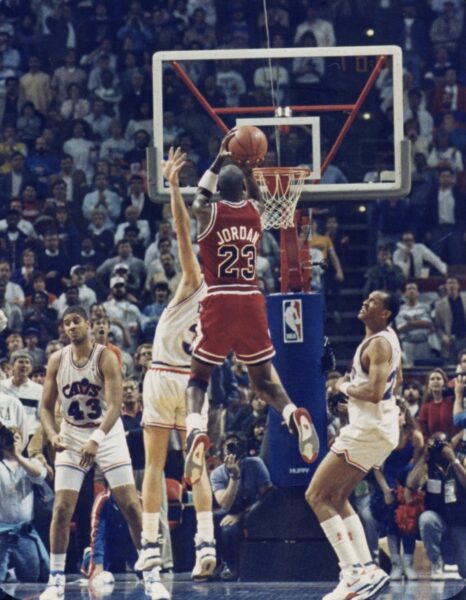
Jordan lined up near the foul line area. Ehlo guarded him. The pass came in. Jordan caught it moving left, took one dribble, rose over Ehlo, and froze time.
The shot went up.
The horn sounded.
The ball dropped.
Bulls 101, Cavaliers 100.
Jordan jumped into the air, pumping his fist over and over, a celebration so iconic it became part of NBA history forever.
Craig Ehlo collapsed to the floor.
Cleveland was crushed.
Chicago survived.
And Michael Jordan had delivered the first true signature playoff moment of his career.
Why It Was Bigger Than One Shot
“The Shot” was not a championship-winning basket.
It did not come in the NBA Finals.
It did not even happen in the conference finals.
But it mattered because it showed the league exactly what kind of player Jordan was becoming.
This was not just a scorer anymore. This was not just the guy who could drop 40 or 50 and still go home early. This was a closer. A killer. A player who could take the entire emotional weight of a franchise, a city, a season, and a hostile arena — and still rise like the moment belonged to him.
That is what separated Jordan.
The Cavs had the better team on paper.
Jordan had the final word.
He finished Game 5 with 44 points, and the Bulls upset a Cleveland team many believed was built for a deep playoff run. Chicago moved on, and Cleveland was left with one of the most painful endings in franchise history.
For the Bulls, it became a launching point.
They did not win the title that year, but Jordan’s legend grew. The Bulls reached the Eastern Conference finals before losing to the Detroit Pistons, the team that would become their greatest obstacle. But something had changed.
Jordan was no longer just a highlight machine.
He was becoming inevitable.
The Human Side
The cruel part of the story is Craig Ehlo did not play bad defense.
That is what makes the moment even more painful.
He stayed with Jordan. He contested the shot. He forced a tough jumper. He did almost everything right.
Jordan just did something better.
That is the cold reality of guarding greatness. Sometimes you can do your job and still end up in the poster. Ehlo became forever attached to the moment, not because he failed, but because he happened to be the man standing closest to history when it happened.
That is sports.
One player’s greatest memory becomes another player’s nightmare.
For Jordan, it was the beginning of his playoff mythology.
For Cleveland, it became another chapter in a long history of heartbreak.
Why It Still Matters
“The Shot” still feels alive because it captured Jordan before the world fully understood him.
This was not the championship Jordan.
This was not the untouchable Jordan of the 1990s.
This was young Jordan, still fighting through the Eastern Conference, still trying to climb past stronger teams, still trying to turn the Bulls into something more than a one-man show.
And that makes it special.
You can almost see the future in that jumper.
You can see the confidence. The footwork. The hang time. The refusal to panic. The celebration. The belief that the biggest moment was not something to fear, but something to own.
That is why the clip still plays like a movie.
The catch.
The rise.
The shot.
The fist pump.
The defender falling.
The crowd stunned.
It is all there.
A superstar becoming a legend in real time.
Final Thought
Michael Jordan’s career is filled with bigger achievements.
Six championships. Six Finals MVPs. Ten scoring titles. The Flu Game. The Shrug. The Last Shot in Utah.
But “The Shot” was different.
It was the first thunderclap.
The first playoff moment that told the NBA, Cleveland, Chicago, and everyone watching that Jordan was not just coming.
He was already here.
And once the ball dropped, everything felt different.
Not because the Bulls had won a title.
But because Michael Jordan had learned how to break a city’s heart with one jump shot.