
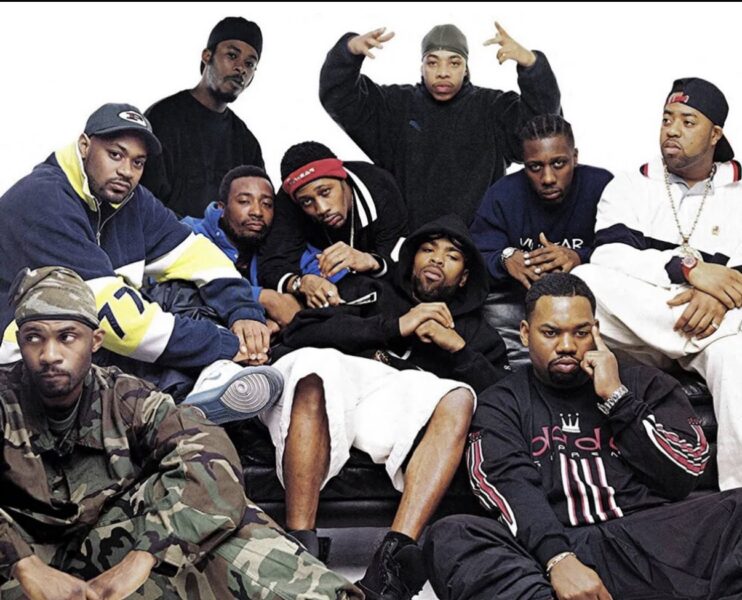
Nine voices, one vision, and a sound that turned underground rap into a cultural empire
Before Wu-Tang Clan became a name printed on T-shirts, murals, posters, records, and the memory of hip-hop itself, they were a group of young men from Staten Island trying to build something nobody had ever heard before.
They were not polished.
They were not industry-made.
They did not sound like the radio.
That was the point.
Wu-Tang Clan came in like a storm from another world, gritty, strange, raw, cinematic, and fearless. Their music felt like a back-alley fight, a kung fu movie, a street sermon, and a basement freestyle all happening at once. When they arrived in the early 1990s, hip-hop was already moving fast, but Wu-Tang did not follow the wave. They created their own lane and made everybody else catch up.
At the center was RZA, the mastermind. He was more than a producer. He was the architect. He took dusty soul samples, kung fu dialogue, haunting piano loops, and hard drums, then built a sound that felt dark, dangerous, and completely original. His beats did not just support the rappers. They created the universe around them.
Then came the voices.
Method Man had the charisma, the voice, the hook, the star power.
Raekwon had the sharp street detail.
Ghostface Killah rapped like emotion was spilling out of him faster than he could control it.
GZA was the technician, calm and surgical with every line.
Ol’ Dirty Bastard was chaos, humor, pain, genius, and unpredictability all in one.
Inspectah Deck had one of the sharpest pens in the group.
U-God brought grit and force.
Masta Killa moved with patience and precision.
Cappadonna became part of the larger Wu-Tang world, adding another streetwise voice to the mythology.
Together, they sounded less like a rap group and more like a full cast of characters. Everybody had their own style. Everybody had their own identity. Nobody blended into the background. That was the magic. Wu-Tang was not built around one superstar. It was built like a dynasty.
Their 1993 debut, Enter the Wu-Tang, 36 Chambers, did not sound clean or expensive. It sounded hungry. It sounded like cracked concrete, cold stairwells, corner stores, late nights, and survival. That roughness became part of its greatness. The album felt alive because it felt unfiltered. It was messy in the best way, full of energy that could not be manufactured.
Songs like “C.R.E.A.M.,” “Protect Ya Neck,” and “Da Mystery of Chessboxin’” were not just records. They were statements. Wu-Tang was telling the world exactly who they were, and they were doing it without asking permission.
But what made Wu-Tang truly different was not just the music. It was the plan.
RZA and the group understood branding before a lot of artists even thought of it that way. Wu-Tang was a group, but it was also a movement. Each member could go solo, build his own world, and still strengthen the larger Wu-Tang name. That idea changed hip-hop business forever. They were not just trying to make hits. They were building an empire.
Method Man became a crossover star. Raekwon’s Only Built 4 Cuban Linx… became one of the greatest street rap albums ever made. GZA’s Liquid Swords became a lyrical masterpiece. Ghostface Killah built one of the most respected solo careers in hip-hop history. Ol’ Dirty Bastard became an unforgettable figure, impossible to copy and impossible to ignore.
That was Wu-Tang’s power. The group was bigger than one album, bigger than one moment, bigger than one rapper.
They turned Staten Island into Shaolin.
They made kung fu films part of hip-hop language.
They made the Wu “W” one of the most recognizable logos in music.
They proved that rap could be raw and artistic, street-level and philosophical, chaotic and carefully designed.
And beneath all the mythology, there was something human about Wu-Tang. Their music carried hunger. You could hear struggle in it. You could hear ambition. You could hear young men trying to escape their circumstances by turning pain, humor, intelligence, and survival into art.
That is why Wu-Tang still matters.
They were not perfect. They were not supposed to be. Their greatness came from the edges, the flaws, the wildness, the brotherhood, and the belief that their world was worth turning into legend.
Wu-Tang Clan did not just change hip-hop because they made classic songs.
They changed hip-hop because they changed what a group could be.
They were artists, characters, businessmen, storytellers, street poets, and mythmakers. They made music that sounded like nobody else, then built a universe strong enough to last for generations.
Thirty years later, that yellow “W” still means something.
It means originality.
It means loyalty.
It means raw genius.
It means nine voices came out of Staten Island and made the whole world listen.
Wu-Tang Clan was not just a rap group.
Wu-Tang was forever.