
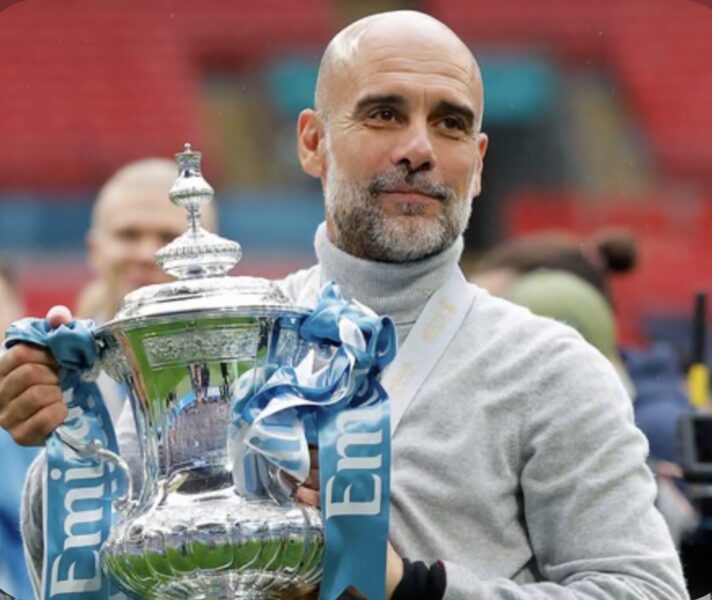
For a decade, the Premier League felt like it belonged to Pep Guardiola.
Not every year.
Not every week.
But over time, in the biggest picture, English soccer started bending around Manchester City. The passing angles. The high press. The fullbacks moving inside. The idea that control could be just as ruthless as chaos.
Now, that era is ending.
Guardiola is set to step down as Manchester City manager at the end of the 2025-26 season, closing a 10-year run that turned City from a powerhouse into the standard every other club measured itself against.
And this is not just a coaching change.
This is the end of a football empire.
The Man Who Changed the League
When Guardiola arrived in 2016, City were already rich, talented, and dangerous.
But Pep made them something else.
He made them inevitable.
Under Guardiola, City became a machine built on patience, precision, and pressure. They did not just beat teams. They suffocated them. Opponents spent entire afternoons chasing the ball, chasing shadows, chasing a game that seemed to move one pass faster than they could handle.
His resume speaks for itself: six Premier League titles, five League Cups, three FA Cups, and a Champions League crown.
But the numbers only tell part of the story.
The bigger story is the way he forced everyone else to evolve.
Liverpool had to become near-perfect to challenge him. Arsenal had to rebuild with a younger, sharper identity. Manchester United spent years trying to rediscover what City seemed to have every weekend: structure, belief, and a plan.
That is what the great managers do.
They do not just win trophies.
They change the sport around them.
The Main Conflict
The strange thing about endings is that they make everything feel heavier.
City are not falling apart. They are not disappearing. This is still one of the most talented clubs in the world.
But Guardiola leaving changes the mood.
For years, City’s biggest advantage was not just the squad. It was the certainty. Players knew the system. The club knew the standard. Opponents knew exactly what was coming and still could not stop it.
Now comes the question no club wants to face:
What happens when the man who built the machine walks away?
Because replacing a manager is one thing.
Replacing an era is something else entirely.
The Legacy
Guardiola’s City will be remembered for many things.
The 100-point season.
The domestic dominance.
The treble.
The endless passing moves that looked less like soccer and more like geometry in motion.
But his real legacy may be simpler than that.
He changed what English soccer expected from a great team.
Before Pep, dominance often looked physical. Fast. Direct. Brutal. After Pep, dominance could look patient. Technical. Almost surgical.
City could win 4-0 and somehow make it feel calm.
That was the genius.
The chaos was happening to everyone else.
Why It Matters
This matters because the Premier League is about to enter a new power vacuum.
For years, every contender had the same problem: eventually, they had to deal with City. Even when they had great seasons, City were waiting. Even when they slipped, City were close enough to make everyone nervous.
Now, the league feels more open.
Arsenal, Liverpool, Manchester United, Chelsea, Tottenham, and everyone chasing the top will see an opportunity. Not because City are suddenly weak, but because the aura changes when Guardiola is no longer standing on the touchline.
That aura mattered.
It made City feel permanent.
Now the rest of England gets to ask whether the empire was built to survive without its architect.
Key Takeaways
1. Guardiola’s departure is bigger than one club.
This is a Premier League-changing moment. Pep did not just manage City. He shaped the way English soccer was played and judged.
2. City’s next manager inherits pressure, not just talent.
The squad will still be strong, but the next coach will be compared to one of the greatest managers ever.
3. The Premier League race could feel wide open again.
City will remain dangerous, but Guardiola leaving gives rivals a different kind of belief.
4. Pep’s legacy is already secured.
Six league titles, a Champions League, a treble, and a decade of tactical influence make this one of the greatest managerial runs in English soccer history.
Final Thought
My final thought: Pep Guardiola leaving Manchester City feels like one of those sports moments that will not fully hit until he is actually gone.
Because for 10 years, he was part of the Premier League’s furniture. The camera would cut to him on the sideline, arms folded, thinking three passes ahead of everybody else, and you knew City were never really out of control.
That is what made his teams terrifying.
They did not just win.
They made winning feel like a system.
Now that system has to live without the man who created it.
And that is where the next great Premier League story begins.