
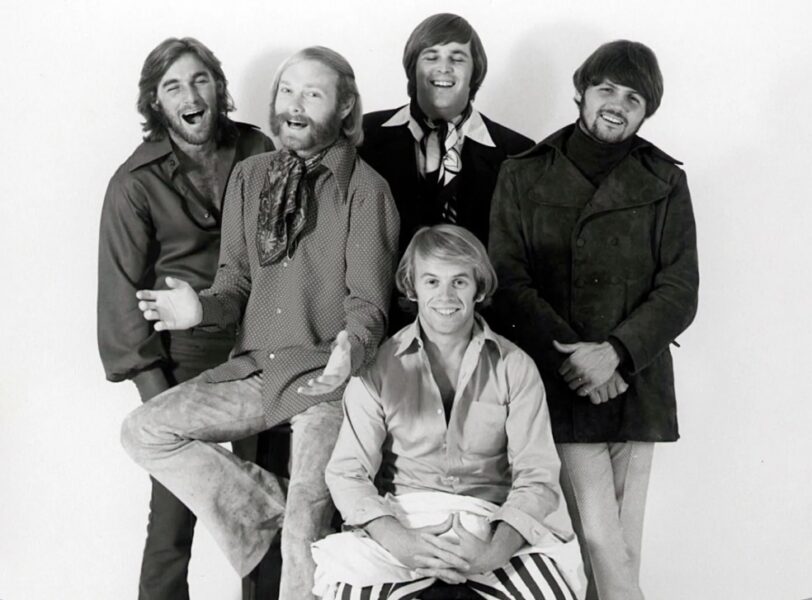
How The Beach Boys turned sunshine into one of the most beautiful and heartbreaking sounds in American music
By Ty
The Beach Boys sounded like summer.
That was the trick.
To the casual listener, they were surfboards, fast cars, pretty girls, blue skies, and endless California afternoons. Their harmonies felt clean enough to sparkle. Their early records sounded like the radio version of a postcard — teenagers chasing waves, engines revving, and the whole world looking young forever.
But the real story of The Beach Boys was never that simple.
Behind the sunshine was sadness.
Behind the harmonies was pressure.
Behind the California dream was Brian Wilson, a musical genius trying to build heaven in the studio while slowly losing his grip on the world outside it.
That is what makes The Beach Boys so powerful.
They did not just make happy music.
They made happy music that, over time, started to reveal how lonely happiness can sound.
The Family Band That Became America’s Sound
The Beach Boys began as a family story.
Brian Wilson formed the group with his brothers Carl and Dennis Wilson, cousin Mike Love, and friend Al Jardine. They came out of Southern California in the early 1960s and quickly became tied to the image of surf culture, even though Brian himself was not really the carefree surfer people imagined. The Rock & Roll Hall of Fame inducted the original members in 1988, recognizing their enormous influence on American popular music.
That contrast is important.
The Beach Boys sold the dream better than almost anyone.
But Brian Wilson was not just writing about the beach. He was writing about escape. He was writing about innocence. He was writing about a world that felt safe, bright, and emotionally simple — maybe because real life rarely felt that way to him.
Early songs like “Surfin’ U.S.A.,” “Fun, Fun, Fun,” “I Get Around,” and “California Girls” gave America a new mythology.
The Beatles had Liverpool.
Dylan had Greenwich Village.
The Beach Boys had California.
And for a while, California sounded like paradise.
The Harmonies Were the Secret Weapon
The Beach Boys’ real power was not just surfing songs.
It was the voices.
Those harmonies were unreal — stacked, glowing, almost weightless. They were influenced by vocal groups like the Four Freshmen, but The Beach Boys pushed that sound into the pop-rock era. Their voices did not just decorate the songs. They became the emotional center.
That is why even the fun songs still feel special.
A song like “Don’t Worry Baby” sounds like it should be about cars and teenage nerves, but it carries something much deeper. Brian’s voice floats above the track with this fragile beauty, like the whole song might break if you touch it too hard.
That became his gift.
He could make innocence sound spiritual.
He could make teenage fear sound eternal.
He could make a three-minute pop song feel like someone trying to hold onto a feeling before it disappears.
Brian Wilson Wanted More
By the mid-1960s, Brian Wilson was no longer satisfied with just writing hits.
He wanted to build worlds.
While the rest of the band toured, Brian increasingly stayed in the studio, chasing sounds that did not exist yet. He heard arrangements in his head that were bigger than normal pop records — strings, horns, bicycle bells, theremins, strange percussion, layered voices, and emotional details most rock producers would never think to use.
This is where The Beach Boys story changes.
They were no longer just competing for radio space.
They were reaching for art.
The turning point was Pet Sounds, released in 1966. Today it is widely viewed as one of the greatest albums ever made, but at the time it was a bold shift away from the band’s earlier surf-and-car image. The album included songs like “Wouldn’t It Be Nice,” “God Only Knows,” and “Sloop John B,” and it showed Brian Wilson pushing pop music toward deeper emotion and more complex studio production.
This was not just a Beach Boys album.
It was Brian Wilson opening his chest and letting the world hear the machinery inside.
Pet Sounds: Sunshine With Tears in It
The genius of Pet Sounds is that it sounds beautiful, but never fully comfortable.
It is full of longing.
“Wouldn’t It Be Nice” sounds bright on the surface, but underneath it is about wanting adulthood before you understand what adulthood costs.
“God Only Knows” is one of the most tender love songs ever written, but even there, the beauty comes with a strange fear — the thought of life without the person you love.
“I Just Wasn’t Made for These Times” might be the key to the whole album. That title alone feels like Brian Wilson’s private confession. It is the sound of a person looking around at the world and realizing he does not quite fit inside it.
That is why Pet Sounds lasts.
It is not just well-produced.
It is emotionally true.
The album understands something that most pop music tried to avoid: growing up is not always exciting. Sometimes it is confusing. Sometimes love is terrifying. Sometimes the dream you were sold does not match the ache inside your own head.
The Beach Boys had once made California sound endless.
On Pet Sounds, Brian made it sound fragile.
“Good Vibrations” and the Pocket Symphony
Then came “Good Vibrations.”
If Pet Sounds was Brian Wilson proving pop music could be intimate and emotional, “Good Vibrations” was him proving it could be cinematic.
The song was released in October 1966 and became a major success, reaching No. 1 in the United States and the United Kingdom. It was famously described as a kind of “pocket symphony,” because it felt like several musical worlds stitched together into one three-and-a-half-minute pop masterpiece.
That song still sounds futuristic.
The cello pulses. The theremin-like sound floats through the track. The sections shift like scenes in a dream. The harmonies rise and vanish. It does not move like a regular pop single. It feels assembled from lightning.
And somehow, it works.
That is Brian Wilson at his peak: not just writing a song, but constructing a universe.
The Dream Became Too Heavy
After “Good Vibrations,” Brian wanted to go even further.
That dream became SMiLE.
The album was supposed to be ambitious, playful, spiritual, strange, and completely unlike anything in pop music. It was going to be Brian’s answer to the creative explosion happening around him — The Beatles, psychedelia, studio experimentation, and the idea that rock music could become art on the highest level.
But SMiLE became too much.
Too much pressure.
Too much expectation.
Too much confusion.
Too much genius pressed against too much pain.
The project collapsed in the 1960s and became one of the most famous unfinished albums in rock history. Reports and histories of Brian Wilson’s career often point to SMiLE as both a symbol of his ambition and the emotional struggles that followed.
That is the heartbreaking part of The Beach Boys story.
Brian Wilson could hear heaven.
But heaven was hard to finish.
The Band Kept Going, But the Myth Changed
The Beach Boys continued after Brian stepped back from being the constant creative center.
They still made music. They still toured. They still had moments of brilliance. Carl Wilson became an essential musical force. Dennis Wilson later proved he had his own deep, soulful songwriting voice. Mike Love remained central to the band’s public identity and live presence.
But the story had changed.
The Beach Boys were no longer just the smiling kings of summer.
They had become something stranger: a band with two identities fighting inside the same name.
One identity was the oldies dream — surf, sun, fun, nostalgia.
The other was the deeper legacy — Pet Sounds, “Good Vibrations,” lost innocence, studio genius, family pain, and Brian Wilson’s fragile brilliance.
That split is what makes them endlessly fascinating.
They were both America’s happiest band and one of its saddest.
Why The Beach Boys Still Matter
The Beach Boys still matter because they proved that pop music could be beautiful without being shallow.
They took the language of teenage America — cars, girls, beaches, dreams — and slowly transformed it into something more emotional and complex. Their best music captures the moment when innocence starts to crack.
That is why the songs still hit.
“In My Room” is not just a pretty ballad. It is a sanctuary for anyone who has ever needed to hide from the world.
“God Only Knows” is not just romantic. It is devotion with fear inside it.
“Wouldn’t It Be Nice” is not just youthful. It is impatient, hopeful, and quietly heartbreaking.
“Good Vibrations” is not just catchy. It is a studio miracle.
And Pet Sounds is not just an album. It is a diary written in harmonies.
Brian Wilson, who died in 2025 at age 82, is remembered as the visionary force behind the band’s most revolutionary music, a songwriter and producer whose work changed the emotional possibilities of pop.
That legacy is enormous.
The Beach Boys made music that sounded simple enough for everyone to love and deep enough for musicians to study forever.
Final Thought
The Beach Boys were never just about the beach.
That was the image.
The real story was much deeper.
They were about family, pressure, innocence, loneliness, beauty, and the impossible dream of making life sound better than it feels. Brian Wilson took sunshine and filled it with doubt. He took teenage music and made it ache. He took pop songs and turned them into little cathedrals of harmony.
That is why The Beach Boys still matter.
Because underneath the surfboards and smiles, they were singing about something everyone understands.
The wish to be young.
The fear of growing up.
The need for a safe place.
The dream of love lasting forever.
And the heartbreaking truth that even the brightest summer eventually fades.
The Beach Boys made that feeling sound beautiful.