
The 2001 NBA Finals were supposed to be a formality.
The Los Angeles Lakers were a machine. Shaquille O’Neal was the most physically dominant force in basketball. Kobe Bryant was becoming a superstar right in front of everyone. Phil Jackson had the calm of a coach who already knew what June was supposed to look like. The Lakers entered the Finals unbeaten in the playoffs, rolling through the West like nobody had enough size, talent, or nerve to stop them.
Then Allen Iverson walked into Staples Center.
And for one night, one of the smallest men on the floor made the biggest team in basketball look human.
The Philadelphia 76ers were not built like the Lakers. They did not have two superstars. They did not have Hollywood flash. They had defense, toughness, role players, Larry Brown on the sideline, Dikembe Mutombo protecting the paint, and Iverson carrying an offense that often felt like it needed a miracle just to survive.
But Iverson was the miracle.
He was barely 6 feet tall, skinny compared to the giants around him, wrapped in sleeves, braids, defiance, and a style the NBA was still trying to understand. He played like every possession was personal. Every crossover felt like a challenge. Every drive into the lane felt like he was running straight into traffic and daring somebody to stop him.
Game 1 became his stage.
Iverson scored 48 points in a stunning overtime win, leading the Sixers past the Lakers 107-101 and handing Los Angeles its first loss of the 2001 postseason.
That alone would have made it legendary.
But then came the moment.
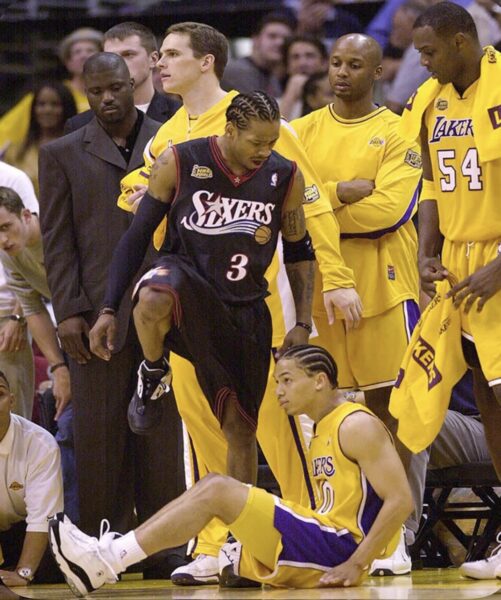
Late in overtime, Iverson isolated against Tyronn Lue near the corner. Lue had been chasing him all night, trying to bother him, trying to stay attached, trying to survive the storm. Iverson gave him a move, created space, rose up, and buried the jumper.
Lue fell backward.
Iverson turned.
And then he stepped over him.
Not around him.
Over him.
It was not just disrespect. It was a photograph of everything Iverson represented.
The little guy against the empire.
The streetball soul inside the corporate NBA.
Philadelphia toughness walking right over Hollywood confidence.
That step-over became one of the most iconic images in basketball history because it said what words could not: Allen Iverson was not afraid of anybody.
Why It Hit So Hard
The Lakers still won the series. That part matters.
They won the next four games and captured the championship. Shaq was too much. Kobe was too good. Los Angeles was too complete. The dynasty continued.
But somehow, Iverson’s Game 1 still survived the series loss.
That is how powerful the night was.
Because sports are not only remembered by who won the trophy. Sometimes they are remembered by who made you feel something. Iverson did that. He made people feel like size did not matter. Like reputation did not matter. Like one player with enough heart, skill, and stubborn belief could walk into the loudest room in basketball and steal the whole night.
That was Iverson’s gift.
He did not just score.
He fought.
Every shot looked earned. Every fall looked painful. Every bucket felt like a statement from someone who had been doubted, judged, criticized, and misunderstood his whole career.
And that is why fans connected with him so deeply.
Iverson was not polished in the traditional NBA superstar way. He was raw. Real. Emotional. Defiant. He brought hip-hop culture into the league’s mainstream image and forced basketball to meet a generation it had often tried to clean up.
He was not trying to be perfect.
He was trying to be himself.
The Bigger Story
The 2001 Sixers were a reflection of Iverson’s entire career.
Undersized.
Outgunned.
Uncomfortable to play against.
Impossible to ignore.
They won with defense, grit, and Iverson doing superhero work on offense. He took hits. He played through pain. He carried a scoring burden that would have broken most players. That season, he won MVP, led the league in scoring, and dragged Philadelphia all the way to the Finals.
Against almost any other opponent, maybe that run ends with a championship.
But the Lakers were not just any opponent.
They had Shaq at his absolute peak. They had Kobe becoming Kobe. They had the league’s best combination of power, skill, and playoff confidence. Beating them four times was probably too much to ask.
Beating them once?
Iverson made sure that happened.
And he made sure nobody forgot it.
Why It Still Matters
The step-over still lives because it was bigger than a highlight.
It was a symbol.
It was Iverson’s whole story in one second: smaller than the players around him, louder than the moment, fearless against the favorite, and impossible to control.
The NBA has had better teams. It has had cleaner champions. It has had more efficient scorers and more decorated legends.
But few players ever felt as alive as Allen Iverson did that night.
He turned one Finals game into mythology.
He gave Philadelphia one unforgettable win.
He gave basketball one of its coldest images.
And even though the Lakers won the championship, Iverson won something else that night.
He won immortality in the minds of every fan who loves the underdog.
Final Thought
Allen Iverson did not beat the Lakers in the 2001 Finals.
But for one night, he made the unbeatable look beatable.
He walked into Staples Center against Shaq, Kobe, Phil Jackson, and a team chasing history, and he gave them 48 points, an overtime loss, and a moment nobody could erase.
The step-over was not just a celebration.
It was a message.
You can be smaller.
You can be doubted.
You can be outnumbered.
And still, for one night, you can stand taller than everyone.