
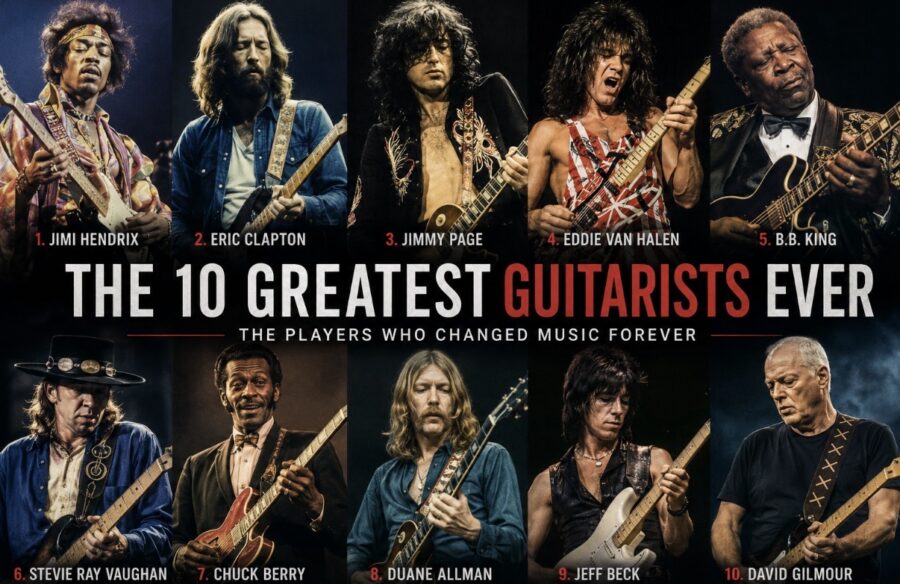
Before the guitar became a weapon, it was just wood, wire, and electricity.
Then came the players who made it sound dangerous.
They bent notes until they sounded like voices. They turned amplifiers into thunderclouds. They made blues cry, rock roar, metal explode, and stadiums shake. Some played with speed. Some played with soul. Some needed only three notes to say everything. The greatest guitarists were never just technicians. They were storytellers, inventors, outlaws, and sometimes magicians.
A great guitarist does not simply play a solo. A great guitarist creates a world.
These are the ten players who did exactly that.
10. David Gilmour
David Gilmour never had to chase the spotlight. He let the note find him.
With Pink Floyd, Gilmour became the master of space, patience, and emotional weight. His solos did not feel like displays of ego. They felt like memories floating through smoke. On “Comfortably Numb,” he did not just play one of the greatest solos in rock history — he built a cathedral out of sorrow, distance, and release.
Gilmour’s genius was restraint. He understood silence as much as sound. While other guitarists raced across the fretboard, Gilmour could hold one bend and make it feel like the entire sky was opening.
Essential listens: “Comfortably Numb,” “Time,” “Shine On You Crazy Diamond”
9. Jeff Beck
Jeff Beck was the guitarist other guitarists whispered about.
He was not always the loudest name in the room, but he may have been the most fearless. Beck treated the guitar like a living animal. He could make it snarl, cry, laugh, and scream without ever sounding trapped by tradition. His playing was wild but controlled, strange but beautiful, futuristic but rooted in the blues.
From the Yardbirds to his solo work, Beck never seemed interested in becoming predictable. He kept pushing. He kept searching. He made the guitar feel less like an instrument and more like a machine with a soul.
Essential listens: “Cause We’ve Ended as Lovers,” “Beck’s Bolero,” “Freeway Jam”
8. Duane Allman
Duane Allman played slide guitar like it came from another lifetime.
His tone had warmth, pain, and Southern fire. With the Allman Brothers Band, he helped shape Southern rock into something deeper than barroom blues. It became gospel, jazz, country, and blues all tied together by a guitar that seemed to sing from the dirt roads of America.
On “Statesboro Blues,” Allman’s slide cuts through like sunlight through a cracked window. On “Layla,” his guitar became part of rock history forever. He died young, but the playing he left behind still feels alive — restless, human, and full of ache.
Essential listens: “Statesboro Blues,” “Whipping Post,” “Layla”
7. Chuck Berry
Before the gods of guitar stood on festival stages with Marshall stacks behind them, there was Chuck Berry, duck-walking across the birth of rock and roll.
Berry did not just play guitar. He wrote the language. The riffs, the double-stops, the swagger, the teenage energy — so much of rock music starts with him. Without Chuck Berry, the Beatles sound different. The Stones sound different. Springsteen sounds different. Rock and roll itself sounds different.
“Johnny B. Goode” is more than a song. It is practically the blueprint. Every kid who ever picked up a guitar and dreamed of escaping a small town owes something to Chuck Berry.
Essential listens: “Johnny B. Goode,” “Maybellene,” “Roll Over Beethoven”
6. Stevie Ray Vaughan
Stevie Ray Vaughan played like a storm rolling through Texas.
He brought the blues back with muscle, sweat, and fire. In an era when pop was polished and rock was changing shape, Vaughan showed up with a Stratocaster and reminded everyone that the blues could still burn the house down.
His playing had power, but it was never empty flash. Behind the speed was feeling. Behind the volume was pain. “Texas Flood” sounds like a man trying to wrestle lightning out of six strings. “Lenny” shows the other side — soft, tender, almost prayer-like.
Vaughan made the blues feel young again.
Essential listens: “Texas Flood,” “Pride and Joy,” “Lenny”
5. B.B. King
B.B. King did not need to play fast.
He had Lucille.
That was enough.
King’s guitar style was built on space, phrasing, vibrato, and emotion. He could play one note and make it hurt. He could answer his own voice with the guitar, like a conversation between pain and survival. His playing was not about showing you how much he knew. It was about making you feel something before you even understood why.
Every great blues-rock guitarist learned from him. Clapton, Page, Hendrix, Vaughan — they all drank from the well B.B. King helped dig. He was not just a blues legend. He was one of the great emotional communicators in American music.
Essential listens: “The Thrill Is Gone,” “Lucille,” “Sweet Little Angel”
4. Eddie Van Halen
Then came Eddie.
When “Eruption” hit in 1978, it sounded like someone had kicked open the future. Eddie Van Halen did not just play guitar differently. He made the instrument feel physically impossible. The tapping, the harmonics, the speed, the tone, the joy — it was technical wizardry with a grin.
But Eddie was more than a shredder. That is what people sometimes miss. His rhythm playing was explosive. His riffs were catchy. His solos were fireworks, but the songs still moved. He made guitar playing feel fun, dangerous, and superhuman all at once.
After Hendrix, no guitarist changed the electric guitar’s vocabulary more dramatically than Eddie Van Halen.
Essential listens: “Eruption,” “Ain’t Talkin’ ’Bout Love,” “Panama”
3. Jimmy Page
Jimmy Page made the guitar sound mythic.
As the architect of Led Zeppelin, Page built one of the biggest sounds in rock history. He could be heavy, delicate, mysterious, sloppy in the best possible way, and brilliant in the studio. He understood riffs like a sculptor understands stone. “Whole Lotta Love,” “Black Dog,” “Kashmir,” “Heartbreaker” — these were not just guitar parts. They were monuments.
But Page’s greatness was not only volume. He brought folk, blues, Eastern textures, acoustic beauty, and dark electricity into the same universe. Led Zeppelin sounded ancient and futuristic at the same time, and Page was the wizard behind the curtain.
He made the guitar feel like mythology plugged into an amplifier.
Essential listens: “Stairway to Heaven,” “Since I’ve Been Loving You,” “Whole Lotta Love”
2. Eric Clapton
Before Clapton became a legend, someone spray-painted three words on a wall in London:
Clapton is God.
That may sound ridiculous now, but in the mid-1960s, it captured something real. Clapton brought blues guitar into British rock with seriousness, fire, and devotion. With John Mayall’s Bluesbreakers, Cream, Derek and the Dominos, and his solo career, he helped turn the guitar solo into a central act of rock expression.
His playing on “Crossroads” was fierce and alive. “White Room” had psychedelic bite. “Layla” was desperation turned into a riff. Clapton’s best playing always had that blues foundation underneath it — the feeling that the guitar was not decoration, but confession.
His influence is impossible to avoid. He helped teach rock how to speak blues fluently.
Essential listens: “Crossroads,” “Layla,” “White Room”
1. Jimi Hendrix
Jimi Hendrix did not play the guitar.
He detonated it.
Before Hendrix, the electric guitar had already become important. After Hendrix, it became infinite. He made feedback musical. He made distortion beautiful. He made the Star-Spangled Banner sound like bombs, sirens, protest, and prophecy. He could play with volcanic force one second and impossible tenderness the next.
“Purple Haze” sounded like rock music beamed in from another planet. “Little Wing” floated like a dream. “Voodoo Child” stomped like a giant walking across the earth. And “All Along the Watchtower” did something almost impossible — it took a Bob Dylan song and made it feel like the end of the world.
Hendrix had technique, but technique alone does not explain him. What made him the greatest was imagination. He heard sounds nobody else heard. He turned the guitar into weather, war, love, sex, chaos, and soul.
Every guitarist after Hendrix had to respond to him in some way. Some copied him. Some ran from him. Some spent their whole lives trying to understand him.
Nobody truly caught him.
Jimi Hendrix remains the greatest guitarist ever because he did not just master the instrument.
He expanded its universe.
Final Thought
The greatest guitarists are not always the fastest. They are not always the cleanest. They are not always the ones who can play the most notes in the shortest amount of time.
The greatest guitarists are the ones who make the instrument feel bigger than itself.
Chuck Berry gave rock and roll its first great guitar language. B.B. King gave it a soul. Clapton gave it blues authority. Page gave it mythology. Van Halen gave it a new physics. Gilmour gave it space. Beck gave it imagination. Duane Allman gave it Southern fire. Stevie Ray Vaughan gave it thunder.
But Hendrix gave it everything.
He made the guitar sound like the future crashing into the past — and somehow, all these years later, we are still standing in the echo.