
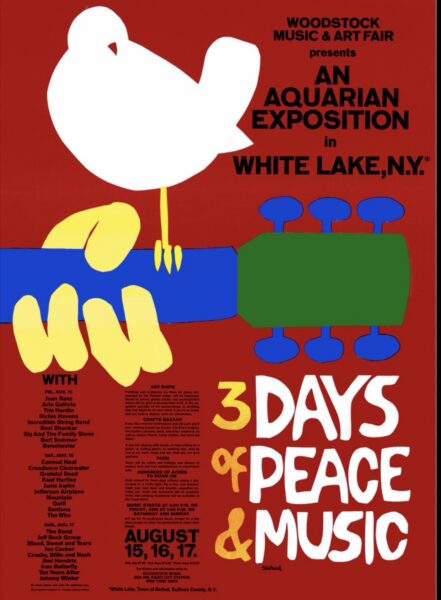
Before it became a poster on a dorm-room wall, before it became a documentary, before it became shorthand for peace, love, rebellion, and every dream the 1960s ever sold to the world, Woodstock was just a field.
A dairy farm in Bethel, New York.
Grass. Mud. Fences. Bad roads. Bad planning. Too many people. Not enough food. Rain coming down like the sky had joined the band.
And somehow, out of that mess, came the most famous music festival in history.
Woodstock was not clean. It was not smooth. It was not some perfectly organized celebration of youth culture. It was chaos with a backbeat. It was half disaster, half miracle. It was hundreds of thousands of young people pouring into the countryside in August 1969, looking for music, freedom, each other, and maybe some proof that the world did not have to stay as broken as it looked on the evening news.
Vietnam was still burning. America was divided. Parents and children were speaking different languages. The old world was cracking. The new one had not arrived yet.
Then the amps turned on.
And for three days, the mud became holy ground.
The Festival That Escaped Its Own Organizers
Woodstock was supposed to be big.
It was not supposed to become uncontrollable.
The official name was the Woodstock Music & Art Fair, held from August 15 to August 18, 1969, on Max Yasgur’s farm in Bethel, New York. The organizers imagined a major festival. What they got was a human wave.
Cars jammed the roads for miles. People abandoned vehicles and walked. Fences became suggestions. Tickets became almost meaningless. The crowd kept growing until the festival stopped feeling like an event and started feeling like a temporary nation.
By the time everyone realized there were too many people to control, there was only one choice left: let it happen.
That is when Woodstock became more than a concert.
It became a social experiment with guitars.
No one really knew whether it would hold together. There were too many bodies, too little infrastructure, too much weather, too much uncertainty. Any reasonable person could have looked at that field and seen a disaster waiting to happen.
But something strange happened.
The disaster never fully arrived.
The crowd endured. The musicians played. The rain fell. The mud swallowed shoes, blankets, and whatever remained of the original plan. Yet the spirit of the place kept rising. Woodstock became one of those rare moments where the failure of organization created the feeling of freedom.
It was not perfect.
That was the point.
A Generation Arrives in One Field
The late 1960s were not background noise to Woodstock. They were the reason Woodstock mattered.
This was not just a festival full of people who liked music. This was a generation living inside a storm. The Vietnam War was on television. Civil rights battles had reshaped the country. Political assassinations were still fresh wounds. The gap between young America and old America felt like a canyon.
For many of the people who came to Bethel, music was not just entertainment.
It was language.
Rock ’n’ roll had become the newspaper, the church, the protest sign, the diary, and the escape route. Dylan had already gone electric. The Beatles had stopped touring and gone inward. The Stones were getting darker. Hendrix had turned the guitar into a weapon of sound. Soul music had carried pain and dignity into the mainstream. Folk music had turned protest into poetry.
Woodstock gathered all of that energy and dropped it into one wet, overcrowded field.
That is why the festival still feels enormous.
It was not only who played.
It was what the moment represented.
A generation showed up not just to hear songs, but to see itself.
The Music That Held the Whole Thing Together
The lineup was absurd.
Not just good. Not just historic. Absurd.
Jimi Hendrix. The Who. Janis Joplin. Santana. Sly and the Family Stone. Jefferson Airplane. Joan Baez. Joe Cocker. Creedence Clearwater Revival. Crosby, Stills, Nash & Young. Richie Havens. The Band. Ten Years After. Country Joe and the Fish. Arlo Guthrie. Canned Heat.
It was a living museum of the era before anyone knew it would become one.
But Woodstock’s greatness was not just in the names on the poster. It was in the way the performances collided with the conditions. Everything felt unstable. Everything felt delayed, improvised, stretched past the breaking point. Artists went on at strange hours. Sets blurred into dawn. The weather kept interfering. The crowd kept waiting.
And somehow, the chaos made the music feel bigger.
Richie Havens opened the festival and became its first great spirit. With the schedule already falling apart, he stretched his performance, improvised, and turned the word “freedom” into a chant that seemed to rise out of the whole field. It felt less like an opening set and more like the festival finding its pulse.
Santana, still not yet the massive name they would become, walked onto that stage and exploded. Their set had heat, rhythm, and danger. It sounded like Latin percussion and electric blues had met in the middle of a thunderstorm. Woodstock made them famous because they played like they were already legends.
The Who came in like a riot. Their performance was aggressive, sharp, and almost violent in its energy. At a festival remembered for peace, The Who reminded everyone that rock ’n’ roll was not always gentle. Sometimes it kicked the door open.
Janis Joplin brought a different kind of storm. Her voice always sounded like it had lived three lives before the song even started. She did not sing polished. She sang exposed. At Woodstock, that rawness mattered. She was not there to be perfect. She was there to be felt.
Sly and the Family Stone may have captured the festival’s most electric sense of possibility. Their music was funk, soul, rock, gospel, and revolution wrapped into one. They sounded like the future had rhythm.
By the time the weekend dragged toward Monday morning, the festival had become something beyond exhaustion. It had become ritual.
Then Hendrix walked out.
Hendrix and the Sound of America Coming Apart
Jimi Hendrix did not close Woodstock in front of the biggest crowd of the weekend.
By the time he played, many people had already left. The field was drained. The dream was tired. The festival was limping into Monday morning.
But sometimes history waits for the perfect wrong moment.
Hendrix stood there with his white Stratocaster and played “The Star-Spangled Banner” like no one had ever heard it before. It was not just a cover. It was an interpretation so powerful it became part of the national memory.
His guitar screamed. It bent. It groaned. It mimicked bombs, sirens, rockets, fear, violence, and mourning. It sounded like the national anthem being dragged through Vietnam and returned covered in smoke.
Some heard protest.
Some heard patriotism.
Some heard chaos.
That is why it mattered.
Great art does not always explain itself. Sometimes it creates a sound large enough for everyone’s argument to fit inside it.
Hendrix made the anthem beautiful and terrifying at the same time. He took a song everyone knew and turned it into a mirror. What people heard depended on what they already believed America was becoming.
In a weekend full of legendary performances, that moment became the one that would not die.
It was Woodstock’s final lightning strike.
The Mud Was Part of the Message
The myth of Woodstock usually comes dressed in flowers, fringe, peace signs, and sunlight.
But the real Woodstock was soaked.
Rain turned the grounds into mud. People slept outside, shared food, lost belongings, and moved through the weekend in a strange mix of discomfort and joy. The festival was underprepared for the size of the crowd. Medical teams were stretched. Supplies were limited. Performers had to be flown in by helicopter because the roads were jammed beyond usefulness.
On paper, it sounds miserable.
In memory, it became magic.
That is one of the strange truths about Woodstock: the hardship helped create the legend. The mud made it communal. Nobody could pretend to be above the mess. Everyone was in it together — the famous, the unknown, the idealists, the wanderers, the kids who came for Hendrix, the kids who came for something they could not name.
The field became a city without walls.
For three days, the usual rules loosened. Money mattered less. Status mattered less. The outside world felt far away, even though all its problems were the reason everyone had gathered in the first place.
Woodstock did not erase reality.
It paused it.
That pause was enough to become myth.
Woodstock vs. the Real World
The easy version of Woodstock says it proved peace and love could save the world.
The harder truth is more interesting.
Woodstock did not save the world. It did not stop the war. It did not fix America. It did not make the 1970s peaceful. In fact, the dream of the ’60s would soon face darker endings — Altamont, Kent State, breakups, burnout, disillusionment, and the realization that music could inspire change but could not do all the work by itself.
But Woodstock still mattered because it showed what people were reaching for.
That is the difference.
It was not the answer.
It was the wish.
A muddy, overcrowded, feedback-filled wish that maybe people could gather without destroying each other. Maybe music could create community. Maybe youth culture had power. Maybe the future did not have to look exactly like the past.
That hope may have been naive.
But it was not meaningless.
Sometimes a generation needs a symbol before it knows what to do next.
Woodstock became that symbol.
The Legend That Outgrew the Weekend
Most concerts end when the lights go down.
Woodstock kept growing.
The documentary helped make it immortal. The performances became cultural artifacts. The images became posters, album covers, history-book shorthand. The word itself became bigger than the event. Say Woodstock, and people do not just think of a festival. They think of a feeling.
That feeling has been sold, copied, misunderstood, marketed, and romanticized for decades. But underneath all of that, the original still has power because it was not manufactured cleanly enough to feel fake.
It was too messy to be fake.
That is why people still care.
Woodstock was the rare cultural moment that looked impossible while it was happening and inevitable after it was over. Of course the 1960s needed a gathering like that. Of course rock music needed its great communal myth. Of course Hendrix had to be there at the end, bending the anthem into smoke.
But none of that was obvious in the moment.
In the moment, it was just mud, noise, rain, traffic, nerves, and music.
History came later.
Final Thought
Woodstock was not the greatest festival because everything went right.
It became the greatest festival because almost everything could have gone wrong — and somehow, the music carried it.
It was a beautiful accident. A muddy miracle. A generation’s dream with bad weather and loud amplifiers. It captured rock ’n’ roll at the exact moment when music felt like it could explain the world, challenge the world, and maybe even heal some tiny broken piece of it.
For three days in August 1969, a farm in Bethel became the center of the cultural universe.
Not because it was perfect.
Because it was alive.
And that is why Woodstock still matters.
It was not just a concert.
It was the sound of a generation standing in the mud, looking at a broken world, and singing anyway.