
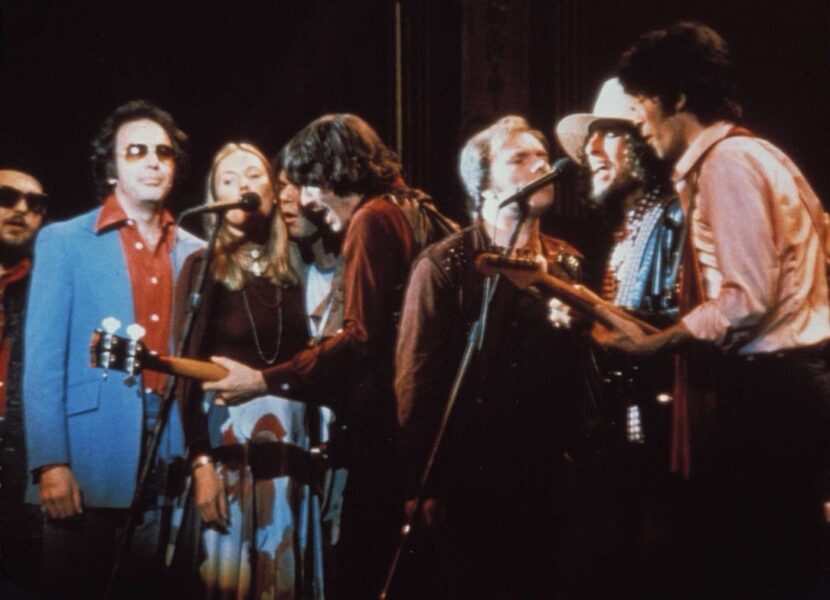
Thanksgiving night, 1976.
Most people were home eating turkey, watching football, or falling asleep on the couch.
But inside the Winterland Ballroom in San Francisco, something much bigger was happening. One of the most respected groups in rock history was getting ready to say goodbye — and they weren’t going quietly.
They were going out with Bob Dylan.
With Muddy Waters.
With Van Morrison.
With Dr. John.
With Eric Clapton.
With Joni Mitchell.
With Neil Young.
With Ringo Starr and Ronnie Wood.
What started as a farewell concert for The Band turned into one of the most legendary gatherings of musicians ever put on a stage. It was called The Last Waltz, and almost 50 years later, it still feels less like a concert and more like rock and roll’s final Thanksgiving dinner. The show took place on November 25, 1976, at San Francisco’s Winterland Ballroom, and was later turned into a film by Martin Scorsese.
But the wildest part?
It wasn’t just a goodbye.
It was a coronation.
The Band Was Never Supposed to Be Flashy
The Band didn’t look like rock stars from another planet.
They didn’t have the glitter of Bowie, the swagger of Mick Jagger, or the danger of Zeppelin.
They looked like five guys who had walked out of an old photograph — part bar band, part country church, part traveling circus.
That was their magic.
Robbie Robertson, Levon Helm, Rick Danko, Richard Manuel, and Garth Hudson built a sound that felt older than rock itself. They sounded like dirt roads, old railways, whiskey glasses, Southern ghosts, gospel choirs, and back-room blues bands all at once.
Before they were known as The Band, they backed Ronnie Hawkins as The Hawks, then became Bob Dylan’s backing band during his electric era. That connection mattered. Dylan didn’t just show up to The Last Waltz as a guest. He showed up like a ghost from their origin story. The concert included both Ronnie Hawkins and Bob Dylan, two figures tied directly to The Band’s rise.
That’s what made the night feel so powerful.
It wasn’t just famous people playing songs.
It was The Band inviting their past onto the stage.
Cool Fact: The Audience Got Thanksgiving Dinner First
This wasn’t a normal concert where people just walked in, grabbed a beer, and waited for the lights to go down.
Bill Graham, the legendary promoter, helped turn the night into a full event. The audience of about 5,000 people was served turkey dinner before the show. There was even ballroom dancing before The Band started playing.
Think about that.
Before one of the greatest rock concerts ever, people were sitting down for Thanksgiving dinner inside Winterland.
That detail makes the whole thing feel almost unreal.
It wasn’t just a concert.
It was a feast.
A funeral.
A reunion.
A celebration.
A goodbye party for an entire era of music.
The Show Started Like a Movie Before It Even Became One
The Band hit the stage around 9 p.m. and opened with “Up on Cripple Creek.” From there, they moved through songs like “The Shape I’m In,” “Stage Fright,” “This Wheel’s on Fire,” and “The Night They Drove Old Dixie Down.” They were backed by a horn section with arrangements connected to Allen Toussaint, which gave the whole night a bigger, richer sound.
But the real drama came when the guests started walking out.
One by one, the stage became a museum of American music.
Ronnie Hawkins brought the old rockabilly spirit.
Dr. John brought New Orleans voodoo piano.
Muddy Waters brought the blues.
Eric Clapton brought British guitar royalty.
Neil Young brought the cracked, haunted folk-rock edge.
Joni Mitchell brought poetry.
Van Morrison brought soul-fire.
Bob Dylan brought the myth.
It was like The Band wasn’t just saying goodbye to their own career.
They were saying goodbye to every road that led them there.
Dr. John Was the Coolest Man in the Room
One of the best moments of the night was Dr. John performing “Such a Night.”
He didn’t need to jump around.
He didn’t need to force it.
He sat at the piano with that New Orleans cool, wearing shades, playing like he had the entire room in his pocket.
Dr. John’s appearance mattered because The Band’s music always had that old American gumbo feeling. They pulled from blues, gospel, country, soul, folk, and New Orleans rhythm. Dr. John fit perfectly because he sounded like the midnight version of what The Band was chasing in daylight.
He made the stage feel smoky even if you weren’t there.
Van Morrison Basically Stole the Show
Van Morrison came out and performed “Caravan,” and by the end of it, he looked like a man possessed.
There’s a moment where he kicks his leg and struts offstage like he knows he just tore the roof off the place.
It is one of the most replayable moments in the entire film.
The funny thing is, The Last Waltz is loaded with giants — Dylan, Clapton, Muddy Waters, Neil Young — but Van Morrison’s performance still jumps out because he treated it like a prizefight.
He didn’t just sing.
He attacked the song.
That’s what makes the concert so special. Everyone brought their own world onto the stage.
Eric Clapton’s Guitar Strap Broke — And Robbie Robertson Saved the Moment
One of the coolest little facts from the night involves Eric Clapton.
During “Further On Up the Road,” Clapton’s guitar strap came loose. For a split second, it could have thrown off the performance.
But Robbie Robertson jumped in with a quick guitar lead, basically covering the moment like a veteran ballplayer making a diving stop.
That’s the beauty of the night.
Even with cameras, legends, and a historic farewell atmosphere, it was still live music. Things could go wrong. The players had to react.
That little mistake makes the performance feel more real, not less.
Neil Young Had a Famous Editing Problem
One of the most talked-about behind-the-scenes stories from The Last Waltz involves Neil Young.
Young performed “Helpless,” and in the final film there was famously editing done because of cocaine visible on his nose. It became one of those rock-history stories that sounds too ridiculous to be real — but it fits the chaotic 1970s atmosphere around the whole event.
That’s part of why The Last Waltz feels so fascinating.
It is polished and cinematic, but underneath the polish, you can still feel the wildness of the era.
The tuxedos were clean.
The music was beautiful.
But the 1970s were still in the room.
Muddy Waters Almost Didn’t Get Fully Captured
Muddy Waters performing “Mannish Boy” is one of the strongest moments in the film.
The crazy part is that concert films in that era were not as easy to shoot as today. You didn’t just pull out 20 digital cameras and catch everything. Scorsese’s crew had to plan shots carefully.
That makes Muddy’s performance feel even more valuable. It is not just a blues legend showing up for a guest spot — it is one of the great bluesmen being preserved on film in a room full of younger musicians who owed him everything.
Without Muddy Waters, half the people on that stage don’t exist the same way.
The Band knew that.
That’s why his presence felt so heavy.
The Staples Singers’ “The Weight” Wasn’t Actually From the Concert
Here’s a detail a lot of casual fans don’t know.
The famous version of “The Weight” with The Staple Singers in the movie was not performed live during the Winterland concert. It was filmed later on a soundstage. The same goes for some other staged musical segments. Mavis Staples later remembered the soundstage performance as emotional and powerful, especially because of her connection to the song and The Band.
That doesn’t ruin the moment.
It actually adds another layer.
The Last Waltz is not just raw concert footage. It is part concert, part documentary, part myth-making.
Scorsese wasn’t only recording a show.
He was building a legend.
Martin Scorsese Turned It Into Cinema
This is why The Last Waltz still stands apart from most concert films.
A lot of concert movies simply point cameras at a stage.
Scorsese made it feel like a crime movie, a religious service, and a dream all at once.
The lighting is dramatic. The faces look carved out of shadow. The interviews feel intimate. The performances feel massive.
And the opening title card says it all:
“This film should be played loud.”
That one line tells you exactly what kind of movie you’re about to see.
The film was released in 1978, two years after the concert, and it became widely known as one of the greatest concert films ever made.
But Not Everyone in The Band Saw It the Same Way
This is where the story gets deeper.
On the surface, The Last Waltz looks like a perfect farewell.
But behind the scenes, there was tension.
Robbie Robertson was ready to stop touring. He felt the road had become dangerous, exhausting, and unsustainable. In the film, he talks about the weight of being on the road for 16 years and how the numbers started to scare him.
But Levon Helm, the Band’s drummer and one of its great voices, later became critical of the film and the way the story was shaped. He felt it focused too heavily on Robertson and not enough on the full group.
That tension gives The Last Waltz a bittersweet edge.
It is beautiful, but it is not innocent.
It is a goodbye concert, but also a power struggle over memory.
Who gets to tell the story?
Who gets remembered as the leader?
Who gets pushed into the background?
That’s what makes it more than a music movie.
It is about legacy.
Bob Dylan Showing Up Made the Night Complete
The Band could not have had a true farewell without Dylan.
Their history with him was too important.
They were there when Dylan went electric and shocked the folk world. They played with him during one of the most important transformations in modern music. So when Dylan walked onto the Winterland stage, it felt like the circle closing.
Dylan performed songs including “Forever Young” and “Baby Let Me Follow You Down.”
By the end, the stage filled with musicians for “I Shall Be Released.”
That final group performance felt almost biblical.
The Band had backed Dylan.
They had carried American music on their backs.
And now everybody was standing around them, singing a song about release.
You almost couldn’t write it better.
Why It Still Feels So Powerful
The reason The Last Waltz still hits is because it captures something people don’t always realize until later:
Great eras usually don’t announce when they’re ending.
They just end.
One night, the lights go down.
One band stops touring.
One stage gets cleared.
One group of musicians walks off, and years later everyone realizes they witnessed the closing scene of something bigger than a concert.
That is what happened at Winterland.
The Band was saying goodbye to the road, but the night also felt like a farewell to the old idea of rock and roll as a traveling brotherhood — musicians swapping songs, borrowing sounds, backing each other up, learning from bluesmen, poets, gospel singers, folk writers, and barroom piano players.
It was messy.
It was romantic.
It was probably impossible to ever recreate.
Final Thought
The Last Waltz wasn’t great just because famous people showed up.
It was great because every famous person on that stage meant something to The Band’s story.
Dylan represented the revolution.
Muddy Waters represented the roots.
Dr. John represented the mystery.
Van Morrison represented the soul.
Joni Mitchell represented the poetry.
Eric Clapton represented the guitar-hero era.
And The Band stood in the middle of it all, not as the loudest group in the room, but maybe the most important.
They were the house band for American music’s memory.
That’s why The Last Waltz still matters.
It wasn’t just the end of The Band.
It was the night rock and roll threw itself a goodbye party — and somehow, everyone who mattered found their way to the stage.