
There are ugly moments in sports.
Then there is the night basketball spilled into the stands.
On November 19, 2004, the Indiana Pacers and Detroit Pistons met at The Palace of Auburn Hills in what was supposed to be an early-season heavyweight fight. It had all the ingredients of a real rivalry: two Eastern Conference powers, bad blood from the previous playoffs, physical defense, big personalities, and a crowd that already felt like it was sitting on top of the court.
The Pacers were not just another team. They were championship contenders. Reggie Miller was chasing one last ring. Jermaine O’Neal was an All-NBA force. Ron Artest, now known as Metta Sandiford-Artest, was the league’s reigning Defensive Player of the Year. Stephen Jackson brought toughness. Indiana had the kind of edge that made them dangerous.
Detroit was the defending NBA champion.
That alone made the night feel bigger.
But with less than a minute left, the game stopped being about basketball.
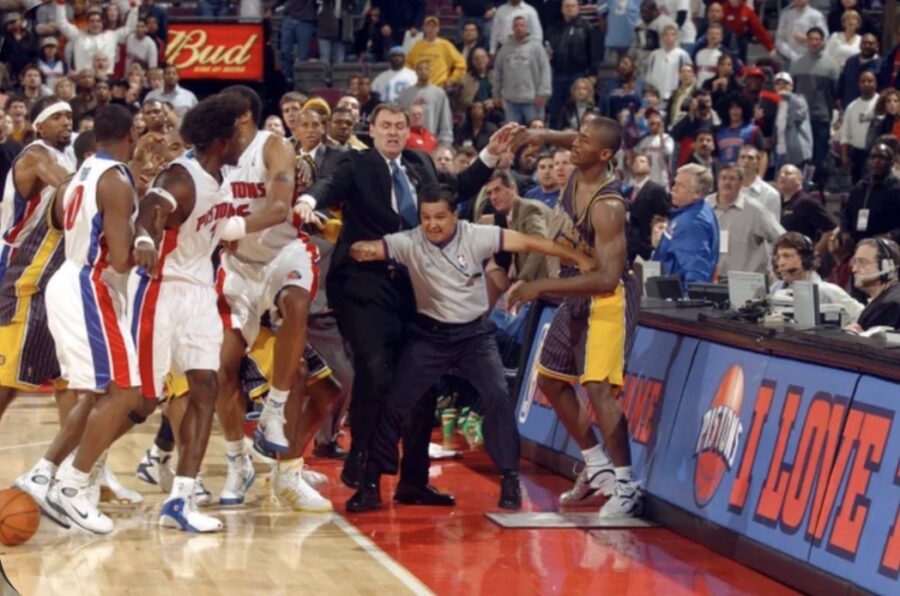
Indiana was up comfortably, 97-82, when Ben Wallace went up for a shot near the rim. Artest fouled him hard from behind. Wallace, already frustrated, shoved Artest with both hands. Players rushed in. Coaches jumped between bodies. The crowd rose. The whole building started buzzing with that strange playoff-type anger, even though it was only November.
For a moment, it looked like the situation might calm down.
Then came the cup.
As Artest lay on the scorer’s table trying to separate himself from the chaos, a fan threw a drink that hit him. That one act changed everything.
Artest jumped into the stands.
Stephen Jackson followed.
Suddenly, NBA players were in the crowd. Fans were throwing punches. Players were swinging back. Security was overwhelmed. Announcers were stunned. The court turned into a battlefield, and the image of a professional basketball game completely disappeared.
It was not just a fight.
It was a total breakdown of the invisible wall between athletes and fans.
Why It Was So Shocking
Sports fights had happened before. Basketball had always been emotional. The NBA had seen hard fouls, bench-clearing moments, trash talk, and rivalries that ran hot.
But this was different.
This was the crowd becoming part of the fight.
That is what made Malice at the Palace so unforgettable. It was not just players losing control. It was fans losing control too. The arena, which is supposed to be entertainment, suddenly felt dangerous. The people watching were no longer just spectators. Some became part of the chaos.
That image scared the NBA.
It scared the league office. It scared teams. It scared sponsors. It scared parents watching at home. And it changed how people talked about the players involved, especially Ron Artest, Stephen Jackson, Jermaine O’Neal, and the Pacers.
The suspensions were massive.
Artest was suspended for the rest of the season, including the playoffs — 86 games total. Stephen Jackson received 30 games. Jermaine O’Neal originally received 25 games, later reduced to 15. Ben Wallace received six games. Several other players were punished too.
For Indiana, it was devastating.
The Pacers had real championship hopes, and in one night, that dream basically collapsed. Artest was their defensive anchor. Jackson was a key wing. O’Neal was their star big man. Reggie Miller was near the end of his career. This was supposed to be one of the best teams in the league.
Instead, their season became defined by one of the darkest nights in NBA history.
The Human Side
What makes this story so powerful is that nobody walked away untouched.
Artest became the face of the incident, but the full story is more complicated than one player snapping. The fan who threw the drink started the spark. Security was not prepared. Emotions were already out of control. The rivalry had pressure built into it. The atmosphere was combustible.
That does not excuse what happened.
But it explains why the night still gets discussed.
It was not one bad decision. It was a chain reaction. A hard foul. A shove. A tense crowd. A thrown drink. A player charging into the stands. Other players following. Fans coming onto the court. Punches thrown. Cups flying. A league watching its image burn in real time.
And in the middle of it all were human beings, not just highlights.
Ron Artest later spoke openly about his mental health and the pressure he carried. Stephen Jackson has said he went into the stands to protect his teammate. Jermaine O’Neal saw his reputation take a hit despite being one of the league’s best players. Reggie Miller lost maybe his last real chance at a championship run.
That is the tragedy of the story.
It was not just a fight.
It was a turning point that changed careers.
How It Changed the NBA
The league never looked at security the same way again.
After Malice at the Palace, the NBA cracked down hard. Arena security became tighter. Fan behavior became a bigger priority. Alcohol rules were reviewed. The league created more distance between players and spectators. The dress code era soon followed under commissioner David Stern, part of a larger attempt to clean up the NBA’s image.
That part is still debated.
Some people saw it as necessary. Others believed the league unfairly used the incident to control how players looked, dressed, and expressed themselves. Either way, Malice at the Palace became bigger than one game. It became a cultural moment.
It forced the NBA to ask uncomfortable questions.
How close is too close between fans and players?
What happens when spectators cross the line?
How much responsibility belongs to the athletes, and how much belongs to the people in the stands?
And maybe the biggest question:
How does a league built on emotion control the exact thing that makes it exciting?
Why It Still Matters
Twenty years later, Malice at the Palace still feels unreal.
Part of that is because it looked like something that was never supposed to happen in a major American sports league. NBA players are larger than life, but they are also expected to absorb everything: boos, insults, drinks, popcorn, heckling, disrespect. Fans pay for tickets and sometimes think that gives them permission to say or do whatever they want.
That night exposed how dangerous that idea can be.
It also showed how fast a game can lose control when everyone involved forgets the line.
The Pacers lost a championship window. The Pistons’ arena became the site of the NBA’s most infamous brawl. Ron Artest’s career was forever tied to that moment, even though he later rebuilt his image, won a championship with the Lakers, and became one of the most fascinating redemption stories in basketball.
But the footage remains.
The cup flying.
Artest charging.
Jackson in the stands.
O’Neal sliding across the court.
Fans screaming.
Players being covered in drinks as they left the floor.
It is chaotic, ugly, and impossible to forget.
Final Thought
Malice at the Palace is not remembered because it was a great basketball game.
It is remembered because it was the night the NBA’s worst fear came true.
The court and the crowd became one mess of anger, fear, and violence. A championship contender was destroyed. Careers were reshaped. The league changed its rules, its image, and the way it protected its players.
For most NBA stories, the game is the center of everything.
But on November 19, 2004, the game disappeared.
And all that was left was one of the most shocking nights basketball has ever seen.