
By Ty
Bob Dylan has spent most of his life refusing to stand still long enough for anyone to fully explain him.
Every time people thought they had him figured out, he moved.
Folk prophet? He plugged in.
Voice of a generation? He rejected the crown.
Rock star? He disappeared into country, gospel, blues, standards, radio, painting, whiskey-voiced road songs, and whatever else the world was not expecting him to do next.
So when Dylan finally released a memoir in 2004, people probably expected some kind of grand confession. Maybe a clean timeline. Maybe the “real story” behind the famous moments. Maybe the book that would finally explain the man behind the myth.
Instead, Dylan gave them something much stranger.
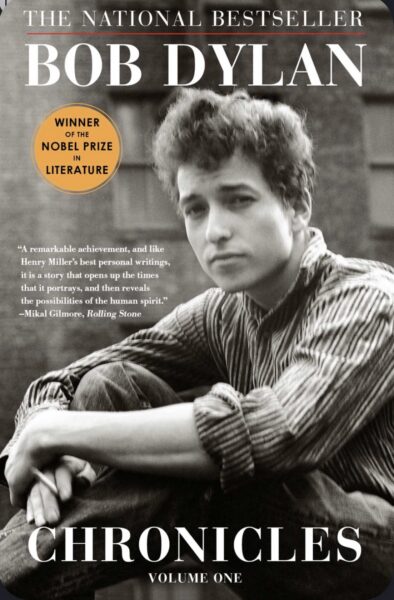
He gave them Chronicles: Volume One — a memoir that does not really behave like a memoir at all.
It moves like a song.
It drifts through time. It skips the obvious parts. It lingers on side characters, smoky rooms, forgotten streets, old records, books, voices, weather, and the strange feeling of being young in New York with nothing but ambition and a guitar case.
It is not Dylan sitting down to say, “Here is what happened.”
It is Dylan saying, “Here is what it felt like.”
And with Bob Dylan, that difference means everything.
The Autobiography Nobody Expected
By the time Chronicles arrived, Dylan was already one of the most written-about musicians in American history.
People had spent decades trying to decode him. They studied his lyrics like scripture. They argued over his interviews. They built theories around his motorcycle crash, his electric transformation, his religious years, his silence, his comeback, his voice, his masks, his jokes, and his contradictions.
Everybody knew Bob Dylan had a way with words.
But not everybody expected him to write a book this alive.
Chronicles: Volume One was published by Simon & Schuster and is officially presented as a personal reflection on key moments, people, places, and influences that shaped Dylan’s life and art. The publisher describes it as “revealing, poetical, passionate, and witty,” and that is actually pretty close to the experience of reading it.
The book does not give readers the easy version of Bob Dylan.
It gives them the foggy one.
The funny one.
The wounded one.
The restless one.
The one who can turn a room, a song, or a passing stranger into something that feels half-real and half-dreamed.
That is why the book works. Dylan does not write like a celebrity looking back at his own statue. He writes like a man walking through old neighborhoods at night, seeing ghosts in every doorway.
The Trick: Dylan Skips the Parts Everyone Wanted
Here is what makes Chronicles so fascinating.
Dylan does not spend the whole book explaining the 1960s.
He does not give readers a neat, full breakdown of Blowin’ in the Wind, Like a Rolling Stone, Newport, the motorcycle crash, the full electric controversy, or every major cultural earthquake attached to his name.
That would have been the predictable version.
Dylan does not do predictable.
Instead, he focuses heavily on selected chapters of his life: his early arrival in New York around 1961, the New Morning period around 1970, and the Oh Mercy period in the late 1980s. The book is not a straight-line life story. It is a set of chosen rooms Dylan lets the reader enter.
That decision says a lot.
Most artists would rush toward the famous scenes.
Dylan walks around them.
He knows the legend is already there. He knows the world has talked the 1960s to death. So instead of handing over the obvious greatest-hits version of his life, he writes about the corners: the years before the explosion, the years after the pressure, and the strange creative valleys where a man has to figure out how to become himself again.
That might be the most Dylan thing about the whole book.
He makes the missing parts feel as important as the parts he includes.
Greenwich Village Before the Crown
The strongest section of Chronicles may be Dylan’s early New York material.
This is where the book feels most cinematic.
You can feel the cold. You can smell the coffee. You can hear the chairs scraping across the floors of small clubs. Dylan arrives in New York young, hungry, sharp-eyed, and still becoming the person the world would later turn into a symbol.
He is not famous yet.
That is what makes it so good.
He is watching. Listening. Absorbing.
He is walking through Greenwich Village like a student of everything: folk songs, old books, street characters, political arguments, blues records, Woody Guthrie, Irish ballads, Civil War songs, newspapers, poets, drifters, performers, and whatever else might sharpen his voice.
This is Dylan before the world started asking him to explain the times.
This is Dylan trying to find a language big enough to survive them.
And the book makes New York feel like more than a city. It feels like a furnace. A place where identities are melted down and rebuilt. Dylan does not arrive fully formed. He arrives like someone carrying pieces of himself in his pockets, looking for the right spark.
That is what makes the early section so powerful.
You are not reading about a legend.
You are watching the legend assemble himself.
The Man Who Hated Being Turned Into a Symbol
One of the most important parts of Chronicles is Dylan’s frustration with being labeled the “voice of a generation.”
That phrase has followed him for decades, but Dylan never seemed comfortable wearing it. In the book, he pushes back against the idea that he wanted to be some kind of Pied Piper leading a movement.
That is one of the central tensions of Dylan’s career.
The world wanted him to be clear.
Dylan wanted to remain free.
Fans, critics, journalists, and political believers wanted answers from him. They wanted him to stand in front of history and tell everyone what it meant. But Dylan was never that simple. He was too slippery, too funny, too suspicious of labels, too committed to movement.
He did not want to become a museum piece while he was still alive.
That is why Chronicles matters beyond music. It shows the cost of being misunderstood by people who love you.
Fame did not just make Dylan bigger. It made him trapped. The more people praised him as a prophet, the more they took away his right to be a musician, a husband, a father, a reader, a fan, a working artist, or just a strange guy following his own instincts.
That is the quiet sadness underneath the book.
Dylan got everything artists dream about.
Then he had to spend years escaping what people thought that meant.
The Beauty of the Side Characters
One of the best things about Chronicles is that Dylan does not only write about Dylan.
He fills the book with people.
Club owners. Musicians. Poets. Producers. Friends. Strangers. Odd characters. Brilliant talkers. People who appear for a few pages and then disappear like they stepped out of a song.
That is where Dylan’s prose feels closest to his songwriting.
He has always been great at creating characters who seem larger than the space they occupy. Think of the people drifting through songs like “Desolation Row,” “Tangled Up in Blue,” “Visions of Johanna,” or “Lily, Rosemary and the Jack of Hearts.” They feel real and unreal at the same time.
Chronicles works the same way.
Dylan turns memory into atmosphere. A person does not need to be famous to matter. A conversation does not need to change history to feel important. A dusty room can become a whole world if the right voice is describing it.
That is Dylan’s gift.
He notices what other people walk past.
The Book Is Also a Magic Trick
Of course, with Dylan, there is always another layer.
Chronicles has been praised as a great memoir, but it has also been questioned for how factual it really is. Some critics and Dylan scholars have argued that parts of the book are slippery, exaggerated, borrowed, rearranged, or mythologized. The book has drawn attention for its loose relationship with strict autobiography, including debates over Dylan’s use of outside phrases and literary echoes.
But with Dylan, that controversy almost becomes part of the point.
This is not an excuse for everything. Facts matter. Accuracy matters. A memoir is still supposed to carry responsibility.
But Dylan has always worked in the space between truth and invention.
He came to New York and reshaped his own origin story. He borrowed from folk tradition, blues language, old ballads, newspapers, poetry, scripture, movies, and American myth. His whole artistic identity was built from fragments — not in a cheap way, but in the old folk way, where songs travel, change clothes, pick up dust, and come back sounding new.
That is why Chronicles feels less like a court transcript and more like a Dylan song in book form.
You do not read it only to find out what happened.
You read it to watch Dylan arrange reality.
Memory, Myth, and the Dylan Problem
The problem with Bob Dylan is that everybody wants the “real” one.
But what if the real Dylan is the one who keeps changing?
That is what Chronicles seems to understand better than most books about famous people. Identity is not always a fixed thing. Memory is not always clean. Artists do not always explain themselves best by giving exact dates and perfect facts.
Sometimes they reveal themselves through obsession.
Dylan writes about the records that hit him like lightning.
He writes about old songs like they are sacred maps.
He writes about hearing certain voices and feeling doors open inside him.
Those moments may tell us more about Dylan than a traditional confession ever could.
Because Dylan’s real autobiography was never just where he lived or who he met.
It was what he heard.
It was the songs that entered him, rearranged him, and gave him permission to become something else.
The Strange Power of the Missing Volumes
The title is Chronicles: Volume One.
That alone is part of the mystery.
It suggests more was coming. A second volume. Maybe a third. More rooms. More stories. More Dylan fog.
But more than 20 years later, Chronicles: Volume Two still has not properly arrived. The original book has continued to stand alone as the one major Dylan memoir, even as rumors and reports have floated around for years about possible follow-ups. As of the latest publicly available publisher information, Chronicles: Volume One remains the book officially available from Simon & Schuster.
And honestly?
That almost makes it better.
The missing sequels feel like part of the Dylan story.
Of course he gave the world “Volume One” and then vanished from the promise.
Of course the book leaves people wanting the next chapter.
Of course the man who spent a lifetime dodging final explanations would publish a memoir that still feels unfinished.
That is the joke and the genius.
Even when Dylan explains himself, he leaves you chasing him.
Why Chronicles Still Matters
Chronicles matters because it proves Bob Dylan’s greatness was never limited to songs.
He did not win the Nobel Prize in Literature in 2016 by accident. Long before that award, his work had already changed the way people thought about lyrics, language, voice, and American storytelling. Simon & Schuster’s author page lists Dylan’s Nobel Prize, Pulitzer Prize Special Citation, Presidential Medal of Freedom, and other honors, but Chronicles shows something more intimate than awards: the machinery of his imagination.
The book lets you see the artist as a collector of sparks.
Dylan is not just remembering his life. He is showing how art gets made from everything around it: books, weather, fear, ambition, old songs, bad rooms, good voices, strange cities, dead heroes, and the pressure of being turned into something you never asked to become.
For music fans, it is essential because it gives texture to the legend.
For writers, it is essential because it shows how voice can carry a story even when the structure refuses to behave.
For Dylan fans, it is essential because it feels like sitting beside the man for a few hours while he tells you everything and nothing at the same time.
That is Bob Dylan.
He opens the door, lets you peek inside, then changes the locks before you can get too comfortable.
Final Thought
The best memoirs do not just tell you what a person did.
They show you how that person saw the world.
That is why Chronicles: Volume One still works. It is not a clean map of Bob Dylan’s life. It is a weather report from inside his mind. It is smoky, funny, sharp, evasive, poetic, and strange. It gives you Greenwich Village, New Orleans, Woodstock, old records, lost characters, private grudges, creative rebirths, and flashes of truth hiding inside stories that may or may not be completely true.
But maybe that is the point.
Bob Dylan was never just a singer.
He was never just a songwriter.
He was never just the voice of a generation, no matter how badly people wanted to trap him inside that phrase.
He was a maker of worlds.
And in Chronicles, he built one out of memory, myth, and the same old American dust that has been blowing through his songs from the very beginning.
The book does not solve Bob Dylan.
It does something better.
It lets the mystery keep singing.