
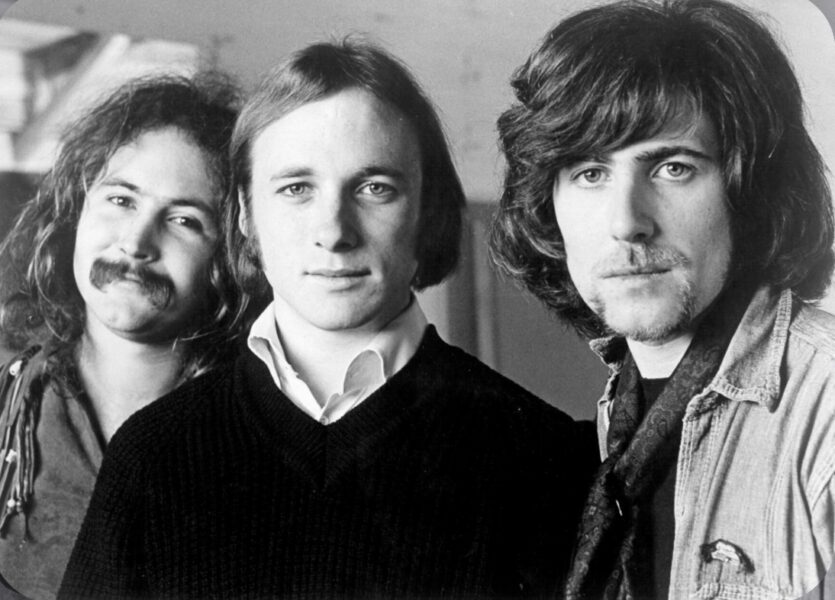
How Crosby, Stills & Nash turned heartbreak, harmony, and a changing America into folk-rock gold
By Ty
Some bands are built slowly.
Some are manufactured.
Some are born in garages, clubs, or record company offices.
But Crosby, Stills & Nash felt like they appeared out of the air.
Three voices. Three egos. Three completely different musical spirits. And somehow, when David Crosby, Stephen Stills, and Graham Nash sang together, the sound was so perfect it almost felt impossible.
It was not just harmony.
It was chemistry.
It was the kind of sound that makes people stop talking in the middle of a room. The kind that makes a song feel larger than the people singing it. Soft, bright, human, haunted — like folk music had suddenly learned how to float.
But the story of Crosby, Stills & Nash is not just about beautiful voices.
It is about what happens when beauty is created by complicated people.
Behind those golden harmonies were broken bands, wounded friendships, heavy ambition, political fire, and three men trying to find a new language for a country that was changing by the day.
They did not sound like The Beatles.
They did not sound like Dylan.
They did not sound like The Rolling Stones.
They sounded like a generation sitting on the floor at 2 a.m., trying to figure out what had just happened to the world.
Three Men Looking for a New Beginning
Before Crosby, Stills & Nash existed, all three members had already lived through major musical stories.
David Crosby had been in The Byrds, one of the most important folk-rock bands in America. He had that strange, rich voice and an even stranger mind — restless, outspoken, creative, and difficult to contain.
Stephen Stills had come from Buffalo Springfield, where he helped shape the sound of a band that could be country, rock, folk, protest, and California cool all at once. Stills had the guitar fire, the musical command, and the writer’s instinct.
Graham Nash had been in The Hollies, a hit-making British group known for clean pop hooks and gorgeous harmonies. Nash brought melody, polish, and a voice that could make a song feel gentle without making it weak.
Each one came from success.
Each one also came from frustration.
That matters because Crosby, Stills & Nash did not begin as young kids chasing their first break. They began as men who had already seen what bands could do — and what bands could do to you.
They were not starting from innocence.
They were starting from experience.
And maybe that is why the music hit so hard.
The Harmony That Changed Everything
The famous magic of Crosby, Stills & Nash was not complicated to explain, but it was almost impossible to recreate.
When they sang alone, each voice had its own character.
Together, they became something else.
Crosby gave the blend its mystery. Stills gave it muscle. Nash gave it lift.
One voice was earth.
One was fire.
One was air.
Together, they made songs feel weightless and wounded at the same time.
That was the secret. Their music was beautiful, but it was not empty. It had shadows in it. Even when the harmonies were sweet, the songs carried unease — about love, politics, identity, war, loneliness, and the strange feeling of being alive at the end of the 1960s.
That is why their debut album hit with such force.
It sounded like a new kind of folk-rock: intimate enough for a bedroom, big enough for a movement.
“Suite: Judy Blue Eyes” and the Sound of Heartbreak Turning Into Art
If one song introduced Crosby, Stills & Nash as something serious, it was “Suite: Judy Blue Eyes.”
That song is not just a track.
It is a doorway.
Stephen Stills wrote it about his relationship with Judy Collins, and you can hear all the pieces of a breakup inside it: love, frustration, regret, hope, confusion, and that strange pride people have when they are hurting but still trying to sound graceful.
The song does not move like a normal pop single. It shifts. It opens. It changes shape. It feels like different emotional chapters stitched together by harmony and acoustic guitar.
That is what makes it brilliant.
A lesser band would have turned heartbreak into one clean chorus.
Crosby, Stills & Nash turned it into a suite.
And when those voices rise together, the song stops feeling like one man’s breakup and starts feeling like something bigger — the sound of an entire era realizing love was not going to save everyone from the chaos outside.
They Arrived Right When America Needed That Sound
Crosby, Stills & Nash did not become important just because they sounded good.
They arrived at the exact moment their sound made sense.
America was tired. Vietnam was raging. The civil rights movement had changed the country and exposed its deepest wounds. Young people were losing faith in institutions. Music was no longer just entertainment. It was becoming a place where people went to feel understood.
CSN fit that moment perfectly.
They could sing softly without sounding weak.
They could write politically without sounding like they were giving a speech.
They could make songs that felt personal and national at the same time.
That is why their music has a different kind of power. It does not always charge at you. Sometimes it sits beside you and lets the weight of the world settle into the room.
Songs like “Wooden Ships,” “Long Time Gone,” and later, with Neil Young, “Ohio,” carried the fear and anger of the era without losing the humanity.
They were not just making records.
They were keeping emotional score.
Woodstock Made Them Mythic
Then came Woodstock.
Crosby, Stills & Nash were still a new group when they played the festival in 1969. They were not yet the untouchable veterans people would later imagine. They were still proving the whole thing could work.
And that made their appearance even more powerful.
There they were, in front of a massive crowd, representing the new dream of the counterculture: acoustic guitars, open harmonies, long hair, idealism, fear, and the belief that music could somehow hold a generation together.
Their performance helped turn them from a promising group into a symbol.
They sounded like the campfire at the end of the world.
That is the strange beauty of CSN. Their music could feel peaceful even when everything around it was trembling.
Then Neil Young Walked In
Of course, the story changed again when Neil Young joined.
Crosby, Stills & Nash became Crosby, Stills, Nash & Young — and suddenly the group had another force in the room.
Neil brought edge.
He brought danger.
He brought a haunted, electric weirdness that made the whole thing less polished and more unpredictable.
With Young, the harmonies were still there, but now the band had more bite. More tension. More storm clouds.
The result was powerful, but also unstable.
That is the thing about adding Neil Young to any situation: the music gets deeper, but the room gets more complicated.
CSNY became one of the greatest collections of talent in rock history, but it was never going to be easy. There were too many writers, too many leaders, too many visions, too many egos, and too much history pressing down on them.
But when it worked, it was incredible.
The Beauty and the Battle
The tragedy of Crosby, Stills & Nash is that the same things that made them great also made them fragile.
They were not a band with one clear captain.
They were a group of stars.
Crosby had his wild creative instincts.
Stills had his perfectionism and musical control.
Nash had his pop sense and emotional clarity.
Young, when involved, had his own restless direction.
That kind of talent can create magic.
It can also create war.
The voices blended better than the personalities did.
And maybe that is why the music still feels so alive. You can hear the tension inside the beauty. You can hear people reaching for unity while struggling to actually live inside it.
That is not a weakness.
That is the story.
Crosby, Stills & Nash made harmony sound perfect because real harmony between people is almost never perfect.
It is work.
It is friction.
It is compromise.
It is three voices trying to meet in the middle before drifting apart again.
Why Their Songs Still Last
The reason Crosby, Stills & Nash still matter is not just nostalgia.
It is because their best songs still feel useful.
“Helplessly Hoping” still sounds like two hearts missing each other in slow motion.
“Marrakesh Express” still carries that wide-eyed search for something bigger than ordinary life.
“Wooden Ships” still feels like a beautiful nightmare.
“Teach Your Children” still sounds like advice passed across generations, simple enough to sing along to and deep enough to sit with.
“Our House” still feels like the dream of peace inside a world that will not stop making noise.
And “Suite: Judy Blue Eyes” still feels like one of the great opening statements in rock history — a song that says, immediately, this group is different.
Their music lasts because it captures a feeling people still understand: wanting peace, wanting love, wanting meaning, and not always knowing how to hold onto any of it.
Final Thought
Crosby, Stills & Nash were not perfect.
That is part of why they were great.
They were complicated men with complicated friendships, carrying old wounds into new songs. But when they sang together, all that mess turned into something beautiful. Their voices made it sound like unity was possible, even if only for three minutes at a time.
That is the magic.
They came from different bands, different worlds, different temperaments — and for one shining moment, they found a sound that belonged to nobody else.
Crosby, Stills & Nash did not just make folk-rock prettier.
They made it feel human.
They proved that a whisper could be powerful, that harmony could carry protest, and that sometimes the most unforgettable sound in music is not a scream.
Sometimes it is three voices trying to become one.