
Jimi Hendrix did not just play guitar.
He attacked it, whispered through it, bent it, burned it, strangled it, and somehow made it sing like it was alive.
Before Hendrix, the electric guitar was already powerful. Chuck Berry made it swing. B.B. King made it cry. Muddy Waters made it growl. Eric Clapton made it roar.
Then Hendrix came along and made it sound like the world was ending and being born at the same time.
He was not just another great player. He was a new language. Feedback became emotion. Distortion became color. A solo was no longer just a solo. In Hendrix’s hands, it could be a storm, a war zone, a dream, a scream, or a prayer.
And the wildest part is this:
He changed music forever in only a few years.
The Kid From Seattle
Jimi Hendrix was born in Seattle on November 27, 1942. His birth name was Johnny Allen Hendrix before his father later renamed him James Marshall Hendrix. As a kid, he became obsessed with music and was influenced by blues, R&B, rock and roll, and guitar giants like B.B. King, Muddy Waters, Howlin’ Wolf, Buddy Holly, and Robert Johnson. He was self-taught and could not read music, which pushed him to focus even harder on what he heard.
That detail matters.
Hendrix did not learn guitar like someone studying a textbook.
He learned it like someone chasing a sound in his head.
He played left-handed, often using right-handed guitars flipped upside down. That image alone became part of the myth: Jimi standing there with a Stratocaster reversed, hair wild, clothes bright, fingers moving like they were plugged into some secret current nobody else could reach.
But before the legend, there was struggle.
Hendrix played backup for other artists. He worked the road. He performed behind acts like Little Richard, the Isley Brothers, and others before he became the name on the marquee. He was learning stagecraft, rhythm, showmanship, and survival.
He was not born famous.
He earned the fire.
London Lights the Fuse
Hendrix’s big break came when he went to England in 1966.
That move changed everything.
In London, he formed The Jimi Hendrix Experience with bassist Noel Redding and drummer Mitch Mitchell. Almost immediately, the British rock scene realized something strange had landed in front of them.
This was the era of Clapton, Page, Beck, Townshend, and the Beatles pushing rock music into new territory. These were not easy people to impress.
Hendrix stunned them anyway.
The Experience released Are You Experienced in 1967, and the album sounded like rock music had swallowed lightning. “Purple Haze,” “Foxy Lady,” “The Wind Cries Mary,” “Fire,” and “Manic Depression” were not just songs. They were signals from another planet.
His guitar did not stay in the background.
It became the main character.
Monterey: The Night America Finally Saw Him
By 1967, Hendrix was already making noise in Europe, but America had not fully caught up yet.
Then came the Monterey Pop Festival.
On June 18, 1967, Hendrix walked onto the Monterey stage and left a different kind of history behind. Paul McCartney had pushed for Hendrix to be included in the festival lineup, reportedly calling him “an absolute ace on the guitar.” Brian Jones of the Rolling Stones introduced him to the crowd as one of the most exciting performers he had ever heard.
Then Hendrix played like a man trying to make the old rules look ridiculous.
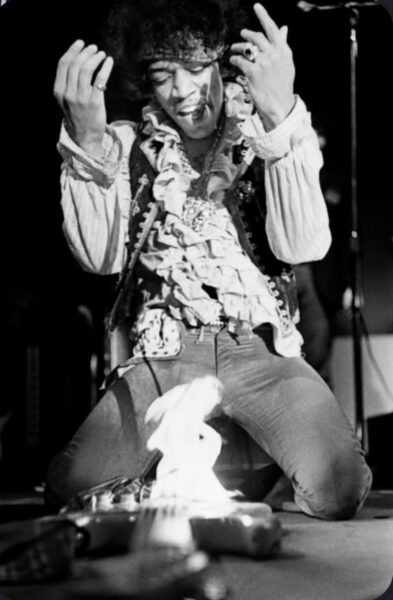
He tore through the set with a mix of blues, rock, sexuality, theater, and chaos. And at the end, he did the thing that became one of the most famous images in rock history.
He set his guitar on fire.
It could have been a cheap stunt in someone else’s hands.
With Hendrix, it felt ritualistic.
He later said he destroyed the guitar as a sacrifice because you sacrifice things you love.
That is what made the moment so powerful. It was not just destruction. It was devotion. He was offering the instrument back to the flames after making it do things people had never heard before.
After Monterey, Jimi Hendrix was no longer a rumor.
He was a revolution.
The Guitar as a Weapon, Paintbrush, and Voice
What separated Hendrix from almost everyone else was not just speed.
Plenty of guitarists could play fast.
Hendrix could make noise feel meaningful.
He used feedback not as an accident, but as an instrument. He used distortion like a painter uses shadow. He bent notes until they sounded almost human. He took the blues and dragged it into the psychedelic age without losing its pain.
That is why his music still feels alive.
“Little Wing” is delicate and beautiful, like a dream that disappears when you wake up.
“Voodoo Child (Slight Return)” sounds like a giant walking across the earth.
“All Along the Watchtower” took Bob Dylan’s song and turned it into something apocalyptic.
“Machine Gun” sounded like Vietnam coming through an amplifier.
He could be tender, violent, funny, cosmic, lonely, and explosive — sometimes in the same performance.
The guitar did not limit him.
It translated him.
Woodstock: The National Anthem Becomes a Mirror
Then came Woodstock.
By 1969, Hendrix was one of the highest-paid rock musicians in the world, and he headlined the festival. Because of delays, he did not perform until Monday morning, when much of the massive crowd had already left. He took the stage around 8 a.m. after days of chaos, mud, exhaustion, and myth-making.
And then he played “The Star-Spangled Banner.”
Not clean.
Not polite.
Not like a school ceremony.
He played it through feedback, distortion, bends, screams, and bombs bursting in air that sounded too much like actual bombs.
The performance became one of the defining moments of the 1960s. Some heard it as protest. Some heard it as patriotism. Some heard it as America being torn apart in real time.
Hendrix later pushed back against the idea that it was simply anti-American, saying, “We’re all Americans,” and that he played it the way the air felt in America at the time — “slightly static.”
That is the genius of the moment.
He did not give a speech.
He let the guitar say it.
Vietnam. Protest. Freedom. Violence. Beauty. Confusion. Pride. Pain.
All of it came out of six strings.
Electric Lady and the Sound He Was Chasing
By the end of the 1960s, Hendrix was not done evolving.
That might be the saddest part.
He was moving beyond the idea of being just a wild guitar hero. He wanted deeper music, more control, more experimentation. He helped create Electric Lady Studios in New York, a recording space designed around his vision and creativity. It officially opened in 1970, shortly before his death.
Think about that.
Hendrix built a place where he could finally chase the sounds in his head without watching the clock.
Then he barely got to use it.
Electric Lady was supposed to be his future.
Instead, it became part of his legend.
The Ending That Came Too Soon
Jimi Hendrix died on September 18, 1970, in London. He was only 27 years old.
That number has followed rock history like a shadow.
Twenty-seven.
Too young to be finished. Too brilliant to be forgotten. Too influential to ever really leave.
The tragedy is not just that Hendrix died young. It is that he died while still transforming. He had already changed rock guitar forever, but he was not done. He was moving toward funk, jazz, blues, soul, studio experimentation, and sounds that probably would have pushed the 1970s in directions nobody could predict.
He left behind three studio albums with the Experience during his lifetime: Are You Experienced, Axis: Bold as Love, and Electric Ladyland. Those records were enough to reshape rock music. The Rock & Roll Hall of Fame inducted the Jimi Hendrix Experience in 1992, recognizing the impact of a band that burned bright and fast.
Most artists spend a lifetime trying to create one unforgettable sound.
Hendrix created a universe in less than four years.
Why Jimi Hendrix Still Matters
Jimi Hendrix still matters because he made the electric guitar feel unlimited.
Before him, it was an instrument.
After him, it was weather.
It could rain, explode, whisper, laugh, cry, and bleed. Hendrix made the guitar speak in colors. He made rock music bigger, stranger, heavier, freer, and more imaginative.
But his story is not only about technique.
It is about vision.
He heard things other people did not hear yet. Then he pulled those sounds into the world, even if people were not ready for them. He stood at the intersection of blues history, psychedelic rock, Black musical tradition, British rock culture, American unrest, and pure personal imagination.
That is why Hendrix does not feel stuck in the 1960s.
He still sounds ahead of us.
Final Thought
Jimi Hendrix was not just the greatest guitarist people had ever seen.
He was proof that an instrument could become a revolution.
He took the blues, plugged it into the future, and made the world listen. He made noise beautiful. He made distortion emotional. He made the national anthem sound like a country arguing with itself.
And maybe that is why his music still hits so hard.
Because Hendrix did not play like he was trying to impress anyone.
He played like he had heard tomorrow — and was trying to bring the rest of us with him.