
Some bands walk onstage and try to sound dangerous.
Electric Light Orchestra sounded like they arrived from another planet.
They had guitars, drums, violins, cellos, glowing harmonies, massive choruses, and a whole futuristic imagination built around one wild idea: what if rock and roll could become cinematic?
That was the dream behind Electric Light Orchestra, better known as ELO.
They were not trying to be just another rock band. They wanted to take pop music, classical music, Beatles-style melody, and studio experimentation and launch it into the sky. At their best, ELO sounded like a jukebox inside a spaceship — familiar enough to sing along with, strange enough to feel like nothing else on the radio.
And the mastermind behind it all was Jeff Lynne.
The Idea: What If The Beatles Kept Going?
Electric Light Orchestra formed in Birmingham, England, in 1970. The original idea came from musicians including Jeff Lynne, Roy Wood, and Bev Bevan, who wanted to build a band that mixed rock with orchestral instruments. The Rock & Roll Hall of Fame lists Lynne, Wood, Bevan, and keyboardist Richard Tandy among the classic figures connected to ELO’s legacy. ELO was inducted into the Rock & Roll Hall of Fame in 2017.
The goal was bold from the beginning.
Instead of just guitars and drums, ELO wanted strings. Instead of short, simple rock songs, they wanted arrangements that felt bigger. There were cellos where most bands would put another guitar. There were violins swirling through the choruses. There were harmonies that felt like they came from the same dream world as late-period Beatles records.
The band’s early sound came out of that question every music fan loves to ask:
What would have happened if The Beatles never stopped pushing forward?
ELO gave one possible answer.
Make the songs bigger.
Make the studio part of the band.
Make rock sound like a movie.
Jeff Lynne Takes the Controls
Roy Wood left early, and Jeff Lynne became the main creative force behind ELO. That is when the band’s identity sharpened.
Lynne was not the loudest rock star in the room. He was more like a mad scientist with perfect pop instincts. He understood melody. He understood hooks. But he also loved texture — the way a song could sparkle, glow, echo, and build.
That is what made ELO different.
Their songs were catchy enough for the radio, but they were built like little worlds.
“Evil Woman” had a funky strut.
“Telephone Line” sounded like heartbreak traveling through outer space.
“Livin’ Thing” turned strings into pure drama.
“Turn to Stone” had the rush of a train leaving the station.
“Don’t Bring Me Down” proved they could strip away the orchestra and still hit like a rock band.
And “Mr. Blue Sky” became one of the happiest-sounding songs ever made, even though it carries the strange emotional power of someone trying to pull sunlight out of darkness.
From 1972 to 1986, ELO piled up major chart success, including many Top 40 hits in the United Kingdom and the United States. The band sold more than 50 million records worldwide during its original run, according to commonly cited band histories.
But numbers only tell part of the story.
ELO’s real achievement was sound.
They made rock feel enormous without making it cold.
The Sound of a Dream Machine
The 1970s were full of bands trying to be bigger, louder, heavier, or more rebellious.
ELO went another way.
They became brighter.
Their music had the ambition of progressive rock, but the heart of pop music. That combination was rare. A lot of progressive bands could show off. A lot of pop bands could write hooks. ELO could do both — and make it sound like the whole thing was wrapped in starlight.
That is why their songs still feel so alive.
Put on “Mr. Blue Sky” and it does not sound trapped in the 1970s. It sounds like a parade breaking through the clouds. Put on “Telephone Line” and it still captures that lonely feeling of wanting someone on the other end to answer. Put on “Livin’ Thing” and the strings still cut right through the track like lightning.
ELO’s genius was that the music sounded futuristic, but the emotions were simple.
Missing someone.
Trying again.
Falling in love.
Watching things change.
Looking for light.
That is why Jeff Lynne’s songs lasted.
Under all the studio magic, they were human.
The Spaceship Era
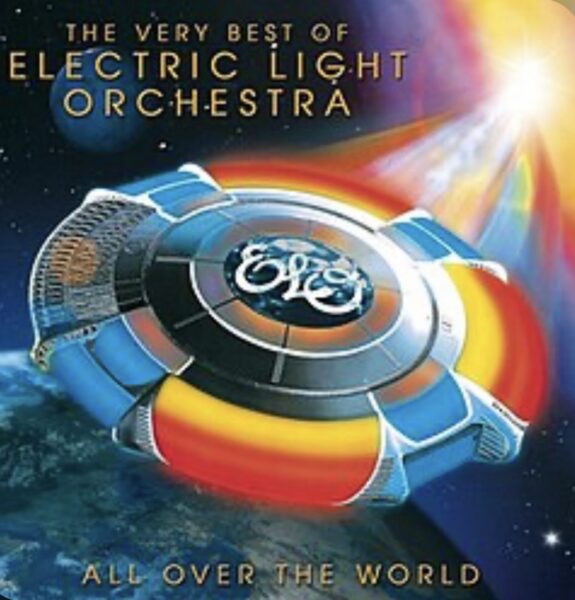
By the late 1970s, ELO had become one of the most visually unforgettable bands in rock.
Their album covers looked futuristic. Their stage shows leaned into the spaceship imagery. Their whole world felt designed around motion, light, and imagination. They were not just selling songs. They were selling an atmosphere.
And that atmosphere mattered.
Because ELO arrived at a time when rock music was splitting in a dozen directions. Punk was tearing everything down. Disco was taking over dance floors. Arena rock was getting louder and bigger. Singer-songwriters were keeping things personal. ELO somehow lived between all of it.
They were too polished to be punk.
Too weird to be ordinary pop.
Too catchy to be dismissed as prog.
Too emotional to be pure studio trickery.
They were their own thing.
That is harder than it sounds.
The Songs That Would Not Die
Some bands become tied to a decade and stay there.
ELO escaped.
Their songs kept finding new lives in movies, commercials, playlists, sports arenas, and younger listeners’ headphones. “Mr. Blue Sky” especially became one of those songs that refuses to disappear. It is the kind of track people recognize even if they do not know the band’s full story.
That is the funny thing about ELO.
For years, they were sometimes treated like a guilty pleasure — too shiny, too produced, too theatrical. But time has been kind to them. What once sounded excessive now sounds imaginative. What once sounded too polished now sounds carefully crafted.
Their music aged better because it never tried to sound normal in the first place.
The Comeback and the Final Bow
After ELO’s original run slowed down in the 1980s, Jeff Lynne stayed active as one of rock’s most respected producers and songwriters. He worked with major artists and became part of the Traveling Wilburys alongside Bob Dylan, George Harrison, Tom Petty, and Roy Orbison.
But ELO never fully disappeared.
In 2014, Lynne brought the music back under the name Jeff Lynne’s ELO, performing again with longtime keyboardist Richard Tandy. The return reminded people how powerful those songs still were live. Richard Tandy later died in 2024, leaving Lynne as the central surviving figure of the group’s classic identity.
In recent years, Jeff Lynne’s ELO also moved toward a farewell chapter. A final Hyde Park performance in 2025 was canceled after Lynne withdrew on medical advice due to illness, which made the ending feel even more emotional for fans who had followed the band for decades.
But even if the live story is ending, the music does not feel finished.
That is the thing about ELO.
Their songs still sound like they are traveling.
Why Electric Light Orchestra Still Matters
Electric Light Orchestra matters because they proved pop music could be huge without losing its heart.
They made orchestras feel like rock instruments. They made studio production feel emotional. They took the influence of The Beatles and did not just copy it — they stretched it into something glowing, strange, and unmistakably their own.
Jeff Lynne understood something important: a song can be simple and still sound enormous.
That is why ELO worked.
The hooks were easy to remember. The arrangements were impossible to ignore. The songs sounded like the future, but they were built around feelings everybody already knew.
Loneliness.
Joy.
Heartbreak.
Hope.
The search for a little blue sky.
Final Thought
Electric Light Orchestra was never just a band with strings.
They were a band with imagination.
They took rock music and dressed it in lights, cellos, harmonies, spaceship dreams, and perfect pop choruses. They made songs that sounded like they were flying, but somehow still landed right in the heart.
Some bands give you noise.
Some bands give you attitude.
ELO gave you wonder.
And that is why, decades later, when those first bright notes of “Mr. Blue Sky” come on, it still feels like the clouds are opening.