
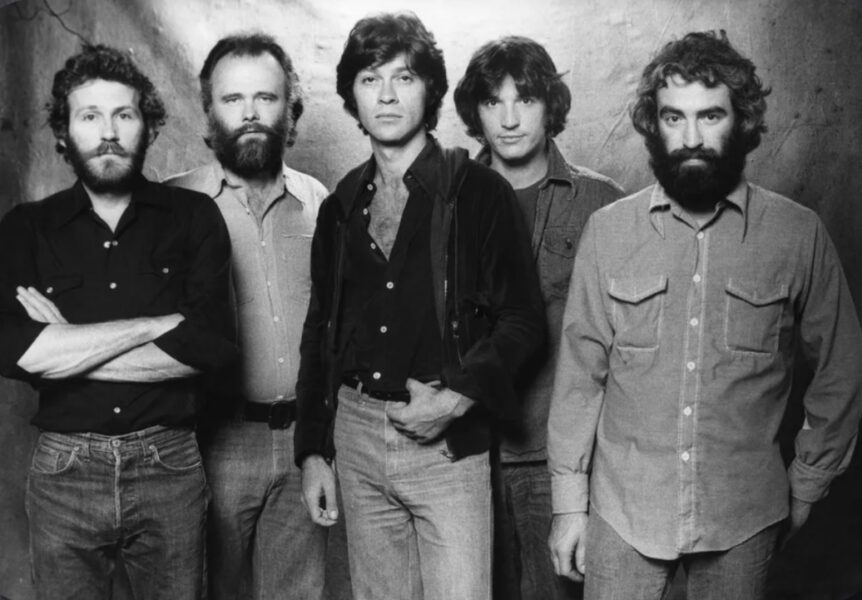
The Band never looked like they were trying to be rock stars.
That was part of the magic.
No glitter. No explosions. No frontman posing like a god under the lights. They looked more like a group of men you might find in an old photograph — standing outside a barn, half-smiling, carrying secrets from some forgotten town.
But when they played, something happened.
The music felt ancient and brand new at the same time.
It sounded like front porches, train tracks, Civil War ghosts, Southern roads, church halls, hard work, lost love, and America itself — not the clean postcard version, but the strange, wounded, beautiful version hiding underneath.
That was The Band.
They did not just write songs.
They made myths.
Before They Were The Band
Before they became legends, they were The Hawks, backing up rockabilly wild man Ronnie Hawkins.
The lineup that would become The Band was unusual from the start. Four Canadians — Robbie Robertson, Rick Danko, Richard Manuel, and Garth Hudson — and one American drummer from Arkansas, Levon Helm.
That mix mattered.
They were outsiders looking into American music with obsession and respect. They studied blues, country, gospel, soul, folk, and early rock and roll. They were not just copying sounds. They were absorbing a whole musical language.
Then Bob Dylan changed their lives.
When Dylan went electric in the mid-1960s, The Hawks became his backing band. The crowds were brutal. Folk fans booed. People yelled. Dylan and the band kept playing louder.
That period hardened them.
They learned how to survive chaos.
And after the noise died down, they ended up in a pink house in Woodstock, New York, making music that sounded like the opposite of the chaos around them.
The Basement Tapes and the Sound of Something Hidden
In Woodstock, Dylan and The Band recorded informal music in a house known as Big Pink.
The music from those sessions became famous as The Basement Tapes.
But the important thing was not just the recordings. It was the feeling.
At a time when rock music was getting louder, flashier, and more psychedelic, The Band went inward. They played old songs, strange songs, funny songs, sad songs. They created music that felt handmade.
No one sounded like that in 1967.
While other bands were trying to reach outer space, The Band went down into the cellar and found America’s bones.
That became their identity.
Music from Big Pink: A Different Kind of Revolution
In 1968, The Band released Music from Big Pink.
It did not sound like the rest of the decade.
This was the era of Hendrix, Cream, The Doors, and psychedelic color. Rock was getting louder and wilder. Then The Band came out with songs that felt dusty, mysterious, and deeply human.
“The Weight” became the centerpiece.
It sounded like a parable, but nobody could fully explain it. There was Nazareth, Miss Moses, Crazy Chester, Luke waiting on judgment day, and a chorus that felt like it had been sung forever.
“Take a load off, Fanny.”
Simple line.
Immortal feeling.
The song did not need to explain itself because it felt true. That was The Band’s genius. They could make a brand-new song sound like something passed down through generations.
Five Musicians, No Weak Link
The Band worked because every member had a distinct soul.
Robbie Robertson was the sharp songwriter and guitarist, the man who shaped many of the group’s stories and gave them cinematic detail.
Levon Helm was the heartbeat. His drumming had dirt, swing, and muscle, and his voice sounded like it came straight out of Arkansas soil.
Rick Danko sang like a man with his heart cracked open. There was a trembling honesty in his voice that made even simple lines feel wounded.
Richard Manuel had one of the most haunting voices in rock history. He could sound broken, beautiful, drunk, holy, and lost all at once.
Garth Hudson was the secret wizard — a brilliant multi-instrumentalist who gave the music its strange colors, organ swells, and deep textures.
That was the thing about The Band.
They did not need one star.
The group was the star.
The Brown Album: America in Five Voices
Their second album, simply called The Band, may be their masterpiece.
Released in 1969, it sounded like a history book written in song.
“The Night They Drove Old Dixie Down” turned the Civil War into a human tragedy seen through the eyes of a defeated Southern man.
“Up on Cripple Creek” had funk, humor, country, and swagger.
“King Harvest” told the story of a struggling farmer with quiet desperation.
“Rag Mama Rag” sounded like a backwoods party.
The album was not patriotic in a cheap way. It was not trying to sell a clean version of the past.
It was complicated.
The Band understood that American history was full of beauty and pain, humor and violence, faith and failure. They turned that contradiction into music.
That is why their songs feel so lived-in.
They were not writing about America as an idea.
They were writing about America as a haunted house.
Fame, Pressure, and the Cracks Beneath the Music
The Band’s music sounded like brotherhood.
But behind the scenes, things were harder.
The road wore them down. Drugs, alcohol, creative tension, and personal struggles began to weigh on the group. Robbie Robertson became more of the main songwriter, which later created bitterness and debates over credit. Levon Helm especially felt that The Band’s collaborative spirit was not always properly reflected.
That tension is part of their story.
The music sounded communal, but the business of music often turns friendship into paperwork.
The Band were brilliant, but they were also human. And like many great groups, the very chemistry that made them special became harder to hold together over time.
The Last Waltz: The Greatest Goodbye Concert Ever Played
By 1976, The Band decided to say goodbye to touring.
But they did not go quietly.
On Thanksgiving night at Winterland Ballroom in San Francisco, they staged The Last Waltz, a farewell concert that turned into one of the most legendary gatherings in rock history.
The guest list was almost impossible:
Bob Dylan.
Muddy Waters.
Van Morrison.
Joni Mitchell.
Neil Young.
Eric Clapton.
Dr. John.
Ringo Starr.
Ronnie Wood.
Ronnie Hawkins.
It was not just a concert.
It was a coronation.
A farewell.
A funeral.
A celebration.
A passing of the torch.
Martin Scorsese filmed it, turning the night into one of the most famous concert films ever made. The movie captured The Band in full color — tired, brilliant, emotional, and still capable of sounding like nobody else.
When they played “The Weight” with the Staples Singers in the film, it felt like American music coming full circle: rock, gospel, soul, folk, and history all standing in the same room.
That was The Band at their best.
Not above the tradition.
Inside it.
Why The Band Still Matters
The Band still matters because they made rock music feel rooted.
They did not chase trends. They did not try to sound futuristic. They sounded backward in the best possible way — like they were digging through the past to find something timeless.
They influenced everyone from Eric Clapton to George Harrison to countless Americana, folk-rock, country-rock, and roots musicians who came after them.
But their real legacy is deeper than influence.
They proved that rock and roll did not always have to be about rebellion through volume.
Sometimes rebellion is choosing restraint.
Sometimes it is writing about farmers, drifters, soldiers, gamblers, and broken people when everyone else is writing about outer space.
Sometimes it is making a song sound like it existed before you were born.
That was The Band’s power.
They made new music feel old.
And they made old feelings feel new.
Final Thought
The Band were never the loudest group in rock history.
They did not need to be.
Their music had the weight of memory. It sounded like wooden floors, muddy boots, old rivers, and voices coming through the walls. They took American music — blues, gospel, country, folk, soul, and rock — and turned it into something that felt both personal and mythic.
They were not just a band with a clever name.
They were The Band because, for a while, they sounded like the group that had been there all along.
And when they said goodbye at The Last Waltz, it felt less like a concert ending than a whole chapter of music history closing its eyes.