
Why MLB’s Salary Cap Push Could Become the Sport’s Next Labor War
Baseball has a storm coming.
Not on the field. Not in the standings. Not in October.
This one is happening behind closed doors, in conference rooms, between owners, executives, lawyers, and the players’ union. And if it goes badly, it could shake Major League Baseball in a way fans have not seen in decades.
MLB owners are pushing for something the sport has resisted for generations: a hard salary cap.
That may sound like boring business talk at first. But it is not. This is one of the biggest baseball stories going right now because it gets to the heart of what MLB is, what owners want it to become, and what players are willing to fight to protect.
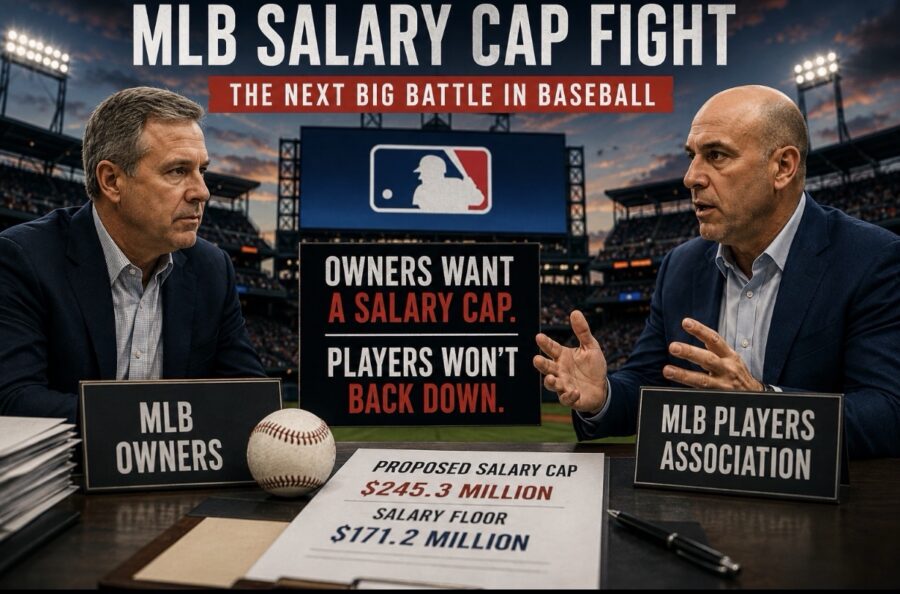
A salary cap would limit how much teams can spend on players. MLB’s proposal reportedly includes a hard cap around $245.3 million and a salary floor around $171.2 million, meaning high-spending teams would have to cut back and low-spending teams would be forced to spend more.
On paper, owners will sell it as competitive balance.
In reality, it could become the next great labor war in baseball.
Why This Is Such a Big Deal
Baseball is not like the NFL or NBA.
Those leagues have salary-cap systems. MLB does not. Baseball has a luxury tax, which penalizes teams that spend over certain thresholds, but it does not fully stop teams from spending big if they are willing to pay the price.
That is why teams like the Dodgers, Mets, Yankees, Phillies, and other big-market clubs can flex financial muscle when they want to chase stars.
A hard cap would change that.
It would put a ceiling on ambition. It would tell rich teams there is a line they cannot cross. It would also force cheaper teams to meet a payroll floor, which could be good for fans in smaller markets who are tired of watching ownership groups rebuild forever while pocketing revenue.
That is the complicated part.
There is a real argument that baseball needs more competitive balance.
But there is also a real fear that a salary cap is less about fairness and more about controlling player salaries.
And the players know that.
The Players’ Union Is Not Going to Fold Easily
The MLB Players Association has historically hated salary caps. That is not new. The union sees caps as a way for owners to limit what players can earn, even as franchise values rise, ticket prices climb, and media money keeps flowing.
Baseball players fought this fight before.
The last time MLB seriously pushed into salary-cap territory, the sport suffered through the 1994 strike, and the World Series was canceled. That moment still hangs over the sport like a ghost.
Nobody wants to see baseball shut down again.
But the fact that MLB is now openly pushing this idea tells you how serious this is.
The owners are not just floating a small tweak. They are trying to reshape the economics of the sport.
And the union is not likely to just say yes.
What This Means for Big-Market Teams
This proposal would hit the biggest spenders immediately.
The Mets, Yankees, Dodgers, and other aggressive teams would have to rethink how they build rosters. Instead of stacking stars and paying the tax, they would have to make harder choices.
Do you pay one superstar and sacrifice depth?
Do you let a homegrown star walk because the payroll math gets tight?
Do you stop chasing the final piece at the trade deadline because the cap says no?
That is where fans should pay attention.
A salary cap does not just change contracts. It changes dreams.
It changes what a front office can do when the team is one bat away, one ace away, one bullpen arm away from a real October run.
For fans of big-spending teams, this could feel like a leash.
For fans of smaller-market teams, it could feel like long-overdue accountability.
That is why this debate is so explosive.
Both sides can make an argument. But only one side has to play the games.
The Salary Floor Might Be the Most Interesting Part
The cap gets the headlines, but the floor matters too.
A salary floor would force teams to spend a minimum amount on payroll. That could be a major win for fans who are tired of watching their teams operate like they are allergic to free agents.
There are too many seasons where a team enters April feeling like it already punted.
A payroll floor could change that.
It could force owners to invest in the product. It could make rebuilding teams more competitive. It could stop clubs from sitting at the bottom financially while still benefiting from league revenue.
But the players’ union will likely ask the obvious question:
Why should players accept a cap just to get a floor?
That is the whole fight.
The owners want a system. The players want freedom. And fans just want their teams to actually try.
Why Fans Should Care
This is not just millionaire players arguing with billionaire owners.
That is the easy way to dismiss it. But fans should care because labor fights always end up landing on the people watching the games.
If negotiations collapse, fans could face another lockout.
If a salary cap arrives, rosters could be built differently.
If a salary floor arrives, cheap teams might finally have to spend.
If the sides cannot agree, the sport could enter another ugly chapter where the business of baseball overshadows the beauty of it.
And that would be a shame, because MLB is in a strong place on the field.
The pitch clock helped the pace of play. Young stars are everywhere. The game feels faster, cleaner, and more watchable than it did a few years ago.
Baseball finally has momentum.
The worst thing it could do now is remind fans how ugly the business side can get.
Key Takeaways
MLB owners are pushing for a hard salary cap.
That would be a massive shift for a sport that has long avoided one.
The reported proposal includes both a cap and a floor.
High-spending teams would be limited, while lower-spending teams would be forced to spend more.
The players’ union is strongly opposed.
The MLBPA has historically resisted salary caps because they limit player earning power.
Big-market teams would be hit hard.
Teams like the Mets, Yankees, and Dodgers would have to rethink how aggressively they build rosters.
A labor fight could be coming.
With the current labor deal expiring in December 2026, this could become one of the biggest baseball stories of the year.
Final Take
Baseball’s salary-cap debate is not just about numbers.
It is about power.
It is about whether owners can limit spending. It is about whether players can protect the open-market system they fought for. It is about whether fans in smaller markets finally get teams that are forced to invest. And it is about whether big-market teams should be punished for acting like winning matters.
That is what makes this story so important.
MLB can call it competitive balance. The union can call it a salary limit. Fans can call it whatever they want.
But one thing is clear:
Baseball’s next biggest battle might not be Yankees vs. Red Sox, Dodgers vs. Padres, or Mets vs. Braves.
It might be owners vs. players.
And if both sides are not careful, the sport could be walking straight toward another labor war at the exact moment it should be building on its momentum.