
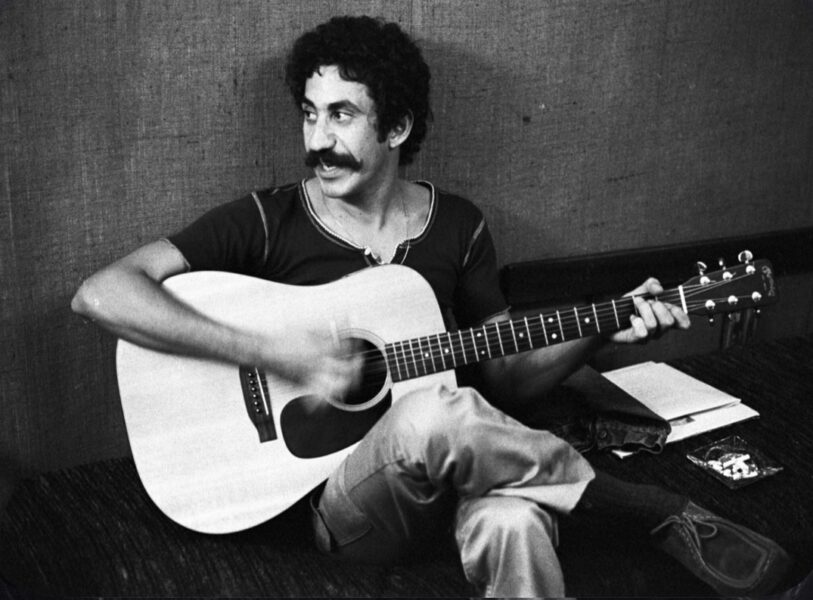
Jim Croce never sounded like a rock star trying to become a legend.
He sounded like the guy at the end of the bar who had seen too much, laughed through most of it, and somehow turned the whole mess into a song before last call.
That was his gift.
Croce could write about tough guys, lonely workers, bad decisions, broken hearts, street-corner characters, and ordinary people without making them feel ordinary. His songs were short stories with guitar strings attached. They had punchlines, pain, rhythm, and soul. One minute he could make you laugh with “Bad, Bad Leroy Brown.” The next, he could stop time with “Time in a Bottle.”
And that is what makes his story so powerful.
Jim Croce did not get decades to build a legacy.
He got a few explosive years.
Then he was gone.
The Working-Class Kid With a Guitar
James Joseph Croce was born in South Philadelphia on January 10, 1943, into a working-class Italian American family. He grew up around different kinds of music, from old-school singers to blues, folk, country, R&B, and rock and roll. Those sounds eventually became the ingredients of his own songwriting style.
Croce was not some overnight invention created by a record label.
He played wherever people would listen.
Coffeehouses. Colleges. Bars. Small rooms. Tough rooms. Places where you had to earn every clap. At Villanova University, he became involved in campus singing groups and started performing around the Philadelphia area. He later said he played almost anything people wanted to hear: blues, rock, a cappella, folk, railroad songs — whatever worked in front of the crowd.
That mattered.
Because Croce learned how people talked. He learned what made them laugh. He learned what made them hurt. He learned that a great song did not always need to sound fancy.
Sometimes it just needed to sound true.
The Long Road Before the Breakthrough
Before the fame, Croce lived the kind of life that later showed up in his songs.
He worked different jobs, played small gigs, struggled with money, and kept chasing music even when music did not seem ready to reward him. He and his wife, Ingrid Croce, performed together during the 1960s and recorded music as a duo. After becoming disappointed with the music business, they returned to Pennsylvania, where Croce continued taking odd jobs while writing songs inspired by workers, barroom characters, and people he met along the way.
That is why his songs feel lived-in.
When Croce sang about working at the car wash, dealing with hard times, or running into larger-than-life characters, it did not feel fake. It felt like he knew those people. Maybe he had worked next to them. Maybe he had driven past them. Maybe he had been one of them.
He was not writing from above the crowd.
He was writing from inside it.
The Characters That Made Him Famous
Then came the songs.
“You Don’t Mess Around with Jim.”
“Operator.”
“Bad, Bad Leroy Brown.”
“I Got a Name.”
“Time in a Bottle.”
Croce had range, but his real magic was character. He could create a whole world in three minutes.
“Bad, Bad Leroy Brown” was funny, swaggering, and instantly memorable — a street-tough story song about a man who thinks he is unbeatable until he finds out the hard way that every legend has a weakness. The song became Croce’s only No. 1 hit while he was alive.
But Croce was not just a clever writer.
He could be devastating.
“Operator” is one of the great lonely-phone-call songs ever written. A man tries to call an old love, pretends he is fine, then slowly reveals he is not fine at all. The genius of the song is how casual it sounds. He is not screaming. He is not begging. He is trying to keep his dignity while falling apart.
That was Croce at his best.
He made heartbreak sound conversational.
“Time in a Bottle” and the Cruelest Irony
Then there is “Time in a Bottle.”
Even if you know nothing about Jim Croce, that song can still hit you.
It is soft, simple, and almost unbearably tender. The title alone feels like something carved into memory. A man wishes he could save time, keep moments, hold love still before life moves too fast.
After Croce died, “Time in a Bottle” was played heavily on radio, demand grew, and it became his second and final No. 1 song in the United States.
That is the part that makes the song almost painful to hear now.
Because Jim Croce’s whole story became about time.
How little of it he had.
How much he did with it.
How many songs he left behind that sounded like they understood something he could not have known was coming.
The Plane Crash
On September 20, 1973, Jim Croce performed at Northwestern State University in Natchitoches, Louisiana. After the show, he boarded a chartered plane headed for Sherman, Texas, where he was scheduled to play another concert. The plane crashed shortly after takeoff, killing Croce, guitarist Maury Muehleisen, and four others. Croce was only 30 years old.
Thirty.
That number is hard to get past.
He was not an old legend fading out. He was not a star looking backward. He was in the middle of his rise. His album I Got a Name was still coming. His music was reaching more people. His writing was sharpening. His future was opening.
And then it was over.
One of the saddest details is that Croce was reportedly growing tired of the road and wanted to slow down after the tour. He wanted more time with his wife Ingrid and their young son, A.J. He had been writing letters home, thinking about family, thinking about the future.
That makes the ending hurt even more.
Because he was not just chasing fame.
He was trying to get back home.
Why Jim Croce Still Matters
Jim Croce’s career was short, but his songs never sounded temporary.
That is the mark of a real songwriter.
He did not need giant productions. He did not need mystery. He did not need to dress up simple emotions until they became impossible to understand. He wrote straight to the heart of things: love, regret, humor, loneliness, pride, work, time, and death.
His songs feel American in the best storytelling sense. Not polished-perfect American, but roadside American. Diner American. Gas station American. Back porch American. A guy with a guitar telling you about someone he met, someone he lost, or someone he used to be.
That is why his music still works.
Because Jim Croce wrote about people who usually do not get songs written about them.
The working man. The loser. The tough guy. The fool. The romantic. The guy trying not to cry on the phone. The father wishing he could save time in a bottle.
Final Thought
Jim Croce’s tragedy is not just that he died young.
It is that he died right as the world was fully starting to understand him.
He had the rare ability to make a funny song feel human and a sad song feel plainspoken instead of dramatic. He did not write like someone trying to impress critics. He wrote like someone trying to tell the truth before the moment disappeared.
And maybe that is why his music still feels alive.
Jim Croce did not have much time.
But somehow, he knew exactly what to do with the time he had.