
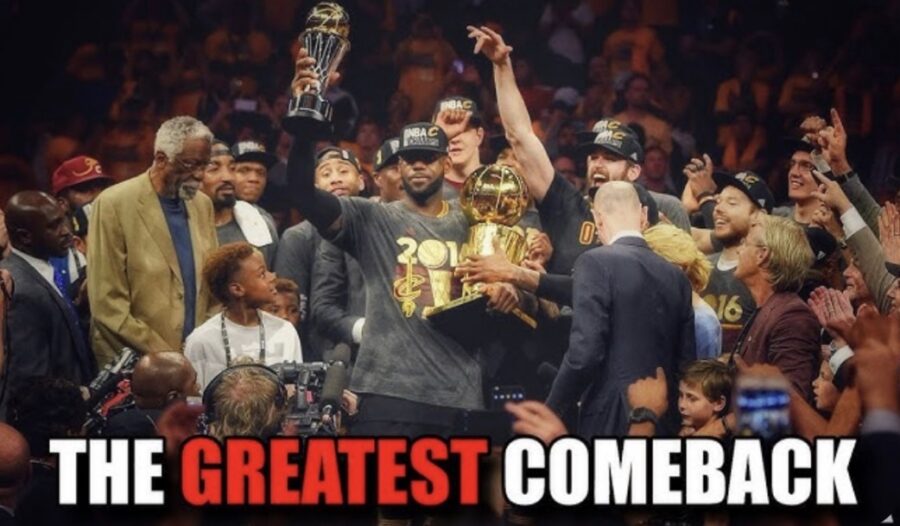
Some championships end with confetti.
This one ended with a city finally breathing again.
The 2016 Cleveland Cavaliers did not just win the NBA Finals. They walked into the deepest hole the league had ever seen on its biggest stage, looked across at a 73-win Golden State Warriors team, and somehow came out with the most impossible championship in NBA history.
Down 3-1.
Against the defending champions.
Against the first unanimous MVP.
Against a team that had just broken the regular-season wins record.
Against more than five decades of Cleveland sports heartbreak.
And still, the Cavs found a way.
They became the first team in NBA Finals history to come back from a 3-1 deficit, beating Golden State 93-89 in Game 7 on the road. But the numbers alone do not explain why this series still feels mythical.
Because this was not just a basketball comeback.
It was LeBron James keeping a promise. It was Kyrie Irving stepping into legend. It was Kevin Love finding redemption in one defensive stand. It was Cleveland, after 52 years without a major professional sports championship, finally watching the ending change.
The Warriors Were Supposed to Finish the Greatest Season Ever
Before the comeback, Golden State looked almost untouchable.
The Warriors went 73-9 during the regular season, breaking the 1995-96 Chicago Bulls’ 72-10 record. They were not just winning games. They were changing the sport.
Stephen Curry had the greatest shooting season anyone had ever seen. He made an NBA-record 402 threes in the regular season, averaged 30.1 points, 6.7 assists, 5.4 rebounds, and became the first unanimous MVP in league history. Golden State finished with the league’s best offense, pushed the pace, stretched defenses beyond comfort, and made 25-footers feel like layups.
They were the future arriving early.
Klay Thompson was the perfect second flame, averaging 22.1 points in the regular season and giving Golden State another shooter who could break a game in three minutes. Draymond Green averaged 14.0 points, 9.5 rebounds and 7.4 assists, serving as the team’s defensive brain, emotional engine, and small-ball center when the Warriors went to their deadly “Death Lineup.”
Golden State was not just great.
It was historic.
And after four games of the Finals, the Warriors looked ready to finish the job.
They led Cleveland 3-1.
The Cavs had been outscored by a combined 48 points in their first two losses of the series. Golden State won Game 1 by 15, Game 2 by 33, and after Cleveland briefly punched back in Game 3 with a 120-90 blowout, the Warriors walked into Cleveland and won Game 4, 108-97, to take command.
The series looked over.
The city of Cleveland had seen this movie before.
Cleveland Was Carrying More Than Basketball
For the Cavaliers, the weight was bigger than one Finals series.
Cleveland had not won a major professional sports championship since the Browns won the NFL title in 1964. That meant generations of fans had grown up knowing disappointment as part of their sports identity.
The Drive.
The Fumble.
The Shot.
The Decision.
Years of almost. Years of jokes. Years of watching somebody else celebrate.
LeBron James had left Cleveland in 2010 and returned in 2014 with the purpose of bringing a championship home. In his famous return letter, the message was clear: this was about Northeast Ohio, about home, about finishing something bigger than basketball.
The Cavaliers had reached the Finals in 2015, but injuries to Kevin Love and Kyrie Irving left LeBron trying to carry an undermanned roster against Golden State. The Warriors won in six games. Cleveland was left with one painful question:
What if we had been healthy?
In 2016, they got their answer.
But after Game 4, the answer looked cruel.
The Warriors were one win away from back-to-back championships.
Cleveland was one loss away from another heartbreak.
Then the series turned personal.
The Trash Talk That Aged Like Dynamite
Game 4 included one of the emotional turning points of the series: LeBron James and Draymond Green got tangled up and exchanged words. Draymond was later suspended for Game 5 after accumulating too many flagrant foul points during the playoffs.
But the line that stuck came from Klay Thompson.
When asked about LeBron reacting to the trash talk, Klay brushed it off.
“I guess his feelings just got hurt,” Thompson said.
At the time, it sounded like the Warriors were loose, confident, and one win away from history.
Looking back, it sounds like someone accidentally handed LeBron a match.
LeBron laughed when reporters told him what Klay said. But it was not an empty laugh. It felt like a man filing the sentence away.
The Warriors were up 3-1.
They had the record.
They had the MVP.
They had the crowd.
They had the swagger.
And then LeBron gave them the kind of answer that does not need a microphone.
Game 5: LeBron and Kyrie Turn Oracle Quiet
Game 5 was supposed to be Golden State’s coronation.
Oracle Arena was ready. The Warriors were home. The crowd expected champagne, confetti, and the finishing touch on the greatest season in league history.
Instead, LeBron James and Kyrie Irving walked into Oakland and played one of the greatest elimination games the Finals had ever seen.
LeBron finished with 41 points, 16 rebounds, seven assists, three steals and three blocks.
Kyrie matched him with 41 points, shooting 17-of-24 from the field, slicing through Golden State’s defense with impossible angles and finishing with the kind of shot-making that made every possession feel personal.
They became the first pair of teammates in NBA Finals history to each score 40-plus points in the same game. Cleveland won 112-97, cutting the series to 3-2.
That was the first crack.
Golden State still had control on paper, but the energy had shifted.
The Warriors were still one win away.
But Cleveland was no longer playing like a team waiting to be finished.
The Cavs were playing like a team that had discovered the door was not locked.
Game 6: LeBron Turns Cleveland Into a Storm
Game 6 moved back to Cleveland, and the building felt different.
This was not just home-court advantage. This was a city trying to believe without getting its heart broken again. Every basket sounded louder than normal. Every stop felt like proof. Every LeBron drive carried the weight of 52 years.
And LeBron delivered again.
He scored 41 points for the second straight game, adding 11 assists, eight rebounds, four steals and three blocks, while committing just one turnover. He shot 16-of-27 from the field and finished as a plus-26.
It was not just the scoring. It was the command.
LeBron controlled the entire rhythm of the game. He hunted mismatches. He punished switches. He defended like a free safety. He sprinted in transition. He turned Cleveland’s desperation into pressure and pushed it directly back onto Golden State.
Kyrie added 23 points. Tristan Thompson dominated the glass with 16 rebounds. The Cavs beat the Warriors 115-101 and forced a Game 7.
Stephen Curry scored 30 points and made six threes, but the Warriors looked rattled. Curry fouled out late and was ejected after throwing his mouthguard into the crowd, a stunning image from a team that had spent the season looking almost above chaos.
Now the series was tied 3-3.
The Warriors had gone from chasing immortality to trying not to become the answer to a trivia question.
And Cleveland, somehow, was one win away.
Game 7: The Most Tense 48 Minutes of the Decade
Game 7 in Oakland did not feel like a basketball game at first.
It felt like a test of nerve.
The Warriors had home court. The Cavaliers had momentum. Golden State had the 73-win season. Cleveland had the burden of history. Every possession felt permanent. Every miss felt like it might be remembered forever.
The game was tight from the start.
By halftime, Golden State led 49-42. Draymond Green, the same player suspended in Game 5, was suddenly playing one of the best games of his life. He scored 32 points, grabbed 15 rebounds, added nine assists, and made 6-of-8 threes.
If Golden State had won, Draymond’s Game 7 might have gone down as one of the great closeout performances ever.
But Cleveland stayed close.
LeBron kept pushing. Kyrie kept attacking. J.R. Smith, quiet for much of the game, hit two huge threes early in the third quarter to keep the Cavs alive. Those shots mattered. In a game this tight, survival came in small bursts.
The fourth quarter turned into a street fight.
Golden State did not score for the final 4:39 of the game.
Think about that.
A 73-win team.
At home.
With Curry and Klay.
With the championship sitting there.
And for the final 4:39, Cleveland held them scoreless.
That is why the comeback was not just about offense.
It was about stops.
It was about endurance.
It was about a team refusing to let the Warriors breathe.
With under two minutes left, the score was tied 89-89.
Then came the sequence that became basketball scripture.
The Block
Andre Iguodala broke free in transition.
For half a second, it looked like the Warriors were about to take the lead. The ball moved ahead. Iguodala gathered. The rim opened.
Then LeBron appeared.
He sprinted back from the opposite side, launched himself into the air, and pinned Iguodala’s layup against the glass.
Blocked by James.
The call became iconic because the play felt impossible. It was not just a defensive highlight. It was a rescue mission in midair. It kept the game tied, kept Cleveland alive, and instantly became one of the greatest plays in NBA history.
LeBron did not just block a shot.
He blocked the ending Cleveland feared.
The Shot
The game was still tied when Kyrie Irving took the ball against Stephen Curry with less than a minute left.
There are shots that are big because of the score.
This was bigger than that.
This was Kyrie, on the road, in Game 7, staring at the unanimous MVP, with a championship waiting on the other side of one clean look.
He dribbled. He waited. He rocked Curry back. Then he stepped behind the line and fired.
With 53 seconds remaining, Kyrie buried the go-ahead three over Curry, giving Cleveland a 92-89 lead.
No panic.
No hesitation.
No fear.
Just one of the coldest shots in Finals history.
The Stop
Then came the play that gave Kevin Love his own place in the story.
Love had been criticized constantly during Cleveland’s title chase. People questioned his defense, his fit next to LeBron and Kyrie, his ability to stay on the floor in the biggest playoff moments.
Then, with the championship on the line, he switched onto Curry.
The Warriors needed a three. Curry danced with the ball, searching for space. Love slid with him. He did not reach. He did not bite. He stayed attached just long enough to force a difficult miss.
For one possession, Kevin Love became exactly what Cleveland needed.
A wall.
LeBron later added a free throw. The Warriors missed again. The clock ran out.
Cavaliers 93, Warriors 89.
The impossible was finished.
The Numbers Behind the Miracle
The story is emotional, but the statistics make it even more unbelievable.
LeBron averaged 29.7 points, 11.3 rebounds, 8.9 assists, 2.6 steals and 2.3 blocks across the seven-game series.
He became the first player in NBA Finals history to lead both teams in all five major statistical categories: points, rebounds, assists, steals and blocks. His full series totals were 208 points, 79 rebounds, 62 assists, 18 steals and 16 blocks.
Kyrie averaged 27.1 points for the series and was electric in the final three games, giving Cleveland the shot creation it did not have in the 2015 Finals.
In the final three games, with Cleveland facing elimination every night, LeBron scored 41, 41 and 27. He added a triple-double in Game 7 with 27 points, 11 rebounds and 11 assists.
Game 7 itself was a grind. Cleveland shot just 40.2 percent from the field and 24 percent from three. Golden State shot 38.6 percent and made 15 threes, but the Warriors’ stars went cold at the worst possible time. Curry finished 6-of-19 from the field. Klay Thompson shot 6-of-17. Together, the Splash Brothers went 12-of-36 in the biggest game of the season.
Draymond nearly saved Golden State with 32 points, 15 rebounds and nine assists, but Cleveland’s late defense shut the door.
The Cavaliers won despite scoring only 93 points.
Because when the game became about will, Cleveland had more of it.
LeBron’s Promise Finally Paid Off
When the final buzzer sounded, LeBron collapsed to the floor.
That image is why sports become memory.
It was not just exhaustion. It was release. It was the weight of a city pouring out of one man’s body.
LeBron had returned to Cleveland in 2014 to finish the job he could not finish the first time. He had been booed when he left, celebrated when he returned, doubted when he lost in 2015, and questioned again when the Cavs fell behind 3-1 in 2016.
Now he had delivered.
After the game, he grabbed the microphone and shouted the words that became part of Cleveland history:
“Cleveland, this is for you!”
It was not polished. It was not rehearsed. That is why it hit so hard.
For Cleveland, it was not just a quote.
It was a release valve.
The city had waited since 1964 for a title from one of its major professional teams. The Cavaliers finally gave it one, and they did it in the most impossible way imaginable: on the road, in Game 7, against the winningest regular-season team ever.
Why This Comeback Still Feels Untouchable
Plenty of teams win championships.
Very few change the emotional history of a city.
The 2016 Cavaliers did both.
They beat the 73-9 Warriors. They beat the first unanimous MVP. They won Games 5 and 7 in Oakland. They survived three straight elimination games. They overcame a 3-1 deficit in the Finals, something no team had ever done before.
And they did it with three plays that still sound like movie titles.
The Block.
The Shot.
The Stop.
That is why the series has never faded. It had everything: rivalry, revenge, trash talk, impossible odds, statistical dominance, late-game drama, and a city finally getting the moment it had been denied for more than half a century.
The Warriors were supposed to complete the greatest season ever.
Instead, Cleveland stole the ending.
Final Take
The 2016 Cavaliers did not just win a championship.
They won the most powerful Finals story the NBA has ever seen.
They were down 3-1 to a 73-win Warriors team, facing Stephen Curry at the peak of his powers, playing Game 7 on the road, with the history of Cleveland heartbreak pressing on every possession.
And somehow, they did not break.
LeBron James delivered the defining masterpiece of his career. Kyrie Irving hit one of the coldest shots in basketball history. Kevin Love made the defensive stand nobody saw coming. The Cavs held the Warriors scoreless over the final minutes and turned a series that looked finished into a legend that will never really age.
That is why 2016 still feels different.
Because it was not just a comeback.
It was a city being told for 52 years that heartbreak was its destiny — until one team finally looked history in the face and said:
Not anymore.