
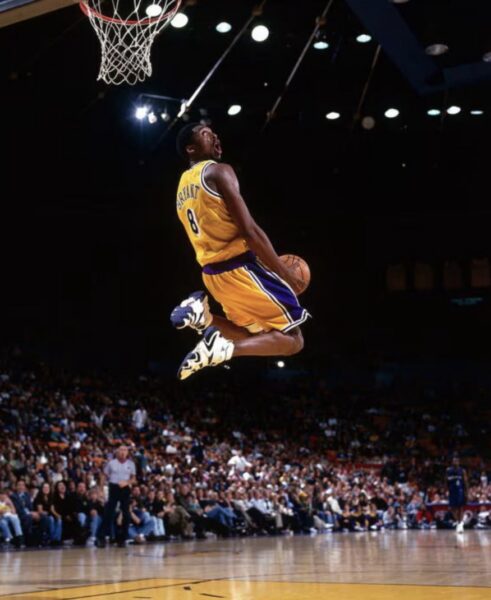
Kobe Bryant did not play basketball like it was a game.
He played it like a lifelong argument.
Against defenders.
Against history.
Against Michael Jordan’s shadow.
Against Shaquille O’Neal’s dominance.
Against critics.
Against injuries.
Against age.
Against the idea that greatness had limits.
For 20 years, Kobe wore the same uniform, chased the same impossible standard, and built one of the most complicated, relentless, unforgettable careers basketball has ever seen. He was not always easy to love. He was not always easy to play with. He was not always the cleanest version of a superstar.
But he was impossible to ignore.
By the end, Kobe Bryant had become more than a Lakers legend. He became a basketball language of his own: footwork, fadeaways, pain tolerance, obsession, cold-blooded shot-making, and a mentality that turned work into identity.
He won five NBA championships, made 18 All-Star teams, earned 15 All-NBA selections, made 12 All-Defensive teams, won two Finals MVPs, captured the 2008 NBA MVP, won two scoring titles, scored 33,643 career regular-season points, and spent all 20 seasons of his career with the Los Angeles Lakers.
But the numbers are only the frame.
The real story is how Kobe became Kobe.
The Kid Who Wanted the Smoke Before He Was Ready
Kobe entered the NBA in 1996 as a teenager with grown-man confidence.
He was drafted out of Lower Merion High School, traded to the Lakers, and arrived in Los Angeles with the kind of belief that can either become greatness or embarrassment. At first, it was a little of both.
He was young, flashy, fearless, and raw. He won the 1997 Slam Dunk Contest, became a teenage attraction, and looked like the future before he fully understood the present. But the moment that really shaped early Kobe was not a dunk.
It was failure.
In the 1997 playoffs against the Utah Jazz, Kobe famously air-balled multiple shots late in an elimination game. For most young players, that kind of public failure can become a scar. For Kobe, it became fuel.
That was the beginning of the pattern.
Kobe did not run from embarrassment. He studied it. He kept it. He used it. Every miss became evidence. Every doubt became a dare. Every failure became something he could turn into work.
That is what separated him early.
He did not just want to be great.
He wanted proof that he had survived the road to greatness.
Shaq and Kobe: A Dynasty Built on Power, Fire, and Tension
The first great chapter of Kobe’s career was not solo.
It was Shaq and Kobe.
And there has never been anything quite like it.
Shaquille O’Neal was the most physically dominant force in basketball. At his peak, he was not just a center. He was a natural disaster wearing No. 34. Teams fouled him because they had no other answer. Defenders bounced off him. Backboards felt unsafe. Entire game plans became survival plans.
Kobe was different. He was sharp, stylish, impatient, and rising fast. He did not just want to be Shaq’s co-star. He wanted to be great enough that the entire basketball world had to deal with him on his own terms.
Together, they were overwhelming.
The Lakers won three straight championships in 2000, 2001 and 2002, creating the NBA’s last true three-peat. Kobe was still young, but he was already becoming something more than a sidekick. In the 2001 playoffs, the Lakers went 15-1, one of the most dominant postseason runs ever. Shaq was the Finals monster, but Kobe was the perimeter killer, the closer, the defender, the young star who could destroy a team before Shaq finished it.
But the greatness came with tension.
That was the fascinating part.
Shaq and Kobe were not the perfect basketball friendship. They were a storm. Ego, competitiveness, leadership battles, personality clashes — all of it lived inside the dynasty. And somehow, for three straight years, it worked because talent kept winning the argument.
The Lakers were not always peaceful.
They were just better than everybody else.
By 2004, the dynasty broke. The Lakers lost the Finals to the Detroit Pistons, Shaq was traded, and Kobe became the face of the franchise. The question that followed him was brutal and simple:
Can Kobe win without Shaq?
It would take years for him to answer.
The Lonely Years: Kobe Becomes a Scoring Storm
After Shaq left, Kobe entered the most explosive scoring phase of his career.
The Lakers were no longer a dynasty. They were uneven, thin, and often dependent on Kobe doing something absurd just to keep them alive. And that version of Kobe became one of the most terrifying offensive players the league had ever seen.
He won scoring titles in 2005-06 and 2006-07. In the 2005-06 season, he averaged 35.4 points per game, one of the highest scoring averages in modern NBA history.
That season was basketball obsession turned into numbers.
Kobe was taking impossible shots and making them look practiced. Turnaround fadeaways. Double-pump jumpers. Footwork from the post. Pull-up threes. Baseline daggers. Free throws through contact. He was not just scoring. He was manufacturing offense out of pressure, angles, and nerve.
And then came the night that still sounds fake.
81 Points: The Night Kobe Turned Scoring Into Theater
On January 22, 2006, Kobe Bryant scored 81 points against the Toronto Raptors.
Eighty-one.
It remains one of the most staggering individual performances in NBA history.
The Lakers beat Toronto 122-104, and Kobe finished 28-of-46 from the field, 7-of-13 from three, and 18-of-20 from the free-throw line. He added six rebounds, two assists, three steals and one block while playing just under 42 minutes.
What made the game even more ridiculous was that the Lakers needed it. They trailed by 18 in the third quarter. This was not empty scoring in a blowout. Kobe dragged them back, then buried the Raptors under an avalanche.
He scored 55 points in the second half.
That is a career night for most All-Stars.
For Kobe, it was half a game.
The 81-point game became the purest example of Kobe’s scoring genius. It was not just about volume. It was rhythm, cruelty, shot selection that only made sense because he was Kobe, and the feeling that once he entered that zone, normal basketball rules no longer applied.
Only Wilt Chamberlain’s 100-point game had stood above it for decades. Kobe’s 81 became the modern scoring summit.
And yet, even after 81, the question remained:
Could he win again as the main man?
The MVP Season: Kobe Becomes the Leader He Had to Become
By 2008, Kobe’s career had entered a new phase.
He was still ruthless, still demanding, still capable of turning a game into a personal duel. But he had also matured. The Lakers had built a real contender around him, especially after acquiring Pau Gasol.
That trade changed everything.
Gasol gave Kobe the perfect frontcourt partner: skilled, unselfish, intelligent, and tough in a quieter way. Lamar Odom brought versatility. Derek Fisher brought steadiness. Andrew Bynum gave size when healthy. Phil Jackson remained the calm center of the storm.
And Kobe, finally, had the roster to compete for the top again.
During the 2007-08 season, Kobe averaged 28.3 points, 6.3 rebounds, 5.4 assists and 1.8 steals, leading the Lakers to a 57-25 record and the No. 1 seed in the Western Conference. He won his first and only regular-season MVP award.
That MVP mattered.
Not because Kobe needed validation as a great player. Everyone knew he was great.
It mattered because it marked the transformation from explosive scorer to franchise leader. The Lakers reached the 2008 Finals, but the Boston Celtics beat them in six games. For Kobe, losing to Boston was not just a defeat.
It was a personal insult.
And the next two years became his answer.
2009: “Job’s Not Finished”
In 2009, Kobe Bryant was not chasing applause.
He was chasing closure.
The Lakers returned to the Finals, this time against the Orlando Magic. After Los Angeles took a 2-0 series lead, Kobe was asked why he did not look happy.
His answer became one of his defining lines:
“Job’s not finished.”
That was Kobe in one sentence.
No celebration too early. No smiling for cameras. No satisfaction until the banner was secured.
The Lakers beat Orlando in five games, and Kobe won his first Finals MVP. He averaged 32.4 points, 7.4 assists and 5.6 rebounds in the series, controlling the matchup with the precision of a player who had waited years to silence the biggest criticism of his career.
He had won without Shaq.
But the true emotional test came the next year.
2010: Revenge Against Boston
The 2010 Finals were not pretty.
They were heavy, physical, ugly, and perfect for Kobe’s legacy.
Lakers vs. Celtics.
Kobe vs. Boston.
A rematch with old ghosts.
Game 7 in Los Angeles.
Kobe did not shoot well in Game 7. He went 6-of-24 from the field. But that game was not about beauty. It was about survival. He grabbed 15 rebounds, fought through a brutal defensive war, and helped the Lakers beat Boston 83-79.
That second straight title gave Kobe his fifth championship.
More importantly, it gave him the one he wanted badly: revenge against the Celtics.
The final two rings changed his career’s argument. The first three titles proved he could win inside a dynasty. The last two proved he could lead one.
That is why the 2009 and 2010 championships are so important.
They gave Kobe the answer he had been chasing since Shaq left.
The Mamba Mentality Becomes Bigger Than Basketball
The phrase Mamba Mentality became attached to Kobe because it captured something people could feel even if they could not fully explain it.
It meant discipline.
It meant obsession.
It meant showing up before everyone else and leaving after them.
It meant turning pain into a challenge.
It meant never giving the opponent, or yourself, an easy way out.
Kobe’s work ethic became almost mythical. Stories piled up: early morning workouts, late-night shooting sessions, studying footwork, calling players at strange hours to talk about details, trying to find any edge. Some of those stories became legend because they sounded extreme. But with Kobe, extreme felt believable.
That was the thing.
The mythology worked because the career supported it.
You could watch the fadeaway, the footwork, the conditioning, the defensive intensity, the way he played through injuries, and believe every story about the work behind it.
Kobe made obsession look like art.
The Achilles Game: When the Body Broke Before the Will Did
On April 12, 2013, Kobe Bryant tore his Achilles tendon against the Golden State Warriors.
It should have been the end of his night immediately.
Instead, he walked to the free-throw line and made both shots before leaving the game.
That moment became one of the defining images of late-career Kobe.
Not because it was smart. Not because it was safe. But because it revealed the core of how he saw competition.
Even when his body betrayed him, he still had a job to finish.
The injury changed the rest of his career. Kobe was never the same physically. He returned, but the years after the Achilles tear were full of setbacks, pain, and a Lakers team that was no longer built to contend.
Still, even diminished, Kobe remained Kobe.
The fire did not leave just because the body could not always follow.
The Farewell Tour: A Legend Says Goodbye
By the 2015-16 season, everyone knew the end was coming.
Kobe announced that season would be his last, and every arena became part of a long goodbye. Cities that had booed him for years suddenly stood and cheered. Rivals became witnesses. Opposing fans brought signs. Former enemies became admirers.
It was strange and beautiful.
For most of his career, Kobe had been the villain in opposing buildings. He had crushed hopes, silenced crowds, and taken joy in the discomfort of other fan bases. But in the final season, the league seemed to realize it was saying goodbye to one of its last true giants.
Then came April 13, 2016.
Kobe’s final game.
Lakers vs. Jazz.
The Lakers were bad. Kobe was 37. His legs were tired. His shoulder had been through surgery. The game was supposed to be ceremonial.
Instead, he scored 60 points.
He took 50 shots, made 22 field goals, scored 23 points in the fourth quarter, and led the Lakers to a comeback win over Utah. ESPN noted he scored 60 on 50 shots in his final NBA game, in front of an enormous media presence.
It was ridiculous.
It was excessive.
It was perfect.
Kobe did not leave with a quiet 18-point tribute night. He left by turning one final game into theater.
Then he took the microphone and gave the ending two words everybody remembers:
“Mamba out.”
There may never be a cleaner farewell line in basketball history.
The Numbers That Built the Legend
Kobe’s career numbers are massive, but they matter more when you understand the story behind them.
He finished with 33,643 regular-season points, ranking among the greatest scorers in NBA history. He averaged 25.0 points, 5.2 rebounds and 4.7 assists over 20 seasons. He played 1,346 regular-season games and spent every one of those seasons with the Lakers.
His résumé is one of the most complete ever:
5 NBA championships
2 NBA Finals MVPs
2008 NBA MVP
18-time All-Star
15-time All-NBA selection
12-time All-Defensive selection
2-time scoring champion
4-time All-Star Game MVP
81-point game
60 points in his final game
Two Olympic gold medals
20 seasons with one franchise
Those numbers tell you he was great.
The moments tell you why people remember him differently.
The air balls in Utah.
The alley-oop to Shaq in 2000.
The three-peat.
The 81.
The MVP.
The “job’s not finished” stare.
The revenge title over Boston.
The Achilles free throws.
The 60-point goodbye.
Kobe’s career was not one story.
It was a series of battles that became one legend.
Beyond the Court: Kobe’s Second Act
Kobe did not disappear after basketball.
He evolved.
He became a storyteller, a mentor, a father deeply invested in his daughter Gianna’s basketball journey, and a supporter of the women’s game. He studied creativity the same way he studied footwork. He moved from the court into storytelling with the same intensity he once brought to a fourth-quarter possession.
In 2018, Kobe won an Academy Award for Dear Basketball, an animated short based on the poem he wrote announcing his retirement. ESPN reported that the film won the Oscar for Best Animated Short.
That mattered because it showed something people sometimes missed.
Kobe was not only obsessed with winning.
He was obsessed with craft.
Basketball had been his first language, but not his only one.
His post-playing life was beginning to show new layers: creativity, mentorship, family, teaching, storytelling, and a softer public side that contrasted with the ruthless competitor everyone had watched for two decades.
That is part of why his death in 2020 hit the sports world so deeply.
It felt like losing someone who still had so much left to build.
The Personal Side of Kobe’s Legacy
What made Kobe so powerful to fans was not just that he was great.
It was that people saw different versions of themselves in him.
Some saw the worker.
Some saw the dreamer.
Some saw the kid taking shots in the driveway yelling “Kobe!” before the ball even hit the rim.
Some saw the competitor who refused to soften.
Some saw the flawed human being who grew, changed, and tried to build a different kind of legacy after basketball.
That complexity is important.
Kobe’s career was not perfect. His life was not without controversy. His personality could be demanding. His shot selection could drive coaches crazy. His leadership style could be harsh. His confidence could feel impossible.
But the full story is what makes him real.
Kobe was not loved because he was simple.
He was loved because he was intense, layered, brilliant, difficult, relentless, and unforgettable.
He gave people a standard to chase, even if they were not athletes.
Wake up earlier.
Work longer.
Study harder.
Take the shot.
Learn from failure.
Do not fold when it hurts.
Do not let the world define your ceiling.
That is why “Mamba Mentality” survived beyond basketball.
It became a phrase people used for life.
Final Take
Kobe Bryant’s career was not just a collection of championships, points, and highlights.
It was a 20-year pursuit of something almost impossible to satisfy.
He came into the league as a fearless teenager, failed in public, built himself into a champion beside Shaq, lost the dynasty, became a scoring storm, dropped 81, won MVP, proved he could win as the leader, beat Boston, tore his Achilles, made the free throws anyway, and somehow ended his career with 60 points and the perfect goodbye.
That is not a normal career arc.
That is mythology.
Kobe was never just chasing Michael Jordan. He was chasing the hardest version of himself. He wanted the work. He wanted the pressure. He wanted the final shot, even if missing it meant carrying the blame. He wanted greatness badly enough that it sometimes made him difficult, but it also made him immortal.
And maybe that is why his story still hits so deeply.
Because Kobe Bryant represented the beautiful and brutal side of ambition.
The part of greatness that hurts.
The part that demands more.
The part that never lets you relax.
The part that keeps shooting after air balls.
The part that walks to the free-throw line on a torn Achilles.
The part that scores 60 when everyone came to say goodbye.
Kobe’s career was not perfect.
It was bigger than perfect.
It was fire, failure, obsession, pain, victory, reinvention, and one final walk off the court with the entire basketball world standing still.
Mamba forever.